Results by title
4 books match the query 'Road films'
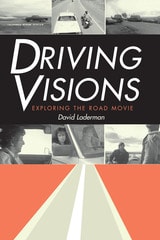
Driving Visions
Exploring the Road MovieBy David Laderman
University of Texas Press, 2002
From the visionary rebellion of Easy Rider to the reinvention of home in The Straight Story, the road movie has emerged as a significant film genre since the late 1960s, able to cut across a wide variety of film styles and contexts. Yet, within the variety, a certain generic core remains constant: the journey as cultural critique, as exploration beyond society and within oneself.
This book traces the generic evolution of the road movie with respect to its diverse presentations, emphasizing it as an "independent genre" that attempts to incorporate marginality and subversion on many levels. David Laderman begins by identifying the road movie's defining features and by establishing the literary, classical Hollywood, and 1950s highway culture antecedents that formatively influenced it. He then traces the historical and aesthetic evolution of the road movie decade by decade through detailed and lively discussions of key films. Laderman concludes with a look at the European road movie, from the late 1950s auteurs through Godard and Wenders, and at compelling feminist road movies of the 1980s and 1990s.
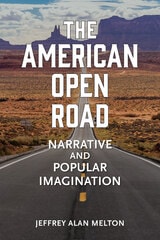
The American Open Road
Narrative and Popular ImaginationJeffrey Alan Melton
University of Alabama Press, 2025
WINNER OF THE ELIZABETH AGEE PRIZE IN AMERICAN LITERATURE
The rearview mirror perspective of a road trip across the American “open road.”
The American Open Road: Narrative and Popular Imagination offers a rich exploration of how the mythos of the open road has shaped, and been shaped by, American culture. Beginning with the post–World War II boom that solidified car culture as central to American life, Melton reflects on how roads, automobiles, and landscapes have been represented in literature, film, and other cultural texts, highlighting the interplay between mobility and narrative.
Drawing on a wide range of cultural texts, from traditional classic road novels and cinematic presentations, to advertisements, poetry, and prose, Melton examines how the open road functions as a symbol of autonomy, reinvention, and resistance. He highlights how road narratives have also exposed deeper tensions in American life—especially around race, gender, and power—and how historically marginalized voices have used the road to reclaim space and tell new stories.
From the romanticism of Route 66 to the political edge of modern road films, The American Open Road offers a thoughtful, engaging analysis of the narratives that continue to define American identity and longing. For readers interested in cultural history, travel literature, or the enduring pull of the highway, this book offers a compelling view from the passenger seat of America’s most iconic journeys.

The Global Road Movie
Alternative Journeys around the WorldEdited by José Duarte and Timothy Corrigan
Intellect Books, 2018
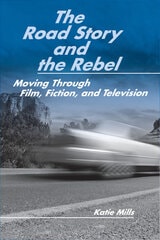
The Road Story and the Rebel
Moving Through Film, Fiction, and TelevisionKatie Mills
Southern Illinois University Press, 2006
In The Road Story and the Rebel: Moving Through Film, Fiction, and Television, Beat studies scholar Katie Mills examines how road stories, which have offered declarations of independence to generations of rebellious Americans, have been transformed by media, technology, and social movements. The genre, which includes literature, films, television shows, and several types of digital media, has evolved, says Mills, as each new generation questions its own identity and embraces the thrill of “automobility” (autonomy and mobility) thus providing audiences a means to consider radically altered notions of independence, even as the genre cycles between innovation and commodification.
This cultural history reveals the unique qualities of road stories and follows the evolution from the Beats’ postwar literary adventures to today’s postmodern reality television shows. Tracing the road story as it moves to both LeRoi Jones’s critique of the Beats’ romanticization of blacks as well as to the mainstream in the 1960s with CBS’s Route 66, Mills also documents the rebel subcultures of novelist Ken Kesey and the Merry Pranksters, who used film and LSD as inspiration on a cross-country bus trip, and she examines the sexualization of male mobility and biker mythology in the films Scorpio Rising,The Wild Angels, and Easy Rider. Mills addresses how the filmmakers of the 1970s—Coppola, Scorsese, and Bogdanovich—flourished in New Hollywood with road films that reflected mainstream audiences and how feminists Joan Didion and Betty Friedan subsequently critiqued them. A new generation of women and minority storytellers gain clout and bring genre remapping to the national consciousness, Mills explains, as the road story evolves from such novels as Song of Solomon to films like Thelma and Louise and television’s Road Rules 2.
The Road Story and the Rebel, which includes twenty illustrations, effectively explores the cultural significance of sixty years of rebellion in film, literature, television, and digital media. Spanning media platforms and marginalized communities, the text offers new interpretations of canonical works and reintroduces forgotten works, revealing the genre to be more political and philosophical than previously understood.