Results by title
3 books match the query 'Robbins, William'
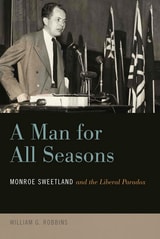
A Man for All Seasons
Monroe Sweetland and the Liberal ParadoxWilliam Robbins
Oregon State University Press, 2015
The life of prominent Oregon political leader Monroe Sweetland spans the spectrum of 20th-century America. Through seven decades, Sweetland experienced the economic collapse of the Great Depression, the unparalleled violence of a nation at war, the divisiveness of Cold War politics, and the cultural and political turmoil of the Vietnam War.
Historian William G. Robbins illuminates the wrenching transformation of American political culture in A Man for All Seasons: Monroe Sweetland and the Liberal Paradox. Racial and economic inequalities motivated much of Sweetland’s civic life, including his lifelong memberships in the American Civil Liberties Committee, the National Association for the Advancement of Colored People, the Urban League, the Japanese American Citizens League, and the Red Cross, where Sweetland worked repatriating American prisoners of war after Japan’s surrender.
Robbins’ portrait is holistic, exploring Sweetland’s socialist beginnings, inconsistencies in his politics—especially during the Cold War—and his regional legacy. He was the most important person in the resurgence of the modern, liberal Oregon Democratic Party from the late 1940s to the 1960s. He joined the National Education Association in 1964 and became the driving force behind the Bilingual Education Act of 1968 and the fight for the age-18 vote, achieved in the ratification of the 26th amendment in 1971. Monroe Sweetland was a nationally prominent figure, whose fights bequeathed to modern America important legislation that shaped its political landscape.
[more]
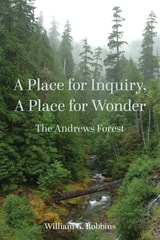
A Place for Inquiry, A Place for Wonder
The Andrews ForestWilliam Robbins
Oregon State University Press, 2020
The H.J. Andrews Experimental Forest is a slice of classic Oregon: due east of Eugene in the Cascade Mountains, it comprises 15,800 acres of the Lookout Creek watershed. The landscape is steep, with hills and deep valleys and cold, fast-running streams. The densely forested landscape includes cedar, hemlock, and moss-draped Douglas fir trees. One of eighty-one USDA experimental forests, the Andrews is administered cooperatively by the US Forest Service, OSU, and the Willamette National Forest. While many Oregonians may think of the Andrews simply as a good place to hike, research on the forest has been internationally acclaimed, has influenced Forest management, and contributed to our understanding of healthy forests.
In A Place for Inquiry, A Place for Wonder, historian William Robbins turns his attention to the long-overlooked Andrews Forest and argues for its importance to environmental science and policy. From its founding in 1948, the experimental forest has been the site of wide-ranging research. Beginning with postwar studies on the conversion of old-growth timber to fast-growing young stands, research at the Andrews shifted in the next few decades to long-term ecosystem investigations that focus on climate, streamflow, water quality, vegetation succession, biogeochemical cycling, and effects of forest management. The Andrews has thus been at the center of a dramatic shift in federal timber practices from industrial, intensive forest management policies to strategies emphasizing biodiversity and healthy ecosystems.
In A Place for Inquiry, A Place for Wonder, historian William Robbins turns his attention to the long-overlooked Andrews Forest and argues for its importance to environmental science and policy. From its founding in 1948, the experimental forest has been the site of wide-ranging research. Beginning with postwar studies on the conversion of old-growth timber to fast-growing young stands, research at the Andrews shifted in the next few decades to long-term ecosystem investigations that focus on climate, streamflow, water quality, vegetation succession, biogeochemical cycling, and effects of forest management. The Andrews has thus been at the center of a dramatic shift in federal timber practices from industrial, intensive forest management policies to strategies emphasizing biodiversity and healthy ecosystems.
[more]
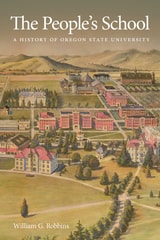
The People's School
A History of Oregon State UniversityWilliam Robbins
Oregon State University Press, 2017
The People’s School is a comprehensive history of Oregon State University, placing the institution’s story in the context of state, regional, national, and international history. Rather than organizing the narrative around institutional presidencies, historian William Robbins examines the broader context of events, such as wars and economic depressions, that affected life on the Corvallis campus. Agrarian revolts in the last quarter of the nineteenth century affected every Western state, including Oregon. The Spanish-American War, the First World War, the Great Depression of the 1930s, and the Second World War disrupted institutional life, influencing enrollment, curricular strategies, and the number of faculty and staff. Peacetime events, such as Oregon’s tax policies, also circumscribed course offerings, hiring and firing, and the allocation of funds to departments, schools, and colleges.
This contextual approach is not to suggest that university presidents are unimportant. Benjamin Arnold (1872-1892), appointed president of Corvallis College by the Methodist Episcopal Church, South, served well beyond the date (1885) when the State of Oregon assumed control of the agricultural college. Robbins uses central administration records and grassroots sources—local and state newspapers, student publications (The Barometer, The Beaver), and multiple and wide-ranging materials published in the university’s digitized ScholarsArchive@OSU, a source for the scholarly work of faculty, students, and materials related to the institution’s mission and research activities. Other voices—extracurricular developments, local and state politics, campus reactions to national crises—provide intriguing and striking addendums to the university’s rich history.
This contextual approach is not to suggest that university presidents are unimportant. Benjamin Arnold (1872-1892), appointed president of Corvallis College by the Methodist Episcopal Church, South, served well beyond the date (1885) when the State of Oregon assumed control of the agricultural college. Robbins uses central administration records and grassroots sources—local and state newspapers, student publications (The Barometer, The Beaver), and multiple and wide-ranging materials published in the university’s digitized ScholarsArchive@OSU, a source for the scholarly work of faculty, students, and materials related to the institution’s mission and research activities. Other voices—extracurricular developments, local and state politics, campus reactions to national crises—provide intriguing and striking addendums to the university’s rich history.
[more]