Results by title
4 books match the query 'Robert Frost'
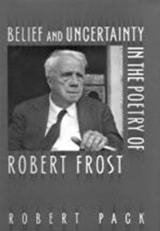
Belief and Uncertainty in the Poetry of Robert Frost
Robert Pack
University Press of New England, 2004
Robert Pack’s lifelong delight in Robert Frost's intricate, beautiful, and profound poetry shines through in the essays in this book. He confronts such broad themes as mourning, inheritance, nature, and the imagination, bringing to bear historical, psychological, Darwinian, and close-textual-reading interpretive approaches. Chapter one sets Frost’s work in the tradition of nature writing, from the Book of Genesis through modern American ecological works. Chapter two examines the profound influences of the Book of Job, Darwin, and evolutionary theory on Frost’s thinking. There follow chapters that structurally and philosophically compare Wordsworth’s “Michael” to Frost’s “Wild Grapes,” focusing on the themes of inheritance, grieving, and the potency of the imagination. The reader encounters Frost as teacher and preacher, Frost’s idea of how beliefs are affirmed, the simultaneous representation of adult memory and immediate childhood sensation, and the underlying duality of place and nothingness, which forms the existential background for his “stay against confusion”—the consoling purpose of Frost's poetic art.
[more]
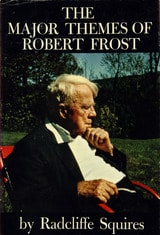
Major Themes of Robert Frost
Radcliffe Squires
University of Michigan Press, 1963
Poet, philosopher, and ambassador of culture Robert Frost has achieved a unique position in the history of American literature. His life has spanned the violent and war-torn years of the 20th century, yet his poetry is dominated by a belief in man’s sacred duty to endure. Like Emerson, Thoreau, and Dickinson, he has transcended regionalism to become a major American writer. Frost's passion for individuality has marked all great poets from Shakespeare and Keats to Dylan Thomas. He has refused to be seduced by passing literary fashions. In an age of literary dogmas, he stands alone, and his integrity is reflected again and again by his poetry. Today, recognition of Frost's work is worldwide. He is the first poet ever to have participated in the inauguration of an American president, and he toured Russia as a guest of the Soviet government. His volume of poems, In The Clearing, published during his eighty-eighth year, immediately became a best seller. But few people are aware that Frost was also once a playwright. In The Major Themes of Robert Frost, Radcliffe Squires examines the relatively unknown drama, A Way Out—a work deeply committed to a psychological view of good and evil. He also examines Frost’s important dramatic poem “West-Running Brook,” comparing its theme with philosophical ideas expressed by William James. In these as well as in other works Squires finds those qualities—the keen intelligence, the compassion, the honesty — which make Frost one of the most widely read poets in the world.
[more]
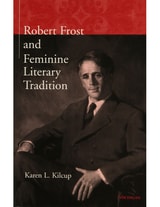
Robert Frost and Feminine Literary Tradition
Karen L. Kilcup
University of Michigan Press, 1998
In spite of Robert Frost's continuing popularity with the public, the poet remains an outsider in the academy, where more "difficult" and "innovative" poets like T. S. Eliot and Ezra Pound are presented as the great American modernists. Robert Frost and Feminine Literary Tradition considers the reason for this disparity, exploring the relationship between notions of popularity, masculinity, and greatness. Karen Kilcup reveals Frost's subtle links with earlier "feminine" traditions like "sentimental" poetry and New England regionalist fiction, traditions fostered by such well-known women precursors and contemporaries as Lydia Sigourney, Sarah Orne Jewett, and Mary E. Wilkins Freeman. She argues that Frost altered and finally obscured these "feminine" voices and values that informed his earlier published work, and that to appreciate his achievement fully, we need to recover and acknowledge the power of his affective, emotional voice in counterpoint and collaboration with his more familiar ironic and humorous tones.Robert Frost and Feminine Literary Tradition also explores the links between cultural femininity and homoeroticism in Frost's work, and investigates the conjunctions and disjunctions between Frost and such modernist women poets as Amy Lowell and Edna St. Vincent Millay. The book contributes to ongoing debates about sentimentalism, regionalism, modernism, and the cultural construction of gender in American literature of the nineteenth and early twentieth centuries. With its interest in popular magazines, folktales, gossip, and children's literature, the book also engages elements of cultural studies and popular culture. "Kilcup demonstrates a remarkably thorough understanding of issues raised by feminist critics over the past few decades. . . . Fascinating and convincing." --Jay Parini, Middlebury College
[more]
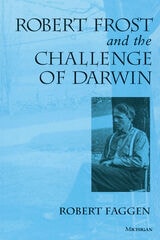
Robert Frost and the Challenge of Darwin
Robert Faggen
University of Michigan Press, 2001
Robert Frost and the Challenge of Darwin gives us a new and compelling portrait of the poet-thinker as a modern Lucretius--moved to examine the questions raised by Darwin, and willing to challenge his readers with the emerging scientific notions of what it meant to be human.
Combining both intellectual history and detailed analysis of Frost's poems, Robert Faggen shows how Frost's reading of Darwin reflected the significance of science in American culture from Emerson and Thoreau, through James and pragmatism. He provides fresh and provocative readings of many of Frost's shorter lyrics and longer pastoral narratives as they illustrate the impact of Darwinian thought on the concept of nature, with particular exploration of man's relationship to other creatures, the conditions of human equality and racial conflict, the impact of gender and sexual differences, and the survival of religion.
The book shows that Frost was neither a pessimist lamenting the uncertainties of the Darwinian worldview, nor a humanist opposing its power. Faggen draws on Frost's unpublished notebooks to reveal a complex thinker who willingly engaged with the difficult moral and epistemological implications of natural science, and showed their consonance with myths and traditions stretching back to Milton, Lucretius, and the Old Testament. Frost emerges as a thinker for whom poetry was not only artistic expression, but also a forum for the trial of ideas and their impact on humanity.
Robert Frost and the Challenge of Darwin provides a deeper understanding not only of Frost and modern poetry, but of the meaning of Darwin in the modern world, the complex interrelations of literature and science, and the history of American thought.
"A forceful, appealing study of the Frost-Darwin relation, which has gone little noted by previous scholars, and a fresh explanation of Frost's ambivalent relation to modernism, which he scorned but also influenced" --William Howarth, Princeton University
Robert Faggen is Associate Professor of Literature, Claremont McKenna College and Adjunct Associate Professor, Claremont Graduate School.
[more]