Results by title
6 books match the query 'Roberts-Miller, Patricia'
Deliberate Conflict
Argument, Political Theory, and Composition ClassesPatricia Roberts-Miller
Southern Illinois University Press, 2004
In Deliberate Conflict: Argument, Political Theory, and Composition Classes, Patricia Roberts-Miller argues that much current discourse about argument pedagogy is hampered by fundamental unspoken disagreements over what democratic public discourse should look like. The book’s pivotal question is, In what kind of public discourse do we want our students to engage? To answer this, the text provides a taxonomy, discussion, and evaluation of political theories that underpin democratic discourse, highlighting the relationship between various models of the public sphere and rhetorical theory.
Deliberate Conflict cogently advocates reintegrating instruction in argumentation with the composition curriculum. By linking effective argumentation in the public sphere with the ability to effect social change, Roberts-Miller pushes compositionists beyond a simplistic Aristotelian conception of how argumentation works and offers a means by which to prepare students for active participation in public discourse.
Fanatical Schemes
Proslavery Rhetoric and the Tragedy of ConsensusPatricia Roberts-Miller
University of Alabama Press, 2009
Rhetoric and Demagoguery
Patricia Roberts-Miller
Southern Illinois University Press, 2019
In a culture of profit-driven media, demagoguery is a savvy short-term rhetorical strategy. Once it becomes the norm, individuals are more likely to employ it and, in that way, increase its power by making it seem the only way of disagreeing with or about others. When that happens, arguments about policy are replaced by arguments about identity—and criticism is met with accusations that the critic has the wrong identity (weak, treacherous, membership in an out-group) or the wrong feelings (uncaring, heartless).
Patricia Roberts-Miller proposes a definition of demagoguery based on her study of groups and cultures that have talked themselves into disastrously bad decisions. She argues for seeing demagoguery as a way for people to participate in public discourse, and not necessarily as populist or heavily emotional. Demagoguery, she contends, depoliticizes political argument by making all issues into questions of identity. She broaches complicated questions about its effectiveness at persuasion, proposes a new set of criteria, and shows how demagoguery plays out in regard to individuals not conventionally seen as demagogues.
Roberts-Miller looks at the discursive similarities among the Holocaust in early twentieth-century Germany, the justification of slavery in the antebellum South, the internment of Japanese Americans in the United States during World War II, and the U.S.-led invasion of Iraq in 2003, among others. She examines demagoguery among powerful politicians and jurists (Earl Warren, chief justice of the U.S. Supreme Court) as well as more conventional populists (Theodore Bilbo, two-time governor of Mississippi; E. S. Cox, cofounder of the Anglo-Saxon Clubs of America). She also looks at notorious demagogues (Athenian rhetor Cleon, Ann Coulter) and lesser-known public figures (William Hak-Shing Tam, Gene Simmons).
Rhetoric and Religion in the Twenty-First Century
Pluralism in a Postsecular AgeEdited by Michael-John DePalma, Paul Lynch, and Jeff Ringer
Southern Illinois University Press, 2023
Expanding the scope of religious rhetoric
Over the past twenty-five years, the intersection of rhetoric and religion has become one of the most dynamic areas of inquiry in rhetoric and writing studies. One of few volumes to include multiple traditions in one conversation, Rhetoric and Religion in the Twenty-First Century engages with religious discourses and issues that continue to shape public life in the United States.
This collection of essays centralizes the study of religious persuasion and pluralism, considers religion’s place in U.S. society, and expands the study of rhetoric and religion in generative ways. The volume showcases a wide range of religious traditions and challenges the very concepts of rhetoric and religion. The book’s eight essays explore African American, Buddhist, Christian, Indigenous, Islamic, and Jewish rhetoric and discuss the intersection of religion with feminism, race, and queer rhetoric—along with offering reflections on how to approach religious traditions through research and teaching. In addition, the volume includes seven short interludes in which some of the field’s most accomplished scholars recount their experiences exploring religious rhetorics and invite readers to engage these exigent lines of inquiry.
By featuring these diverse religious perspectives, Rhetoric and Religion in the Twenty-First Century complicates the field’s emphasis on Western, Hellenistic, and Christian ideologies. The collection also offers teachers of writing and rhetoric a range of valuable approaches for preparing today’s students for public citizenship in our religiously diverse global context.
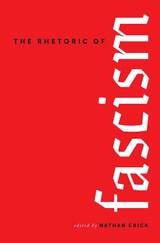
The Rhetoric of Fascism
Edited by Nathan Crick
University of Alabama Press, 2022
Decoding the discourse: Rhetorical foundations of authoritarian power.
Fascism has resurfaced as one of the most pressing problems of our time. The rise of extremist parties and candidates in Europe, the United States, and around the globe has led even mainstream political commentators to begin using the term “fascism” to describe dangerous movements that have revived and repackaged many of the strategies long thought to have been relegated to the margins of political rhetoric. No longer just confined to the state regimes of the past, fascism thrives today as a globally self-augmenting, self-propagating rhetorical phenomenon with a variety of faces and expressions.
The Rhetoric of Fascism defines and interprets the common persuasive devices that characterize fascist discourse to understand the nature of its enduring appeal. By approaching fascism from a rhetorical perspective, this volume complements established political and sociological understandings of fascism as a movement or regime. A rhetorical approach studies fascism less as a party one joins than as a set of persuasive strategies one adopts. Fascism spreads precisely because it is not a coherent entity. Instead, it exists as a loosely bound and often contradictory collection of persuasive trajectories that have attained enough coherence to mobilize and channel the passions of a self-constituted mass of individuals.
Introductory chapters focus on general theories of fascism drawn from twentieth-century history and theory. Contributors investigate specific historical figures and their relationship to contemporary rhetorics, focusing on a specific rhetorical device that is characteristic of fascist rhetoric. A common thread throughout every chapter is that fascist devices are appealing because they speak to us in the familiar language of our culture. As we are seduced by one device at a time, we soon find ourselves part of a movement, a group, or a campaign that makes us act in ways we might never have imagined. This volume reveals that fascism may be closer to home than we think.
CONTRIBUTORS
Patrick D. Anderson / Rya Butterfield / Nathan Crick / Elizabeth R. Earle / Zac Gershberg / Stephen J. Hartnett / Marie-Odile N. Hobeika / Sean Illing / Jacob A. Miller / Fernando Ismael Quiñones Valdivia / Patricia Roberts-Miller / Raquel M. Robvais / Bradley A. Serber / Ryan Skinnell
Voices in the Wilderness
Public Discourse and the Paradox of Puritan RhetoricPatricia Roberts-Miller
University of Alabama Press, 1999
Both Jürgen Habermas and Wayne Booth—two of the most influential theorists in the domain of public discourse and good citizenry—argue for an inclusive public deliberation that involves people who are willing to listen to one another, to identify points of agreement and disagreement, and to make good faith attempts to validate any disputed claims. The Puritan voice crying in the wilderness, Roberts-Miller shows, does none of these things. To this individual of conscience engaged in a ceaseless battle of right and wrong against greedy philistines, all inclusion, mediation, and reciprocity are seen as evil, corrupting, and unnecessary. Hence, the voice in the wilderness does not in any real sense participate in public deliberation, only in public pronouncement.
Arguing that our culture’s continuing affection for the ethos of the voice crying in the wilderness is one of our more troubling inheritances from the early American ambivalence to public discourse—including the Puritan denigration of rhetoric—Roberts-Miller contends that the monologic discourse of the Puritans in fact contains within it arguments for dialogism. Thus, the history of rhetoric can provide much richer fields for reimagining discourse than heretofore credited. Roberts-Miller concludes by extending her findings into their practical applications for argumentation in the public sphere and in the composition classroom.