Results by title
2 books match the query 'Robinson, Edward J.'
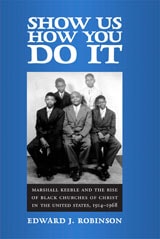
Show Us How You Do It
Marshall Keeble and the Rise of Black Churches of Christ in the United States, 1914-1968Edward J. Robinson
University of Alabama Press, 2008
Marshall Keeble (1878–1968) was the premier evangelist in black Churches of Christ from 1931 until his death in 1968. Born and reared in middle Tennessee, Keeble came under the influence of Preston Taylor, Samuel Womack, and Alexander Campbell, as well as the social influence of Booker T. Washington. In 1914, Keeble committed himself to full-time evangelism and by the 1920s had established himself as a noteworthy preacher. By the time of his death, he reportedly had baptized 40,000 people and had established more than 200 congregations, some of which still flourish today. Show Us How You Do It is the first critical study of Keeble and his evangelical career.
Based on primary sources, Edward Robinson reconstructs the life, public ministry, missionary activities, and the reception of Keeble among Churches of Christ. He also explores Keeble’s relationship with white businessmen and how he secured white support in establishing a large fellowship of African American Churches of Christ in the South. Show Us How You Do It details Keeble’s theology, ethos, and polemics toward other churches. Robinson demonstrates Keeble’s legacy in the labor of his African American co-workers and of the students who attended Nashville Christian Institute.
Of the approximately 2.5 million members of the Churches of Christ in the U.S., an estimated 10 percent are African-Americans, and many in this fellowship can trace their affiliation to Keeble and to those whom he trained.
[more]
To Save My Race from Abuse
The Life of Samuel Robert CassiusEdward J. Robinson
University of Alabama Press, 2009
The story of a fascinating and important figure in black American religious history
Samuel Robert Cassius was born to a slave mother and a white father in Virginia in 1853 and became a member of the Restorationist Movement (Disciples of Christ) while a coal miner in Indiana. For the rest of his long life (he died in 1931 at age 78), Cassius was an active evangelist, prolific publicist, dedicated leader of black Disciples, and an outspoken and uncompromising opponent of racism in religion and society.
An indefatigable preacher, Cassius ranged throughout the Midwest, California, and the southwestern states, founding and encouraging black Stone-Campbell Restorationist congregations. After entering the Oklahoma Territory in 1891, he worked for three decades as an educator, newspaper editor, social activist, postmaster, and Justice of the Peace. Because he consistently incorporated social and racial issues into his religious writings, Cassius often found himself at odds with whites in the Stone-Campbell Movement, the very people he relied on for monetary support. He advocated a Booker T. Washington-style self-help ethos while at the same time firmly resisting racism wherever he encountered it. Largely invisible in a world dominated by such towering figures as Washington, Frederick Douglass, Ida B. Wells, and W. E. B. DuBois, Cassius lived a life of virtual obscurity beyond the circle of the Stone-Campbell Movement. His story is important because, as a racial militant and separatist, he presaged the schism that would engulf and fracture the Churches of Christ in the 1960s, when blacks and whites went their separate ways and formed two distinct groups in one religious fellowship.
By combing through a plethora of primary sources that Cassius left behind in both religious and nonreligious journals, Edward J. Robinson has successfully reconstructed and recaptured the essence of Cassius’ complex and extraordinary life. This book offers the first full-length study of a man of remarkable attainment despite daily obstacles and resistance.
[more]