Results by title
2 books match the query 'Robinson, Todd E'
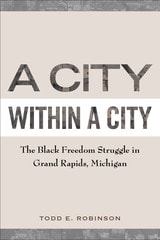
A City within a City
The Black Freedom Struggle in Grand Rapids, MichiganTodd E Robinson
Temple University Press, 2012
A City within a City cogently argues that the post-war political reform championed by local Republicans transformed the city's racial geography, creating a racialized "city within a city," featuring a system of "managerial racism" designed to keep blacks in declining inner-city areas. As Robinson indicates, this bold, provocative framework for understanding race relations in Grand Rapids has broader implications for illuminating the twentieth-century African American urban experience in secondary cities.
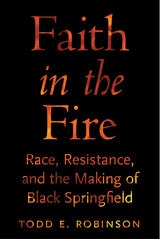
Faith in the Fire
Race, Resistance, and the Making of Black SpringfieldTodd E. Robinson
University of Massachusetts Press, 2027
An intimate history that puts the Black church at the heart of New England’s struggle with race, power, and belonging
On the eve of Barack Obama’s historic election in 2008, the Macedonia Church of God in Christ in Springfield, Massachusetts—a church built by historian Todd E. Robinson’s family—was set ablaze in an act of racial terror. This devastating event echoes a long history of attacks on Black churches, institutions that have served as vital centers of faith, civic life, and community organization.
In Faith in the Fire, Robinson charts the evolution of Springfield’s Black community from its seventeenth-century beginnings through the Great Migration and into the twenty-first century. Centering the Black church, he demonstrates how African Americans shaped the city’s industrial, cultural, and civic landscape, building social networks and organizations that became enduring anchors of community life. From the League of Gileadites, an all-Black armed anti-slavery militia, to twentieth-century initiatives like the Springfield Plan—a pioneering but short-lived experiment in interracial education—Robinson uncovers the city’s deep history of Black resistance to white supremacy. In doing so, he exposes the limits of New England’s mythic racial tolerance. Racial violence, police brutality, economic inequality, educational disparities, and housing segregation, Robinson argues, are not aberrations of the South but also enduring features of Northern life and culture.
Drawing on extensive archival research and his own family’s experience, Robinson offers a powerful and deeply personal narrative that links past and present. Through the intertwined story of Springfield’s Black community and the destruction of one of its most cherished institutions, he illuminates how the long struggle for freedom, justice, and belonging continues to shape the life of Black Americans and the nation as a whole.