Results by title
16 books match the query 'Robots'

Androids in the Enlightenment
Mechanics, Artisans, and Cultures of the SelfAdelheid Voskuhl
University of Chicago Press, 2013
Fault Diagnosis and Fault-Tolerant Control of Robotic and Autonomous Systems
Andrea Monteriù
The Institution of Engineering and Technology, 2020
Flexible Robot Manipulators
Modelling, simulation and controlM. Osman Tokhi
The Institution of Engineering and Technology, 2008
Human Programming
Brainwashing, Automatons, and American UnfreedomScott Selisker
University of Minnesota Press, 2016
Do our ways of talking about contemporary terrorism have a history in the science, technology, and culture of the Cold War? Human Programming explores this history in a groundbreaking work that draws connections across decades and throughout American culture, high and low. Scott Selisker argues that literary, cinematic, and scientific representations of the programmed mind have long shaped conversations in U.S. political culture about freedom and unfreedom, and about democracy and its enemies.
Selisker demonstrates how American conceptions of freedom and of humanity have changed in tandem with developments in science and technology, including media technology, cybernetics, behaviorist psychology, and sociology. Since World War II, propagandists, scientists, and creative artists have adapted visions of human programmability as they sought to imagine the psychological manipulation and institutional controls that could produce the inscrutable subjects of totalitarian states, cults, and terrorist cells. At the same time, writers across the political spectrum reimagined ideals of American freedom, democracy, and diversity by way of contrast with these posthuman specters of mental unfreedom. Images of such “human automatons” circulated in popular films, trials, travelogues, and the news media, giving form to the nebulous enemies of the postwar and contemporary United States: totalitarianism, communism, total institutions, cult extremism, and fundamentalist terrorism.
Ranging from discussions of The Manchurian Candidate and cyberpunk science fiction to the cases of Patty Hearst and the “American Taliban” John Walker Lindh, Human Programming opens new ways of understanding the intertwined roles of literature, film, science, and technology in American culture.
Language and Learning for Robots
Colleen Crangle and Patrick Suppes
CSLI, 1994
The authors develop the notion of an instructable robot—one which derives its intelligence in part from interaction with humans. Since verbal interaction with a robot requires a natural language semantics, the authors propose a natural-model semantics which they then apply to the interpretation of robot commands. Two experimental projects are described which provide natural-language interfaces to robotic aids for the physically disabled. The authors discuss the specific challenges posed by the interpretation of "stop" commands and the interpretation of spatial prepositions.
The authors also examine the use of explicit verbal instruction to teach a robot new procedures, propose ways a robot can learn from corrective commands containing qualitative spatial expressions, and discuss the machine-learning of a natural language use to instruct a robot in the performance of simple physical tasks. Two chapters focus on probabilistic techniques in learning.

Machine Dreams
Race, Robots, and the Asian American BodyMargaret Rhee
Duke University Press, 2027
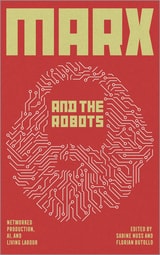
Marx and the Robots
Networked Production, AI, and Human LabourFlorian Butollo
Pluto Press, 2022
It covers a broad range of digital aspects now proliferating across our work and lives, including chapters on the digitalization of agriculture, robotics in the factory and the labor process on crowdworking platforms. It looks to how 20th century Marxist predictions of the 'workerless factory' are, or are not, coming true, and how 'Platform Capitalism' should be understood and critiqued.
Through rich empirical, theoretical and historical material, this book is necessary reading for those wanting a clear overview of our digital world.
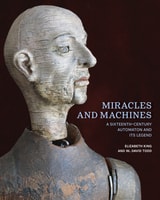
Miracles and Machines
A Sixteenth-Century Automaton and Its LegendElizabeth King
J. Paul Getty Trust, The, 0
This volume tells the singular story of an uncanny, rare object at the cusp of art and science: a 450-year-old automaton known as “the monk.” The walking, gesticulating figure of a friar, in the collection of the Smithsonian Institution’s National Museum of American History, is among the earliest extant ancestors of the self-propelled robot. According to legend connected to the court of Philip II of Spain, the monk represents a portrait of Diego de Alcalá, a humble Franciscan lay brother whose holy corpse was said to be agent to the miraculous cure of Spain’s crown prince as he lay dying in 1562.
In tracking the origins of the monk and its legend, the authors visited archives, libraries, and museums across the United States and Europe, probing the paradox of a mechanical object performing an apparently spiritual act. They identified seven kindred automata from the same period, which, they argue, form a paradigmatic class of walking “prime movers,” unprecedented in their combination of visual and functional realism. While most of the literature on automata focuses on the Enlightenment, this enthralling narrative journeys back to the late Renaissance, when clockwork machinery was entirely new, foretelling the evolution of artificial life to come.

More-than-Human Aging
Animals, Robots, and Care in Later LifeCristina Douglas
Rutgers University Press, 2025

Robots and Automated Manufacture
J. Billingsley
The Institution of Engineering and Technology, 1985
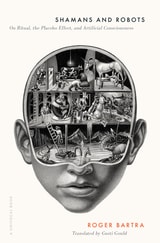
Shamans and Robots
On Ritual, the Placebo Effect, and Artificial ConsciousnessRoger Bartra
University of Minnesota Press, 2024
A profound exploration of the external influences that shape human consciousness, from healing rituals to digital devices
In this voyage through thousands of years of psychosomatic healing, distinguished anthropologist and sociologist Roger Bartra examines the placebo effect as a key to our understanding of human consciousness. Shamans and Robots demonstrates how biology and technology become intertwined within human culture by using the various histories of ritual and symbolic healing to speculate about future developments in artificial intelligence.
Charting the extensive history of the placebo effect through medieval healing, shamanism, and early psychoanalytic practices, Bartra posits that consciousness is not simply the province of the mind but something equally shaped by external systems and objects. He finds evidence of this “exocerebrum”—the extension of our brains outside the body—in the shamanistic concept of the placebo, in which external objects heal our bodies, and in modern technical devices like prostheses or robots, whose development of a mechanical consciousness would have to mimic, and in turn elucidate, the processes involved in the creation of consciousness in humans. Through this radical concept, he analyzes digital media’s relationship to the functions of the human brain and probes the possibility of artificial consciousness.
Both a look at the human body’s potential to restore itself and a profound reflection on the curative power of symbolic structures, Shamans and Robots explores how our technologies increasingly serve as extensions of our cognitive selves.
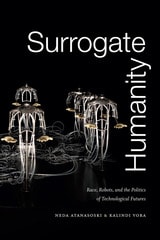
Surrogate Humanity
Race, Robots, and the Politics of Technological FuturesNeda Atanasoski and Kalindi Vora
Duke University Press, 2019
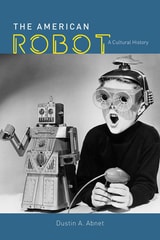
The American Robot
A Cultural HistoryDustin A. Abnet
University of Chicago Press, 2020
In tracing the history of the idea of robots in US culture, Abnet draws on intellectual history, religion, literature, film, and television. He explores how robots and their many kin have not only conceptually connected but literally embodied some of the most critical questions in modern culture. He also investigates how the discourse around robots has reinforced social and economic inequalities, as well as fantasies of mass domination—chilling thoughts that the recent increase in job automation has done little to quell. The American Robot argues that the deep history of robots has abetted both the literal replacement of humans by machines and the figurative transformation of humans into machines, connecting advances in technology and capitalism to individual and societal change. Look beneath the fears that fracture our society, Abnet tells us, and you’re likely to find a robot lurking there.
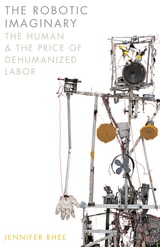
The Robotic Imaginary
The Human and the Price of Dehumanized LaborJennifer Rhee
University of Minnesota Press, 2018
Tracing the connections between human-like robots and AI at the site of dehumanization and exploited labor
The word robot—introduced in Karel Čapek’s 1920 play R.U.R.—derives from rabota, the Czech word for servitude or forced labor. A century later, the play’s dystopian themes of dehumanization and exploited labor are being played out in factories, workplaces, and battlefields. In The Robotic Imaginary, Jennifer Rhee traces the provocative and productive connections of contemporary robots in technology, film, art, and literature. Centered around the twinned processes of anthropomorphization and dehumanization, she analyzes the coevolution of cultural and technological robots and artificial intelligence, arguing that it is through the conceptualization of the human and, more important, the dehumanized that these multiple spheres affect and transform each other.
Drawing on the writings of Alan Turing, Sara Ahmed, and Arlie Russell Hochschild; such films and novels as Her and The Stepford Wives; technologies like Kismet (the pioneering “emotional robot”); and contemporary drone art, this book explores anthropomorphic paradigms in robot design and imagery in ways that often challenge the very grounds on which those paradigms operate in robotics labs and industry. From disembodied, conversational AI and its entanglement with care labor; embodied mobile robots as they intersect with domestic labor; emotional robots impacting affective labor; and armed military drones and artistic responses to drone warfare, The Robotic Imaginary ultimately reveals how the human is made knowable through the design of and discourse on humanoid robots that are, paradoxically, dehumanized.
Transparency for Robots and Autonomous Systems
Fundamentals, technologies and applicationsRobert H. Wortham
The Institution of Engineering and Technology, 2020