Results by title
101 books match the query 'Rock' and 6 start with a
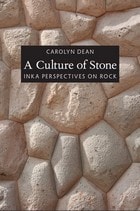
A Culture of Stone
Inka Perspectives on RockCarolyn Dean
Duke University Press, 2010
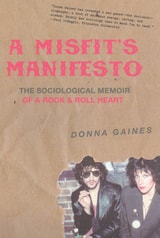
A Misfit's Manifesto
The Sociological Memoir of a Rock & Roll HeartGaines, Donna
Rutgers University Press, 2007
Dubbed the Margaret Mead of heavy metal, Donna Gaines is a walking, talking oxymoron, a turnpike intellectual. A Misfit's Manifesto is the story of her wild-in-the-burbs odyssey-from overweight yeshiva girl to savvy street-punk sociologist. Isolated, angry, and depressed through most of her adolescence and early adulthood, she found truth and beauty in the least likely places. Wandering the craggy terrain of Rockaway Beach, Queens, Gaines embarked upon a path to enlightenment involving sex, drugs, rock & roll, sociology, cosmetology, True Love, the occult, tattoos, science fiction, pizza, guns, comic books, and surfing-by Web and by sea.
For Gaines, dignity, joy, and communion came not from family, organized religion, or mandatory schooling, but in the sound of doo-wop, surf music, acid rock, then punk, trash metal, and hardcore. "For most of my life," she writes, "music was the only way to connect that wouldn't eventually kill me."
Through all the ripped nights of binge-drinking, pill-popping, and nightclubbing, Gaines became an acclaimed author, scholar, and expert on teen suicide. In an age of conformity and censorship, she defends popular culture as a powerful spiritual force-a vibrant, valid connection to God. A meditation on alienation and engagement, this memoir is an outcast's journey into the black-hole sun, where Divine love and light are found-even in Ramones songs.
This edition includes a scholarly introduction that considers memoir as a sociological as well as literary genre, as a reflexive means of understanding the self in social context while nurturing a sociological imagination. Social memoir, Gaines argues, illuminates problems like alienation, marginality, addiction, and suicide, while making sociology more user-friendly and public. Now this work of dazzling originality and iconoclasm that has inspired misfits everywhere is an ideal text for classroom use, making complex social theory exciting, timely, and relevant for students.
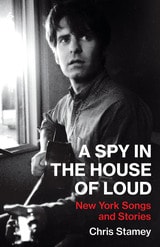
A Spy in the House of Loud
New York Songs and StoriesBy Chris Stamey
University of Texas Press, 2018
Popular music was in a creative upheaval in the late 1970s. As the singer-songwriter and producer Chris Stamey remembers, “the old guard had become bloated, cartoonish, and widely co-opted by a search for maximum corporate profits, and we wanted none of it.” In A Spy in the House of Loud, he takes us back to the auteur explosion happening in New York clubs such as the Bowery’s CBGB as Television, Talking Heads, R.E.M., and other innovative bands were rewriting the rules. Just twenty-two years old and newly arrived from North Carolina, Stamey immersed himself in the action, playing a year with Alex Chilton before forming the dB’s and recording the albums Stands for deciBels and Repercussion, which still have an enthusiastic following.
A Spy in the House of Loud vividly captures the energy that drove the music scene as arena rock gave way to punk and other new streams of electric music. Stamey tells engrossing backstories about creating in the recording studio, describing both the inspiration and the harmonic decisions behind many of his compositions, as well as providing insights into other people’s music and the process of songwriting. Photos, mixer-channel and track assignment notes, and other inside-the-studio materials illustrate the stories. Revealing another side of the CBGB era, which has been stereotyped as punk rock, safety pins, and provocation, A Spy in the House of Loud portrays a southern artist’s coming-of-age in New York’s frontier abandon as he searches for new ways to break the rules and make some noise.
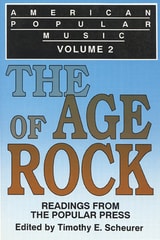
American Popular Music
Readings From the Popular Press Volume 2: The Age of RockTimothy E. Scheurer
University of Wisconsin Press, 1989
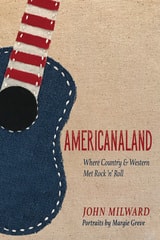
Americanaland
Where Country & Western Met Rock 'n' RollJohn Milward
University of Illinois Press, 2021
With a claim on artists from Jimmie Rodgers to Jason Isbell, Americana can be hard to define, but you know it when you hear it. John Milward’s Americanaland is filled with the enduring performers and vivid stories that are at the heart of Americana. At base a hybrid of rock and country, Americana is also infused with folk, blues, R&B, bluegrass, and other types of roots music. Performers like Bob Dylan, Johnny Cash, Ray Charles, and Gram Parsons used these ingredients to create influential music that took well-established genres down exciting new roads. The name Americana was coined in the 1990s to describe similarly inclined artists like Emmylou Harris, Steve Earle, and Wilco. Today, Brandi Carlile and I’m With Her are among the musicians carrying the genre into the twenty-first century.
Essential and engaging, Americanaland chronicles the evolution and resonance of this ever-changing amalgam of American music. Margie Greve’s hand-embroidered color portraits offer a portfolio of the pioneers and contemporary practitioners of Americana.
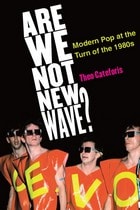
Are We Not New Wave?
Modern Pop at the Turn of the 1980sTheo Cateforis
University of Michigan Press, 2011
“Are We Not New Wave? is destined to become the definitive study of new wave music.”
—Mark Spicer, coeditor of Sounding Out Pop
New wave emerged at the turn of the 1980s as a pop music movement cast in the image of punk rock’s sneering demeanor, yet rendered more accessible and sophisticated. Artists such as the Cars, Devo, the Talking Heads, and the Human League leapt into the Top 40 with a novel sound that broke with the staid rock clichés of the 1970s and pointed the way to a more modern pop style.
In Are We Not New Wave? Theo Cateforis provides the first musical and cultural history of the new wave movement, charting its rise out of mid-1970s punk to its ubiquitous early 1980s MTV presence and downfall in the mid-1980s. The book also explores the meanings behind the music’s distinctive traits—its characteristic whiteness and nervousness; its playful irony, electronic melodies, and crossover experimentations. Cateforis traces new wave’s modern sensibilities back to the space-age consumer culture of the late 1950s/early 1960s.
Three decades after its rise and fall, new wave’s influence looms large over the contemporary pop scene, recycled and celebrated not only in reunion tours, VH1 nostalgia specials, and “80s night” dance clubs but in the music of artists as diverse as Rihanna, Lady Gaga, Miley Cyrus, and the Killers.