Results by title
3 books match the query 'Rock films'
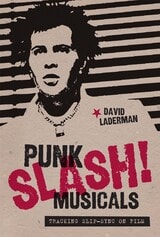
Punk Slash! Musicals
Tracking Slip-Sync on FilmBy David Laderman
University of Texas Press, 2010
Punk Slash! Musicals is the first book to deal extensively with punk narrative films, specifically British and American punk rock musicals produced from roughly 1978 to 1986. Films such as Jubilee, Breaking Glass, Times Square, Smithereens, Starstruck, and Sid and Nancy represent a convergence between independent, subversive cinema and formulaic classical Hollywood and pop musical genres.
Guiding this project is the concept of "slip-sync." Riffing on the commonplace lip-sync phenomenon, "slip-sync" refers to moments in the films when the punk performer "slips" out of sync with the performance spectacle, and sometimes the sound track itself, engendering a provocative moment of tension. This tension frequently serves to illustrate other thematic and narrative conflicts, central among these being the punk negotiation between authenticity and inauthenticity.
Laderman emphasizes the strong female lead performer at the center of most of these films, as well as each film's engagement with gender and race issues. Additionally, he situates his analyses in relation to the broader cultural and political context of the neo-conservatism and new electronic audio-visual technologies of the 1980s, showing how punk's revolution against the mainstream actually depends upon a certain ironic embrace of pop culture.

Rock 'n' Roll Movies
Sterritt, David
Rutgers University Press, 2018
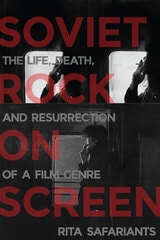
Soviet Rock on Screen
The Life, Death, and Resurrection of a Film GenreRita Safariants
University of Wisconsin Press, 2026
In Soviet Rock on Screen, Rita Safariants chronicles the birth, life, death, and resurrection of a genre that rapidly became one of the most readily recognized cultural signifiers of the perestroika era and which continues to reflect and codify Russian culture. During their initial heyday in the 1980s, rock films were influenced by and encouraged the cultural shifts of perestroika and the incipient political storm. Today, Safariants argues, the reemergence and reconfiguration of the genre indicates the extent to which Soviet-era cultural emblems inform Russian national identity and obliquely support the current political repression under Putin.