Results by title
13 books match the query 'Rocky Mountains'
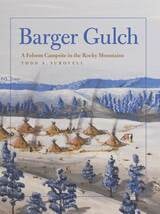
Barger Gulch
A Folsom Campsite in the Rocky MountainsTodd A. Surovell
University of Arizona Press, 2022
The best archaeological sites are those that present problems and inspire research, writes Surovell. From the start, the Folsom site called Barger Gulch Locality B was one of those sites; it was a problem-rich environment. Many Folsom sites are sparse scatters of stone and bone, a reflection of a mobile lifestyle that leaves little archaeological materials. The people at Barger Gulch left behind tens of thousands of pieces of chipped stone; they appeared to have spent quite a bit of time there in comparison to other places they inhabited.
Summarizing findings from nine seasons of excavations, Surovell explains that the site represents a congregation of mobile hunter-gatherers who spent winter along Barger Gulch, a tributary of the Colorado River. Surovell uses spatial patterns in chipped stone to infer the locations of hearths and house features. He examines the organization of household interiors and discusses differential use of interior and exterior spaces. Data allow inference about the people who lived at the site, including aspects of the identity of flintknappers and household versus group mobility. The site shows evidence of a Paleoindian camp circle, child flintknapping, household production of weaponry, and the fission/fusion dynamics of group composition that is typical of nomadic peoples.
Barger Gulch provides key findings on Paleoindian technological variation and spatial and social organization.
Between Urban and Wild
Reflections from ColoradoAndrea M. Jones
University of Iowa Press, 2013
Although not intended as a manual for landowners, Between Urban and Wild nonetheless offers useful and engaging perspectives on the realities of settling and living in a partially wild environment. Throughout her ongoing journey of being home, Jones’s close observations of the land and its native inhabitants are paired with the suggestion that even small landholders can act to protect the health of their properties. Her brief meditations capture and honor the subtleties of the natural world while illuminating the importance of working to safeguard it.
Probing the contradictions of a lifestyle that burdens the health of the land that she loves, Jones’s writing is permeated by her gentle, earnest conviction that living at the urban-wild interface requires us to set aside self-interest, consider compromise, and adjust our expectations and habits—to accommodate our surroundings rather than force them to accommodate us.
Elk in Winter
Robert Pack
University of Chicago Press, 2004
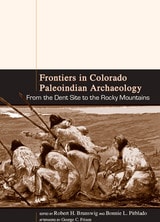
Frontiers in Colorado Paleoindian Archaeology
From the Dent Site to the Rocky MountainsRobert H. Brunswig
University Press of Colorado, 2007
The editors introduce the research with scientific context. A review of seventy-five years of Paleoindian archaeology in Colorado highlights the foundation on which new work builds, and a survey of Colorado's ancient climates and ecologies helps readers understand Paleoindian settlement patterns.
Eight essays discuss archaeological evidence from Plains to high Rocky Mountain sites. The book offers the most thorough analysis to date of Dent--the first Clovis site discovered. Essays on mountain sites show how advances in methodology and technology have allowed scholars to reconstruct settlement patterns and changing lifeways in this challenging environment.
Colorado has been home to key moments in human settlement and in the scientific study of our ancient past. Readers interested in the peopling of the New World as well as those passionate about the methods and history of archaeology will find new material and satisfying overviews in this book. Contributors include Rosa Maria Albert, Robert H. Brunswig, Reid A. Bryson, Linda Scott Cummings, James Doerner, Daniel C. Fisher, David L. Fox, Bonnie L. Pitblado, Jeffrey L. Saunders, Todd A. Surovell, R. A. Varney, and Nicole M. Waguespack.
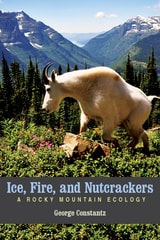
Ice, Fire, and Nutcrackers
A Rocky Mountain EcologyGeorge Constantz
University of Utah Press, 2014
These provocative accounts of birds, insects, rodents, predators, trees, and flowers are sure to stir the reader’s curiosity. Who wouldn’t be intrigued by a rattlesnake’s ability to hunt in total darkness by detecting the infrared radiation emitted by a mouse? Or how white-tailed ptarmigan thrive in their high, treeless alpine environments -- even through the winter? The narratives, often brought home with a counterintuitive twist, invite readers to make new connections and broaden perspectives of a favorite outdoor place.
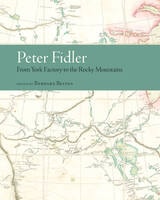
Peter Fidler
From York Factory to the Rocky MountainsBarbara Belyea
University Press of Colorado, 2026
The two journals—“From York Factory to Buckingham House” and “From Buckingham House to the Rocky Mountains”—detail Fidler’s travels over a period of nine months. They include remarks on fur trade history, organization of the inland brigade, three distinct geographical regions, and the daily life of a Plains nation. Belyea’s introduction and ample notes provide insight into the way geographic, specifically cartographic, information was noted in the journals, with additional information on industry trading techniques, traders’ economic decisions, broad changes in regional social and economic conditions, and interactions with indigenous peoples.
Fidler’s journals are an exceptional record of the fur trade’s western expansion and the daily life of a Plains nation at the height of its power and prosperity. With its rich analysis of primary source documents and painstaking reproduction of historical trade routes, Peter Fidler: From York Factory to the Rocky Mountains will be of great value to students and scholars in the fields of fur trade studies, cartography, travel literature, and Canadian history, as well as general readers interested in westward expansion, exploration, commerce, and indigenous-colonial relations.
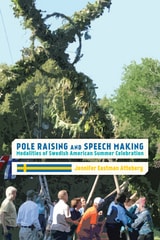
Pole Raising and Speech Making
Modalities of Swedish American Summer CelebrationJennifer Eastman Attebery
Utah State University Press, 2015
In Pole Raising and Speech Making, author Jennifer Eastman Attebery focuses on the beginnings of the traditional Scandinavian Midsummer celebration and the surrounding spring-to-summer seasonal festivities in the Rocky Mountain West during the height of Swedish immigration to the area—1880–1917.
Combining research in folkloristics and history, Attebery explores various ways that immigrants blended traditional Swedish Midsummer-related celebrations with local civic celebrations of American Independence Day on July 4 and the Mormons’ Pioneer Day on July 24. Functioning as multimodal observances with multiple meanings, these holidays represent and reconsider ethnicity and panethnicity, sacred and secular relationships, and the rural and the urban, demonstrating how flexible and complex traditional celebrations can be.
Providing a wealth of detail and information surrounding little-studied celebrations and valuable archival and published primary sources—diaries, letters, speeches, newspaper reports, and images—Pole Raising and Speech Making is proof that non-English immigrant culture must be included when discussing “American” culture. It will be of interest to scholars and graduate students in ethnic studies, folklore, ritual and festival studies, and Scandinavian American cultural history.
Tenderfoot in Colorado
Richard Baxter Townshend
University Press of Colorado, 1968
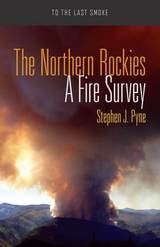
The Northern Rockies
A Fire SurveyStephen J. Pyne
University of Arizona Press, 2016
The Northern Rockies remain one of three major hearths for America’s fire culture. They hold a major fire laboratory, an equipment development center, an aerial fire depot, and a social engagement with fire—even a literature. Missoula is to fire in the big backcountry what Tallahassee is to prescribed burning and what Southern California is to urban-wildland hybrids. On its margins, Boise hosts the National Interagency Fire Center. In this structured collection of essays on the region, Stephen J. Pyne explores what makes the Northern Rockies distinctive and what sets it apart from other regions of the country. Surprisingly, perhaps, the story is equally one of big bureaucracies and of generations that encounter the region’s majestic landscapes through flame.
The Northern Rockies is part of a multivolume series describing the nation’s fire scene region by region. The volumes in To the Last Smoke also cover Florida, the Northern Rockies, the Great Plains, the Southwest, and several other critical fire regions. The series serves as an important punctuation point to Pyne’s 50-year career with wildland fire—both as a firefighter and a fire scholar. These unique surveys of regional pyrogeography are Pyne’s way of “keeping with it to the end,” encompassing the directive from his rookie season to stay with every fire “to the last smoke.”
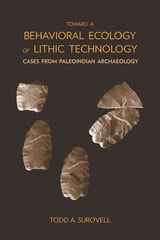
Toward a Behavioral Ecology of Lithic Technology
Cases from Paleoindian ArchaeologyTodd A. Surovell
University of Arizona Press, 2009
Because the fundamental processes of making, using, and discarding stone tools are, at root, exercises in problem solving, Todd Surovell asks what conditions favor certain technological solutions. Whether asking if a biface should be made thick or thin or if a flake should be saved or discarded, Surovell seeks answers that extend beyond a case-by-case analysis. One avenue for addressing these questions theoretically is formal mathematical modeling.
Here Surovell constructs a series of models designed to link environmental variability to human decision making as it pertains to lithic technology. To test the models, Surovell uses data from the analysis of more than 40,000 artifacts from five Rocky Mountain and Northern Plains Folsom and Goshen complex archaeological sites dating to the Younger Dryas stadial (ca. 12,600-11,500 years BP). The primary result is the production of powerful new analytical tools useful to the interpretation of archaeological assemblages.
Surovell's goal is to promote modeling and explore the general issues governing technological decisions. In this light, his models can be applied to any context in which stone tools are made and used.
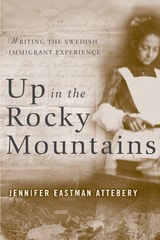
Up in the Rocky Mountains
Writing the Swedish Immigrant ExperienceJennifer Eastman Attebery
University of Minnesota Press, 2007
Before the turn of the twentieth century, many Swedish men emigrated to the American Rockies as itinerant laborers, drawn by the region’s developing industries. Single Swedish women ventured west, too, and whole families migrated, settling into farm communities. By 1920, one-fifth of all Swedish immigrants were living in the West.
In Up in the Rocky Mountains, Jennifer Eastman Attebery offers a new perspective on Swedish immigrants’ experiences in Idaho, Montana, Utah, Wyoming, Colorado, and New Mexico from 1880 to 1917 by interpreting their letters home. Considering more than three hundred letters, Attebery analyzes their storytelling, repetitive language, traditional phrasing, and metaphoric images. Recognizing the letters’ power as a folk form, Attebery sees in them the writers’ relationships back in Sweden as well as their encounters with religious and labor movements, regionalism, and nationalism in their new country.
By defining personal letters as a vernacular genre, Attebery provides a model for discerning immigrants’ shared culture in correspondence collections. By studying their words, she brings to life small Swedish communities throughout the Rocky Mountain region.
Jennifer Eastman Attebery is professor of English and director of American studies at Idaho State University.
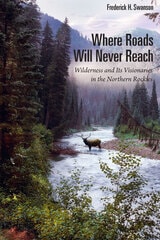
Where Roads Will Never Reach
Wilderness and Its Visionaries in the Northern RockiesFrederick H. Swanson
University of Utah Press, 2015
The Rocky Mountains of Idaho and Montana are home to some of the most important remaining American wilderness areas, preserved because of citizens who stood against massive development schemes that would have diminished important wildlife habitat and the abiding sense of remoteness found in such places. Where Roads Will Never Reach tells the stories of hunters, anglers, outfitters, scientists, and other concerned citizens who devoted themselves to protecting remnant wild lands and ecosystems in the Northern Rockies. Environmental historian Frederick Swanson argues that their heartfelt, dedicated work helped boost the American wilderness movement to its current prominence.
Based on newly available archival sources and interviews with many of the participants, this groundbreaking study explores for the first time the grassroots campaigns that yielded some of the largest designated wilderness areas in America.
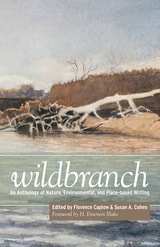
Wildbranch
An Anthology of Nature, Environmental, and Place-based WritingEdited by Florence Caplow and Susan A. Cohen. Foreword by H. Emerson Blake
University of Utah Press, 2010
Wildbranch: An Anthology of Nature, Environmental, and Place-based Writing is a powerful collection of mostly unpublished essays and poetry by both prominent American environmental writers and exciting new voices. The poetry and essays by more than fifty contributors offer the reader glimpses into places as diverse as a forest in West Africa, the moors of Ireland, the canyons of the Sonoran desert mountains, and the fields of New England, and they reflect the varied perspectives of field biologists, hunters, farmers, environmental educators, wilderness guides, academics, writers, and artists.
The collection is an intimate portrait of the natural world drawn through the wisdom, ecological consciousness, and open hearts of these exceptional contributors. The Wildbranch Writing Workshop, cosponsored by Orion magazine and Sterling College, has encouraged thoughtful natural history, outdoor, and environmental writing for more than twenty years. The Wildbranch faculty has included its founder E. Anne Proulx, the essayists Edward Hoagland, Janisse Ray, and Scott Russell Sanders, the poet Alison Hawthorne Deming, and many other notable authors. Many have work included in the anthology.
Winner of the New Mexico Book Association's Southwest Book Design & Production Awards for Excellence in the category Trade Books: Non-illustrated.