Results by title
4 books match the query 'Rodgers, Daniel T.'
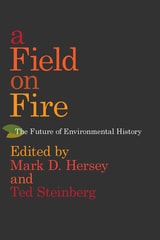
A Field on Fire
The Future of Environmental HistoryEdited by Mark D. Hersey and Ted Steinberg
University of Alabama Press, 2019
Inspired by the pioneering work of preeminent environmental historian Donald Worster, the contributors to A Field on Fire: The Future of Environmental History reflect on the past and future of this discipline. Featuring wide-ranging essays by leading environmental historians from the United States, Europe, and China, the collection challenges scholars to rethink some of their orthodoxies, inviting them to approach familiar stories from new angles, to integrate new methodologies, and to think creatively about the questions this field is well positioned to answer.
Worster’s groundbreaking research serves as the organizational framework for the collection. Editors Mark D. Hersey and Ted Steinberg have arranged the book into three sections corresponding to the primary concerns of Worster’s influential scholarship: the problem of natural limits, the transnational nature of environmental issues, and the question of method. Under the heading “Facing Limits,” five essays explore the inherent tensions between democracy, technology, capitalism, and the environment. The “Crossing Borders” section underscores the ways in which environmental history moves easily across national and disciplinary boundaries. Finally, “Doing Environmental History” invokes Worster’s work as an essayist by offering self-conscious reflections about the practice and purpose of environmental history.
The essays aim to provoke a discussion on the future of the field, pointing to untapped and underdeveloped avenues ripe for further exploration. A forward thinker like Worster presents bold challenges to a new generation of environmental historians on everything from capitalism and the Anthropocene to war and wilderness. This engaging volume includes a very special afterword by one of Worster’s oldest friends, the eminent intellectual historian Daniel Rodgers, who has known Worster for close to fifty years.
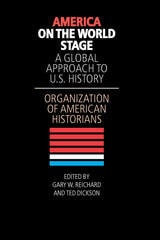
America on the World Stage
A Global Approach to U.S. HistoryOrganization of American Historians. Edited by Gary Reichard and Ted Dickson
University of Illinois Press, 2007
Recognizing the urgent need for students to understand the emergence of the United States' power and prestige in relation to world events, Gary W. Reichard and Ted Dickson reframe the teaching of American history in a global context. Each essay covers a specific chronological period and approaches fundamental topics and events in United States history from an international perspective, emphasizing how the development of the United States has always depended on its transactions with other nations for commodities, cultural values, and populations. For each historical period, the authors also provide practical guidance on bringing this international approach to the classroom, with suggested lesson plans and activities. Ranging from the colonial period to the civil rights era and everywhere in between, this collection will help prepare Americans for success in an era of global competition and collaboration.
Contributors are David Armitage, Stephen Aron, Edward L. Ayers, Thomas Bender, Stuart M. Blumin, J. D. Bowers, Orville Vernon Burton, Lawrence Charap, Jonathan Chu, Kathleen Dalton, Betty A. Dessants, Ted Dickson, Kevin Gaines, Fred Jordan, Melvyn P. Leffler, Louisa Bond Moffitt, Philip D. Morgan, Mark A. Noll, Gary W. Reichard, Daniel T. Rodgers, Leila J. Rupp, Brenda Santos, Gloria Sesso, Carole Shammas, Suzanne M. Sinke, Omar Valerio-Jimenez, Penny M. Von Eschen, Patrick Wolfe, and Pingchao Zhu.
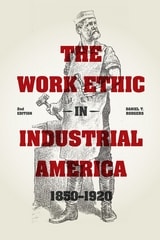
The Work Ethic in Industrial America 1850-1920
Second EditionDaniel T. Rodgers
University of Chicago Press, 2014
Daniel T. Rodgers masterfully explores the ways in which the eclipse of small-scale workshops by mechanized production and mass consumption triggered far-reaching shifts in perceptions of labor, leisure, and personal success. He also shows how the new work culture permeated society, including literature, politics, the emerging feminist movement, and the labor movement.
A staple of courses in the history of American labor and industrial society, Rodgers’s sharp analysis is sure to find a new audience, as twenty-first-century workers face another shift brought about by technology. The Work Ethic in Industrial America 1850–1920 is a classic with critical relevance in today’s volatile economic times.
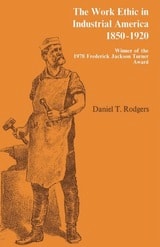
The Work Ethic in Industrial America, 1850-1920
Daniel T. Rodgers
University of Chicago Press, 1978