Results by title
3 books match the query 'Rodowick, D. N.'

Afterimages of Gilles Deleuze’s Film Philosophy
D. N. Rodowick
University of Minnesota Press, 2009
The French philosopher Gilles Deleuze was one of the most innovative and revolutionary thinkers of the twentieth century. Author of more than twenty books on literature, music, and the visual arts, Deleuze published the first volume of his two-volume study of film, Cinema 1: The Movement-Image, in 1983 and the second volume, Cinema 2: The Time-Image, in 1985. Since their publication, these books have had a profound impact on the study of film and philosophy. Film, media, and cultural studies scholars still grapple today with how they can most productively incorporate Deleuze's thought.
The first new collection of critical studies on Deleuze's cinema writings in nearly a decade, Afterimages of Gilles Deleuze's Film Philosophy provides original essays that evaluate the continuing significance of Deleuze's film theories, accounting systematically for the ways in which they have influenced the investigation of contemporary visual culture and offering new directions for research.
Contributors: Raymond Bellour, Centre Nationale de Recherches Scientifiques; Ronald Bogue, U of Georgia; Giuliana Bruno, Harvard U; Ian Buchanan, Cardiff U; James K. Chandler, U of Chicago; Tom Conley, Harvard U; Amy Herzog, CUNY; András Bálint Kovács, Eötvös Loránd U; Patricia MacCormack, Anglia Ruskin U; Timothy Murray, Cornell U; Dorothea Olkowski, U of Colorado; John Rajchman, Columbia U; Marie-Claire Ropars-Wuilleumier, U Paris VIII; Garrett Stewart, U of Iowa; Damian Sutton, Glasgow School of Art; Melinda Szaloky, UC Santa Barbara.

An Education in Judgment
Hannah Arendt and the HumanitiesD. N. Rodowick
University of Chicago Press, 2021
Rodowick takes after the theories of Hannah Arendt and argues that thinking is an art we practice with and for each other in our communities.
In An Education in Judgment, philosopher D. N. Rodowick makes the definitive case for a philosophical humanistic education aimed at the cultivation of a life guided by both self-reflection and interpersonal exchange. Such a life is an education in judgment, the moral capacity to draw conclusions alone and with others, and letting one’s own judgments be answerable to the potentially contrasting judgments of others. Thinking, for Rodowick, is an art we practice with and learn from each other on a daily basis.
In taking this approach, Rodowick follows the lead of Hannah Arendt, who made judgment the cornerstone of her conception of community. What is important for Rodowick, as for Arendt, is the cultivation of “free relations,” in which we allow our judgments to be affected and transformed by those of others, creating “an ever-widening fabric of intersubjective moral consideration.” That is a fragile fabric, certainly, but one that Rodowick argues is worth pursuing, caring for, and preserving. This original work thinks with and beyond Arendt about the importance of the humanities and what “the humanities” amounts to beyond the walls of the university.
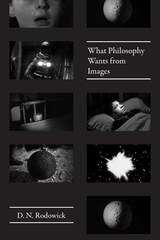
What Philosophy Wants from Images
D. N. Rodowick
University of Chicago Press, 2017
Rodowick here explores work by artists such as Ken Jacobs, Ernie Gehr, Victor Burgin, Harun Farocki, and others—artists who are creating forms that express a new historical consciousness of images. These forms acknowledge a complex relationship to the disappearing past even as they point toward new media that will challenge viewers’ confidence in what the images they see are or are becoming. What philosophy wants from images, Rodowick shows, is to renew itself conceptually through deep engagement with new forms of aesthetic experience.