Results by title
3 books match the query 'Rodríguez, Juana María'
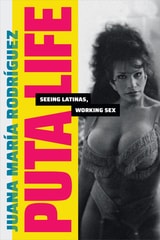
Puta Life
Seeing Latinas, Working SexJuana María Rodríguez
Duke University Press, 2023
In Puta Life, Juana María Rodríguez probes the ways that sexual labor and Latina sexuality become visual phenomena. Drawing on state archives, illustrated biographies, documentary films, photojournalistic essays, graphic novels, and digital spaces, she focuses on the figure of the puta—the whore, that phantasmatic figure of Latinized feminine excess. Rodríguez’s eclectic archive features the faces and stories of women whose lives have been mediated by sex work's stigmatization and criminalization—washerwomen and masked wrestlers, porn stars and sexiles. Rodríguez examines how visual tropes of racial and sexual deviance expose feminine subjects to misogyny and violence, attuning our gaze to how visual documentation shapes perceptions of sexual labor. Throughout this poignant and personal text, Rodríguez brings the language of affect and aesthetics to bear upon understandings of gender, age, race, sexuality, labor, disability, and migration. Highlighting the criminalization and stigmatization that surrounds sex work, she lingers on those traces of felt possibility that might inspire more ethical forms of relation and care.
[more]
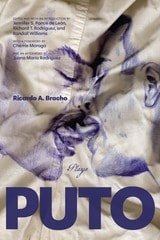
Puto
PlaysRicardo A. Bracho. Edited by Jennifer S. Ponce de León, Richard T. Rodríguez, and Randall Williams
Duke University Press, 2026
Ricardo A. Bracho is a queer Chicano Marxist playwright from Los Angeles whose theatrical works dramatize the lives of gay Black and Brown partisans of anti-capitalism and decolonization. Characterized by their playful use of theory, Bracho’s plays utilize the stage as a place for characters to debate questions of sexual and political liberation. Though Bracho’s work has been breaking ground within the experimental Latinx theater and arts community since the 1990s, his plays have not been widely accessible beyond their staging. Driven by passion—for politics, for the dancefloor, for dispossessed bodies, communities, and lands—Bracho’s award-winning plays express a polyphony of outlaw voices and contemporary dramas. With a foreword by Bracho’s teacher and iconic Chicana writer Cherríe Moraga, an afterword by Juana Maria Rodriguez, as well as critical notes and an introduction by editors Jennifer Ponce de León, Richard T. Rodriguez, and Randall Williams, Puto makes Bracho’s key works available to a broader public for the first time, bringing Bracho’s frank, transgressive, and revolutionary work to the forefront just when the world needs it most.
[more]

Trans Studies en las Americas
Claudia Sofia Garriga-López, Cole Rizki, and Juana María Rodríguez, special issue editors
Duke University Press, 0
Shifting the geopolitics of trans studies, travesti theory is a Latinx American body of work with an extensive transregional history. As a particular body politics, travesti identification is not only a sexed, gendered, classed, and racialized form of relation, but a critical mode and an epistemology. Throughout the Américas, trans and travesti studies take a multiplicity of forms: scholarly work that engages identitarian and anti-identitarian analytical frameworks as well as interventions into state practices, cultural production, and strategic activist actions. These multiple critical approaches—both travesti and trans—are regionally inflected by the flows of people, ideas, technologies, and resources that shape the hemisphere, opening up space to explore the productive tensions and expansive possibilities within this body of work.
This special issue of TSQ prompts a conversation between trans and travesti studies scholars working across the Américas to investigate how shifts in cultural practices, aesthetics, geographies, and languages enliven theories of politics, subjectivity, and embodiment. Contributors to this issue offer a hemispheric perspective on trans and travesti issues to the Anglophone academy, expand transgender studies to engage geopolitical connections, and bring interdisciplinary approaches to topics ranging from policy to cultural production. This issue is an unprecedented English-language collection by Latin American and Latinx scholars on trans and travesti issues.
Contributors. Lino Arruda, Daniel Coleman, Cynthia Citlallin Delgado, El Colectivo del Archivo de la Memoria Trans, Juan Carlos Garrido, Claudia Sofía Garriga-López, Bernadine Hernández, Hillary Hiner, Denilson Lopes, Andrés Lopez, Cole Rizki, Juana María Rodríguez, Oli Rodriguez, Marcia Lucia Machuca Rose, Martín de Mauro Rucovsky, Dora Silva Santana, Susy Shock, Sayak Valencia
[more]