Results by title
6 books match the query 'Rogers, William Warren'
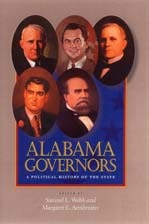
Alabama Governors
A Political History of the StateSamuel L. Webb
University of Alabama Press, 2001
The story of Alabama's governors has been often bizarre, occasionally inspiring, but never dull. Several of the state's early governors fought duels; one killed his wife's lover. A Reconstruction era-governor barricaded himself in his administrative office and refused to give it up when voters failed to reelect him. A 20th-century governor, an alumnus of Yale, married his first cousin and served as an officer in the Ku Klux Klan.
This collection of biographical essays, written by 34 noted historians and political scientists, chronicles the foibles and idiosyncrasies, in and out of office, of those who have served as the state's highest elected official. It also describes their courage; their meaningful policy initiatives; their accomplishments and failures; the complex factors that led to their actions or inaction; and the enormous consequences of their choices on the state's behalf.
Taken together, the essays provide a unified history of the state, with its recurring themes of race, federal-state relations, economic development, taxation, and education. Alabama Governors is certain to become an invaluable resource for teachers, students, librarians, journalists, and anyone interested in the colorful history and politics of the state.
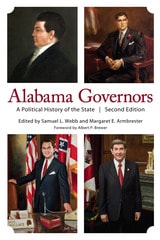
Alabama Governors
A Political History of the StateSamuel L. Webb
University of Alabama Press, 2014
An entirely revised and updated edition of the best-selling 2001 original guide to the leaders, politics, and personalities that shaped Alabama's history.
This collection of biographical essays, written by thirty-four noted historians and political scientists, chronicles the times, careers, challenges, leadership, and legacies of the fifty-seven men and one woman who have served as the state's highest elected official. The book is organized chronologically into six sections that cover Alabama’s years as a US territory and its early statehood, the 1840s through the Civil War and Reconstruction, the late nineteenth-century Bourbon era, twentieth-century progressive and wartime governors, the Civil Rights era and George Wallace’s period of influence, and recent chief executives in the post-Wallace era.
The political careers of these fifty-eight individuals reflect the story of Alabama itself. Taken together, these essays provide a unified history of the state, with its recurring themes of race, federal-state relations, tensions between north and south Alabama, economic development, taxation, and education.
Alabama Governors expertly delineates the decisions and challenges of the chief executives, their policy initiatives, their accomplishments and failures, and the lasting impact of their terms. The book also includes the true and sometimes scandalous anecdotes that pepper Alabama’s storied history. Several of the state's early governors fought duels; one killed his wife's lover. A Reconstruction era-governor barricaded himself in his office and refused to give it up when voters failed to reelect him. A twentieth-century governor, an alumnus of Yale, served as an officer in the Ku Klux Klan.
This entirely updated and revised edition includes enlarged and enhanced images of each governor. Alabama Governors is certain to become a valuable resource for teachers, students, librarians, journalists, and anyone interested in the colorful history of Alabama politics.
Alabama
The History of a Deep South StateWilliam Warren Rogers
University of Alabama Press, 1994
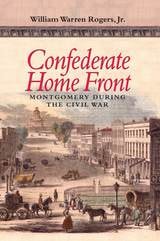
Confederate Home Front
Montgomery during the Civil WarWilliam Warren Rogers, Jr.
University of Alabama Press, 2001
Drawing from a wealth of historic documents and personal papers, William Warren Rogers, Jr., provides a fascinating and detailed political, economic, social, and commercial history of Montgomery from 1860 to 1865. His account begins with an examination of daily life in the city before the war began-how slaves outnumbered whites, how an unvarnished frontier atmosphere prevailed on the streets despite citizens' claims to refinement, how lush crops of corn and cotton grew in fields right up to the city limits, and how class divisions were distinct and immovable.
Rogers arranges his material topically, covering the events that led to the decision for secession and Montgomery's heady days as the Confederacy's first capital; the industrialization of the city's war effort as it became a hub of activity and served as a military post; the city's business patterns and administration as it attempted to promote the Confederacy and defend itself from federal forces; and the plight of the small group of Unionists who inhabited Montgomery through the war. Rogers concludes with chapters examining the situation in Montgomery as the Confederacy unraveled and the city fell to Union troops.
The Montgomery experience offers a microcosm of life on the Confederate home front and demonstrates that citizens generally experienced the same hopes, deprivations, and tragedies that other Southerners did at this time. Rogers's well-written, comprehensive history of the wartime city makes an original contribution to Civil War homefront and community studies that should appeal to general readers and scholars alike.
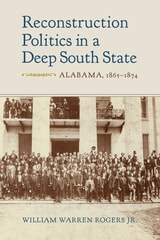
Reconstruction Politics in a Deep South State
Alabama, 1865–1874William Warren Rogers Jr.
University of Alabama Press, 2021
The battle for democracy in reconstruction-era Alabama.
Following the end of the Civil War, white Southerners were forced to concede equal rights to those who had been enslaved, ushering in a new and ruthless brand of politics. Suddenly, the status and place of some four million former slaves dominated the national and regional political dialogue. In Alabama, the Republican Party established itself quickly and powerfully with the participation of a newly freed constituency, firmly aligned against the Democratic Party that had long dictated the governance of the state. Well-heeled planters, merchants, and bankers, joined by yeoman farmers, staged a counterrevolution by gravitating strongly to the Democratic Party and its unabashedly white supremacist measures. The ensuing power struggle in the birthplace of the Confederacy is at the heart of Reconstruction Politics in a Deep South State: Alabama, 1865–1874.
What emerges in William Warren Rogers Jr.’s comprehensive study of the era is a detailed examination of Reconstruction politics, particularly in Alabama. This book explores an explosive and unpredictable political environment that a few years earlier would have been inconceivable. A vivid picture emerges of courthouse rallies and bitter infighting in legislative circles. Rogers’s narrative ventures into darker places as well: to the Tennessee Valley and the Black Belt regions of Alabama, where Klan nightriders used violence against an enemy and ideology they could not abide.
The attempt to capture and account for the unforgiving political landscape created by the extraordinary circumstances of Reconstruction constitutes this study’s most central contribution. Rogers often quotes black and white citizens, Democrats and Republicans. Drawn from newspapers, correspondence, and various federal investigations, these firsthand voices are passionate, unvarnished, and filled with conviction. They offer a startling immediacy and illustrate the temper—or distemper—of the times. Readers are treated to a panoramic unveiling of Reconstruction Alabama politics that provides a sense of what was truly at stake: the values by which a region and the nation as a whole would chart its future for the century to come.
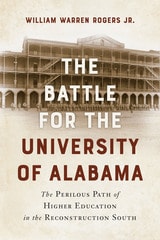
The Battle for the University of Alabama
The Perilous Path of Higher Education in the Reconstruction SouthWilliam Warren Rogers, Jr.
University of Alabama Press, 2025
Traces the little-known story of the bitter contest for the fate of the University of Alabama after the Civil War.
In The Battle for the University of Alabama, William Warren Rogers Jr. gives a fascinating account of the fierce struggle over the nature of the University of Alabama after the Civil War. Union forces reduced the campus to ruins as the war ended, and the university did not reopen until 1869. In the interregnum, powerful forces shifted the trajectory of the school. Alabama Republicans authored an egalitarian state constitution that delivered oversight of the university to the Republican Party. That set the stage for turmoil and confrontation. This book tells the story of that conflict.
In the next few years, Democrats charged Republicans with turning the university into a “radical” institution. They alleged that a handful of unqualified individuals had gained faculty positions because of their political allegiance, which resulted in the university’s academic desecration. Professors were bitterly denounced in the state newspaper press and quite personally in Tuscaloosa. Administration of the university became part of the fratricidal political debate in the state. Political violence and questions concerning race, specifically the possible integration of the university, illuminated the controversies of the Reconstruction years. Many of these questions resonate even today.
This authoritative account sets events at the University of Alabama against the backdrop of what occurred at other state universities in the Reconstruction South. The University of North Carolina experienced controversy similar to Alabama’s. At the University of Georgia, however, calm prevailed. This story of the incendiary events at Alabama’s flagship university charts new ground and provides a revelatory look into the extraordinary partisanship that characterized the South after the Civil War.