Results by title

7 books match the query 'Rojas, Carlos'
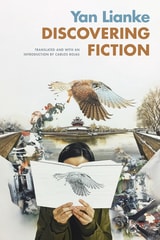
cover of Discovering Fiction

Discovering Fiction

Yan Lianke

Duke University Press, 2022
Over the past twenty years, Chinese novelist Yan Lianke has emerged as one of the most important writers in the world. In Discovering Fiction, Yan offers insights into his views on literature and realism, the major works that inspired him, and his theories of writing. He juxtaposes discussions of the high realism of Leo Tolstoy and Lu Xun against Franz Kafka’s modernism and Gabriel García Márquez’s magical realism, charting the relationship between causality, truth, and modes of realism. He also discusses his approach to realism, which he terms “mythorealism”—a way of capturing the world’s underlying truth by relying on the allegories, myths, legends, and dreamscapes that emerge from daily life. Revealing and instructive, Discovering Fiction gives readers an unprecedented look into the mind and art of a literary giant.
[more]
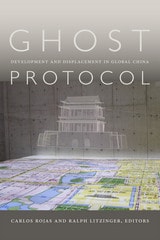
cover of Ghost Protocol: Development and Displacement in Global China

Ghost Protocol

Development and Displacement in Global China

Carlos Rojas and Ralph A. Litzinger, editors

Duke University Press, 2016

Even as China is central to the contemporary global economy, its socialist past continues to shape its capitalist present. This volume's contributors see contemporary China as haunted by the promises of capitalism, the institutional legacy of the Maoist regime, and the spirit of Marxist resistance. China's development does not result from historical imperatives or deliberate economic strategies, but from the effects of discrete practices the contributors call protocols, which stem from an overlapping mix of socialist and capitalist institutional strategies, political procedures, legal regulations, religious rituals, and everyday practices. Analyzing the process of urbanization and the ways marginalized communities and migrant workers are positioned in relation to the transforming social landscape, the contributors show how these protocols constitute the Chinese national imaginary while opening spaces for new emancipatory possibilities. Offering a nuanced theory of contemporary China's hybrid political economy, Ghost Protocol situates China's development at the juncture between the world as experienced and the world as imagined.

Contributors. Yomi Braester, Alexander Des Forges, Kabzung, Rachel Leng, Ralph A. Litzinger, Lisa Rofel, Carlos Rojas, Bryan Tilt, Robin Visser, Biao Xiang, Emily T. Yeh
[more]
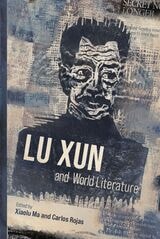
cover of Lu Xun and World Literature

Lu Xun and World Literature

Edited by Xiaolu Ma and Carlos Rojas

Hong Kong University Press, 2025

Impressive and significant contributions to Lu Xun scholarship and world literature.

In Lu Xun and World Literature, the contributors examine various aspects of Lu Xun, who is known as the father of modern Chinese literature. Essays in this book focus on Lu Xun’s works in relation to the notions of world literature and processes of literary worlding. They offer detailed analyses of Lu Xun’s own literary oeuvre and of foreign works that engage with his writings. This volume also focuses on many facets of the publication and dissemination of Lu Xun’s works, from printing and binding to the discussions and debates that followed their release in China and abroad. This book not only makes an important contribution to the field of Lu Xun studies, but also proposes a reexamination of the category of world literature.
[more]
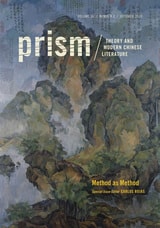
cover of Method as Method

Method as Method

Carlos Rojas, special issue editor

Duke University Press, 2020

In 1960, Japanese scholar of Chinese literature Takeuchi Yoshimi gave a pair of lectures titled “Asia as Method,” in which he considered how one might engage with Western theory from an East Asian perspective. Since then, it has been fashionable to use the “X as method” formulation to take what might have otherwise been an object of analysis and use it to elaborate an innovative methodology. Drawing inspiration from the numerous recent books and articles built around that formulation, contributors to this issue propose breaking the linkage between methodologies and objects or phenomena that inspired them and then applying them to a broader array of topics. Essays address the meanings that get left out in the process of translation, artistic representations of garbage, indigenous eco-fiction from Inner Mongolia, the role of cannibalism in a popular Hong Kong television series, and the implications of Taiwan legalizing same-sex marriage. The issue focuses on topics related to China in hopes of reassessing the assumptions that have come to define the concept of "China" and its relationship to the West.

Contributors. Yomi Braester, Hsiao-hung Chang, Margaret Hillenbrand, Chun-kit Ko, Belinda Kong, Petrus Liu, Laikwan Pang, Christopher Rea, Carlos Rojas, Shuang Shen, Robin Visser, Lorraine Wong
[more]
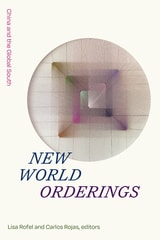
cover of New World Orderings: China and the Global South

New World Orderings

China and the Global South

Lisa Rofel and Carlos Rojas, editors

Duke University Press, 2022

The contributors to New World Orderings demonstrate that China’s twenty-first-century rise occurs not only through economics and state politics but equally through the mutual entanglements of overlapping social, economic, and cultural worlds in Southeast Asia, Africa, and Latin America. They show how the Chinese state has sought to reconfigure the nation’s position in the world and the centrality of trade, labor, religion, migration, gender, race, and literature to this reconfiguration. Among other topics, the contributors examine China’s post-Bandung cultural diplomacy with African nations, how West African “pastor-entrepreneurs” in China interpreted and preached the prosperity doctrine, the diversity of Chinese-Argentine social relations in the soy supply chain, and the ties between China and India within the complex history of inter-Asian exchange and Chinese migration to Southeast Asia. By examining China’s long historical relationship with the Global South, this volume presents a non-state-centric history of China that foregrounds the importance of transnational communicative and imaginative worldmaking processes and interactions.

Contributors. Andrea Bachner, Luciano Damián Bolinaga, Nellie Chu, Rachel Cypher, Mingwei Huang, T. Tu Huynh, Yu-lin Lee, Ng Kim Chew, Lisa Rofel, Carlos Rojas, Shuang Shen, Derek Sheridan, Nicolai Volland
[more]
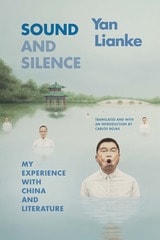
cover of Sound and Silence: My Experience with China and Literature

Sound and Silence

My Experience with China and Literature

Yan Lianke

Duke University Press, 2024

Yan Lianke is a world-renowned author of novels, short stories, and essays whose provocative and nuanced writing explores the reality of everyday life in contemporary China. In Sound and Silence, Yan compares his literary project to a blind man carrying a flashlight whose role is to help others perceive the darkness that surrounds them. Often described as China’s most censored author, Yan reflects candidly on literary censorship in contemporary China. He outlines the Chinese state’s project of national amnesia that suppresses memories of past crises and social traumas. Although being banned in China is often a selling point in foreign markets, Yan argues that there is no requisite correlation between censorship and literary quality. Among other topics, Yan also examines the impact of American literature on Chinese literature in the 1980s and 1990s. Encapsulating his perspectives on life, writing, and literary history, Sound and Silence includes an introduction by translator Carlos Rojas and an afterword by Yan.
[more]
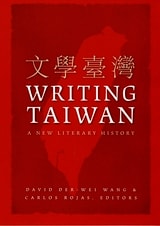
cover of Writing Taiwan: A New Literary History

Writing Taiwan

A New Literary History

David Der-wei Wang and Carlos Rojas, eds.

Duke University Press, 2007

Writing Taiwan is the first volume in English to examine the entire span of modern Taiwan literature, from the first decades of the twentieth century to the present. In this collection, leading literary scholars based in Taiwan and the United States consider prominent Taiwanese authors and works in genres including poetry, travel writing, and realist, modernist, and postmodern fiction. The diversity of Taiwan literature is signaled by the range of authors treated, including Yang Chichang, who studied Japanese literature in Tokyo in the early 1930s and wrote all of his own poetry and fiction in Japanese; Li Yongping, an ethnic Chinese born in Malaysia and educated in Taiwan and the United States; and Liu Daren, who was born in mainland China and effectively exiled from Taiwan in the 1970s on account of his political activism.

Because the island of Taiwan spent the first half of the century as a colony of Japan and the second half in an umbilical relationship to China, its literature challenges basic assumptions about what constitutes a “national literature.” Several contributors directly address the methodological and epistemological issues involved in writing about “Taiwan literature.” Other contributors investigate the cultural and political grounds from which specific genres and literary movements emerged. Still others explore themes of history and memory in Taiwan literature and tropes of space and geography, looking at representations of boundaries as well as the boundary-crossing global flows of commodities and capital. Like Taiwan’s history, modern Taiwan literature is rife with conflicting legacies and impulses. Writing Taiwan reveals a sense of its richness and diversity to English-language readers.

Contributors. Yomi Braester, Sung-sheng Yvonne Chang, Fangming Chen, Lingchei Letty Chen, Chaoyang Liao, Ping-hui Liao, Joyce C. H. Liu, Kim-chu Ng, Carlos Rojas, Xiaobing Tang, Ban Wang, David Der-wei Wang, Gang Gary Xu, Michelle Yeh, Fenghuang Ying

[more]