Results by title
10 books match the query 'Role Playing & Fantasy'
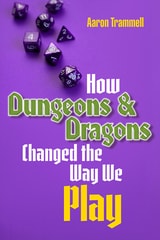
How Dungeons & Dragons Changed the Way We Play
Aaron Trammell
Duke University Press, 2026
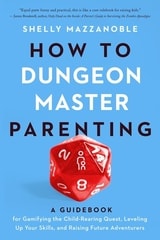
How to Dungeon Master Parenting
A Guidebook for Gamifying the Child Rearing Quest, Leveling Up Your Skills, and Raising Future AdventurersShelly Mazzanoble
University of Iowa Press, 2024
2025 National Indie Excellence Award Finalist, Parenting & Family
2025 Independent Publishers Book Awards (IPPY Awards) bronze medalist, Parenting
2024 Zibby Awards, Best Book for Parents selection
2024 Foreword INDIES Book of the Year Awards Finalist, Family & Relationship
2024 American Book Fest Best Book Award Finalist, Parenting
Gather your party, it’s time to level up your parenting game!
For years, millions of fans have looked to the beloved roleplaying game Dungeons & Dragons for fun, friendship, and entertainment. And now parents and parents-to-be can use D&D to gain inspiration and how-to when it comes to their most challenging and rewarding role yet. Dungeon Masters are not just expert storytellers and arbiters of the rules, they’re compassionate, creative, quick-thinking leaders who embody the same traits that make a great parent.
Where do you find an adventuring party who will have your back? What must-have starting equipment should you own before venturing into babyland? How does your gaming style reflect your parenting style? You don’t have to know how to be a Dungeon Master to master parenting—just think like one. Kids may not come with rulebooks, but now their parents do.

Inclusive Play
Magic Commander and Community PracticeJohn Banks
University of Michigan Press, 2027
Magic: The Gathering, considered to be the first collectible trading card game, was conceived by Richard Garfield in 1991 and commercially released by Wizards of the Coast in 1993. Since then, Magic has exerted profound influence on hobbyist board gaming through its distinctive and innovative mechanics and practices of collecting cards from periodic set releases and deckbuilding for competitive play. Originating in the Magic player community, the Commander format became popular for casual play and a more inclusive style of social play. Like games cultures more broadly, Magic has been characterized by oppressions that exclude marginalized people.
Drawing on his research of the player community at his local game store in Brisbane, Australia; interviews with Sheldon Menery and members of the Commander Rules Committee and Advisory Group; and research in the field of game studies, John Banks considers how games like Commander can be approached and played more inclusively. Banks argues that there is an ethical dimension to how players approach inclusion. While not all games or communities embody inclusivity, Commander play has integral practices that exemplify virtuous play: an ethic of play rooted in respect, care, and community. Inclusive Play shows that games such as Commander are culturally significant as they provide opportunity for meaningful inclusive cultural change.
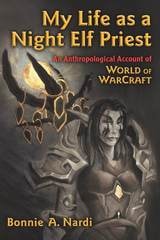
My Life as a Night Elf Priest
An Anthropological Account of World of WarcraftBonnie A. Nardi
University of Michigan Press, 2010
"Ever since the creators of the animated television show South Park turned their lovingly sardonic gaze on the massively multiplayer online game World of Warcraft for an entire episode, WoW's status as an icon of digital culture has been secure. My Life as a Night Elf Priest digs deep beneath the surface of that icon to explore the rich particulars of the World of Warcraft player's experience."
—Julian Dibbell, Wired
"World of Warcraft is the best representative of a significant new technology, art form, and sector of society: the theme-oriented virtual world. Bonnie Nardi's pioneering transnational ethnography explores this game both sensitively and systematically using the methods of cultural anthropology and aesthetics with intensive personal experience as a guild member, media teacher, and magical quest Elf."
—Lisa Nakamura, University of Illinois
World of Warcraft rapidly became one of the most popular online world games on the planet, amassing 11.5 million subscribers—officially making it an online community of gamers that had more inhabitants than the state of Ohio and was almost twice as populous as Scotland. It's a massively multiplayer online game, or MMO in gamer jargon, where each person controls a single character inside a virtual world, interacting with other people's characters and computer-controlled monsters, quest-givers, and merchants.
In My Life as a Night Elf Priest, Bonnie Nardi, a well-known ethnographer who has published extensively on how theories of what we do intersect with how we adopt and use technology, compiles more than three years of participatory research in Warcraft play and culture in the United States and China into this field study of player behavior and activity. She introduces us to her research strategy and the history, structure, and culture of Warcraft; argues for applying activity theory and theories of aesthetic experience to the study of gaming and play; and educates us on issues of gender, culture, and addiction as part of the play experience. Nardi paints a compelling portrait of what drives online gamers both in this country and in China, where she spent a month studying players in Internet cafes.
Bonnie Nardi has given us a fresh look not only at World of Warcraft but at the field of game studies as a whole. One of the first in-depth studies of a game that has become an icon of digital culture, My Life as a Night Elf Priest will capture the interest of both the gamer and the ethnographer.
Bonnie A. Nardi is an anthropologist by training and a professor in the Department of Informatics in the Donald Bren School of Information and Computer Sciences at the University of California, Irvine. Her research focus is the social implications of digital technologies. She is the author of A Small Matter of Programming: Perspectives on End User Computing and the coauthor of Information Ecologies: Using Technology with Heart and Acting with Technology: Activity Theory and Interaction Design.
Cover art by Jessica Damsky

Narrative Interplay in the Digital Era
Generative AI, Alternate Reality Games, and the Future of Interactive PedagogyEdited by Andrew Klobucar
Intellect Books, 2025
In Narrative Interplay in the Digital Era, leading scholars and artists explore how digital narratives, alternate reality games, and AI-driven storytelling reshape how we create, experience, and teach interactive fiction. This collection moves beyond traditional analysis and examines the social and artistic dimensions of interactivity, highlighting how narratives unfold dynamically through player engagement and machine collaboration.
Organized into three sections—alternate realities, digital interactive fiction, and the politics of gaming—this book reveals the evolving role of play and interactivity in contemporary education, creative expression, and online culture. Contributors offer insights from inside the creative process, centering the perspectives of game designers and artists to shed light on how interactive stories emerge at the intersection of technology and human imagination.
A practical resource for researchers in game studies, electronic literature, and digital storytelling, this collection also speaks to educators and creators eager to explore how AI and interactivity are redefining the future of narrative.
Shared Fantasy
Role Playing Games as Social WorldsGary Alan Fine
University of Chicago Press, 1983

The Beginner’s Guide to Tabletop Roleplaying Games for Neurodivergent Players
Tips and TalesMaxwell, Lucas
University of Iowa Press, 2027
From Dimension 20 fandom to homebrewed campaigns, the game of Dungeons & Dragons offers neurodivergent players a space to create and celebrate new systems of thinking, connect with others, and have fun. The Beginner’s Guide to Tabletop Role playing Games for Neurodivergent Players is for anyone—neurodivergent or neurotypical—who has ever wanted to give D&D a try but felt overwhelmed by its scope. Combining research, resources, testimonials, and interviews with experts, Lucas Maxwell illuminates the bridge between Dungeons & Dragons and those who seek to play it. Maxwell even provides two one-shot adventures and everything you need to play them, whether in the classroom, a club, or at home.
Their System, Our Game
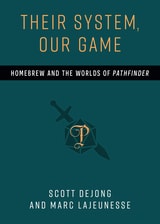
Homebrew and the Worlds of PathfinderScott DeJong and Marc Lajeunesse
University of Michigan Press, 2026
Our favorite tabletop role-playing games (TTRPGs) provide a chance to act out a fantasy. It might be the desire to wipe out foes with a single strike, the ability to charm even the most curmudgeonly townsfolk, or maybe even just the aspiration to adventure as a potted plant. Since game systems don’t always let players craft the kinds of games they want to experience, this is when they turn to the “homebrew” process to create personal rules and worlds. While Pathfinder has a history of being an underdog to the longtime industry leader Dungeons & Dragons, it has an ethos of open game design that inspires players, indie makers, and third-party content creators to brew up new rules, characters, classes, and game settings.
Their System, Our Game looks at the history of Pathfinder and how it encourages aspiring makers to break into the game design space. Through interviews with player-creators and third party makers, the authors use a range of perspectives to define homebrew for TTRPGs. Taking a closer look at homebrew design, they create two homebrew campaigns (available as free downloads) collaboratively with two different groups of players. Player accounts of gameplay and designer reflections of how their homebrew actually played out at the game table outline some of the challenges and perks of designing on the fly, creating customized settings, and bending or breaking rules. The book concludes by going through the research, interviews, design, and play analysis to show what homebrew and Pathfinder mean together. Ultimately Their System, Our Game is a celebration of how players use homebrew to explore creation and expression in their own TTRPGs.
Ultima and Worldbuilding in the Computer Role-Playing Game
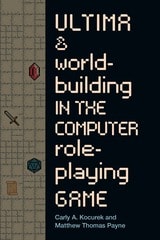
Carly A. Kocurek and Matthew Thomas Payne
Amherst College Press, 2024
This book first considers the contributions of series founder and lead designer, Richard Garriott, examining how his fame and notoriety as a pioneering computer game auteur shaped Ultima’s reception and paved the way for the evolution of the series. Next, the authors retrace the steps that Garriott took in fusing analog, tabletop role-playing with his self-taught lessons in computer programming. Close textual analyses of Ultima I outline how its gameplay elements offered a foundational framework for subsequent innovations in design and storytelling. Moving beyond the game itself, the authors assess how marketing materials and physical collectibles amplified its immersive hold and how the series’ legions of fans have preserved the series. Game designers, long-time gamers, and fans will enjoy digging into the games’ production history and mechanics while media studies and game scholars will find Ultima and World-Building in the Computer Role-Playing Game a useful extension of inquiry into authorship, media history, and the role of fantasy in computer game design.
Welcome to Dragon Talk
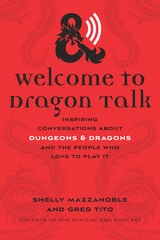
Inspiring Conversations about Dungeons & Dragons and the People Who Love to Play ItShelly Mazzanoble
University of Iowa Press, 2022
Shelly and Greg recount some of their most inspiring interviews and illuminate how their guests use the core tenets of the game in everyday life. An A-list actor defends D&D by baring his soul (and his muscles) on social media. A teacher in a disadvantaged district in Houston creates a D&D club that motivates students to want to read and think analytically. A writer and live-streamer demonstrates how D&D–inspired communication breaks barriers and empowers people of color. Readers will see why Dungeons & Dragons has remained such a pop culture phenomenon and how it has given this disparate and growing community the inspiration to flourish and spread some in-game magic into the real world.