Results by title
4 books match the query 'Roll, Jarod'
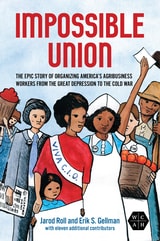
Impossible Union
The Epic Story of Organizing America’s Agribusiness Workers from the Great Depression to the Cold WarJarod Roll and Erik S. Gellman
University of Illinois Press, 2027
Workers of many racial, ethnic, and social identities united under the UCAPAWA-FTA banner. Their grassroots activism and bold national leadership fueled the union’s success despite opposition from employers, the government, and other labor groups. The union’s common sense anti-fascist ideology empowered workers to forge solidarities across their vast differences and linked workers’ rights to campaigns against racism and inequality. UCAPAWA-FTA advocated for an inclusive American democracy that can inform today’s struggles for dignity and security. This unique volume includes a special collection of essays by affiliated scholars that explore specific aspects of the union’s larger history.
Expansive and monumental, Impossible Union chronicles the labor organization that brought personhood and power to America’s marginal yet essential workers.
Additional contributors: Benjamin Makani Fortun, Dorothy Fujita-Rony, Robert Korstad, Bernadette Pérez, Michael Pierce, Charles Romney, Vicki L. Ruiz, Dan Sidorick, Dwana Waugh, John Weber, and Lane Windham
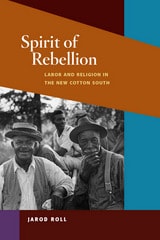
Spirit of Rebellion
Labor and Religion in the New Cotton SouthJared Roll
University of Illinois Press, 2010
Winner of the Herbert G. Gutman Prize from the Labor and Working-Class History Association
In Spirit of Rebellion, Jarod Roll documents an alternative tradition of American protest by linking working-class political movements to grassroots religious revivals. He reveals how ordinary rural citizens in the south used available resources and their shared faith to defend their agrarian livelihoods amid the political and economic upheaval of the first half of the twentieth century.On the frontier of the New Cotton South in Missouri's Bootheel, the relationships between black and white farmers were complicated by racial tensions and bitter competition. Despite these divisions, workers found common ground as dissidents fighting for economic security, decent housing, and basic health, ultimately drawing on the democratic potential of evangelical religion to wage working-class revolts against commodity agriculture and the political forces that buoyed it. Roll convincingly shows how the moral clarity and spiritual vigor these working people found in the burgeoning Pentecostal revivals gave them the courage and fortitude to develop an expansive agenda of workers' rights by tapping into the powers of existing organizations such as the Socialist Party, the Universal Negro Improvement Association, the NAACP, and the interracial Southern Tenant Farmers' Union.
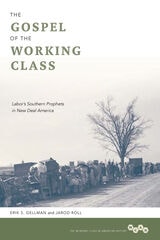
The Gospel of the Working Class
Labor's Southern Prophets in New Deal AmericaErik S. Gellman and Jarod Roll
University of Illinois Press, 2011
In this exceptional dual biography and cultural history, Erik S. Gellman and Jarod Roll trace the influence of two southern activist preachers, one black and one white, who used their ministry to organize the working class in the 1930s and 1940s across lines of gender, race, and geography. Owen Whitfield and Claude Williams, along with their wives Zella Whitfield and Joyce Williams, drew on their bedrock religious beliefs to stir ordinary men and women to demand social and economic justice in the eras of the Great Depression, New Deal, and Second World War.
The Pew and the Picket Line
Christianity and the American Working ClassEdited by Christopher D. Cantwell, Heath W. Carter, and Janine Giordano Drake
University of Illinois Press, 2016