Results by title
4 books match the query 'Román, David'
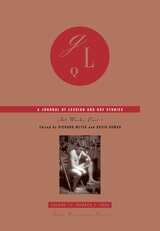
Art Works
Part 1, Volume 12Richard Meyer and David Román, eds.
Duke University Press, 0
Arguing for the primacy of the arts in queer life, the contributors show how art and performance can constitute a form of critical theorizing rather than simply an illustration of it. In different ways, each author demonstrates how art works to invigorate queer critique. The first issue includes a special dossier on AIDS activist film and video, marking the twenty-fifth year of the AIDS pandemic, and essays on late-nineteenth-century male nudes, lesbian surrealism, homoerotic photography in the Deep South, and the transnational, transgender contexts of the Pulitzer Prize–winning play I Am My Own Wife. Essays in the second issue focus on a series of queer case studies, including gay power graphics and psychedelia, female duets on the Broadway stage, Keith Haring and racial politics, British Vogue in the 1920s, and lesbian-feminist magazines of the 1970s. The issue concludes with a dossier of three shorter pieces on queer art and performance: an interview with the Chicano drag street performer Robert Legoretta (“Cyclona”), an essay on blogs and the Five Lesbian Brothers, and a discussion of a rarely exhibited work about cruising and public space by the contemporary artist Glenn Ligon.
Contributors. Deborah Bright, Jill Dolan, Jens Giersdorf, Jason Goldman, Scott Herring, Lucas Hilderbrand, Alexandra Juhasz, Tirza Latimer, Glenn Ligon, Richard Meyer, Rachel Middleman, Ricardo Montez, Erica Rand, Christopher Reed, David Román, Jennifer Flores Sternad, Margo Hobbs Thompson, Stacy Wolf

Art Works
Part 2, Volume 12Richard Meyer and David Román, eds.
Duke University Press, 0
Arguing for the primacy of the arts in queer life, the contributors show how art and performance can constitute a form of critical theorizing rather than simply an illustration of it. In different ways, each author demonstrates how art works to invigorate queer critique. The first issue includes a special dossier on AIDS activist film and video, marking the twenty-fifth year of the AIDS pandemic, and essays on late-nineteenth-century male nudes, lesbian surrealism, homoerotic photography in the Deep South, and the transnational, transgender contexts of the Pulitzer Prize–winning play I Am My Own Wife. Essays in the second issue focus on a series of queer case studies, including gay power graphics and psychedelia, female duets on the Broadway stage, Keith Haring and racial politics, British Vogue in the 1920s, and lesbian-feminist magazines of the 1970s. The issue concludes with a dossier of three shorter pieces on queer art and performance: an interview with the Chicano drag street performer Robert Legoretta (“Cyclona”), an essay on blogs and the Five Lesbian Brothers, and a discussion of a rarely exhibited work about cruising and public space by the contemporary artist Glenn Ligon.
Contributors. Deborah Bright, Jill Dolan, Jens Giersdorf, Jason Goldman, Scott Herring, Lucas Hilderbrand, Alexandra Juhasz, Tirza Latimer, Glenn Ligon, Richard Meyer, Rachel Middleman, Ricardo Montez, Erica Rand, Christopher Reed, David Román, Jennifer Flores Sternad, Margo Hobbs Thompson, Stacy Wolf
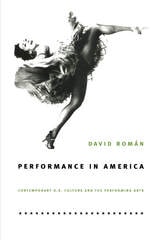
Performance in America
Contemporary U.S. Culture and the Performing ArtsDavid Román
Duke University Press, 2005
The performances that Román analyzes range from localized community-based arts events to full-scale Broadway productions and from the controversial works of established artists such as Tony Kushner to those of emerging artists. Román considers dances produced by the choreographers Bill T. Jones and Neil Greenberg in the mid-1990s as new aids treatments became available and the aids crisis was reconfigured; a production of the Asian American playwright Chay Yew’s A Beautiful Country in a high-school auditorium in Los Angeles’s Chinatown; and Latino performer John Leguizamo’s one-man Broadway show Freak. He examines the revival of theatrical legacies by female impersonators and the resurgence of cabaret in New York City. Román also looks at how the performing arts have responded to 9/11, the U.S. invasion of Afghanistan, and the second war in Iraq. Including more than eighty illustrations, Performance in America highlights the dynamic relationships among performance, history, and contemporary culture through which the past is revisited and the future reimagined.

Tarell Alvin McCraney
Theater, Performance, and CollaborationEdited by Sharrell D. Luckett, David Román, and Isaiah Matthew Wooden
Northwestern University Press, 2020
Contributors consider McCraney’s innovations as a playwright, adapter, director, performer, teacher, and collaborator, bringing fresh and diverse perspectives to their observations and analyses. In so doing, they expand and enrich the conversations on his much-celebrated and deeply resonant body of work, which includes the plays Choir Boy, Head of Passes, Ms. Blakk for President, The Breach, Wig Out!, and the critically acclaimed trilogy The Brother/Sister Plays: In the Red and Brown Water, The Brothers Size, and Marcus; Or the Secret of Sweet, as well as the Oscar Award–winning film Moonlight, which was based on his play In Moonlight Black Boys Look Blue.