Results by title
4 books match the query 'Roman Republic'
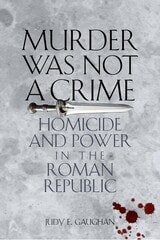
Murder Was Not a Crime
Homicide and Power in the Roman RepublicBy Judy E. Gaughan
University of Texas Press, 2009
Embarking on a unique study of Roman criminal law, Judy Gaughan has developed a novel understanding of the nature of social and political power dynamics in republican government. Revealing the significant relationship between political power and attitudes toward homicide in the Roman republic, Murder Was Not a Crime describes a legal system through which families (rather than the government) were given the power to mete out punishment for murder.
With implications that could modify the most fundamental beliefs about the Roman republic, Gaughan's research maintains that Roman criminal law did not contain a specific enactment against murder, although it had done so prior to the overthrow of the monarchy. While kings felt an imperative to hold monopoly over the power to kill, Gaughan argues, the republic phase ushered in a form of decentralized government that did not see itself as vulnerable to challenge by an act of murder. And the power possessed by individual families ensured that the government would not attain the responsibility for punishing homicidal violence.
Drawing on surviving Roman laws and literary sources, Murder Was Not a Crime also explores the dictator Sulla's "murder law," arguing that it lacked any government concept of murder and was instead simply a collection of earlier statutes repressing poisoning, arson, and the carrying of weapons. Reinterpreting a spectrum of scenarios, Gaughan makes new distinctions between the paternal head of household and his power over life and death, versus the power of consuls and praetors to command and kill.
The Roman Republic in Political Thought
Fergus Millar
Brandeis University Press, 2002
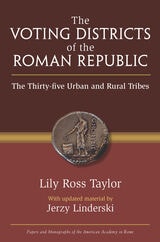
The Voting Districts of the Roman Republic
The Thirty-five Urban and Rural TribesLily Ross Taylor
University of Michigan Press, 2013
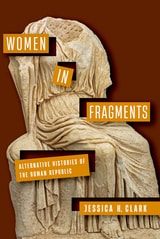
Women in Fragments
Alternative Histories of the Roman RepublicJessica H. Clark
University of Wisconsin Press, 2026
Our sources of knowledge about women in the ancient Roman Republic are flawed. Roman historians were uniformly male, as were most historians of ancient Rome until quite recently. In the historiography handed down by Enlightenment-era scholars, women generally played marginal and often sexualized roles, relegated to the footnotes by historians who assumed the Roman Republic to be fully androcentric. The evidence, however, suggests otherwise. In this detailed and insightful volume, Jessica H. Clark returns to the source material to gain insight into how Roman men understood the lives, roles, and contributions of the women they wrote about.
Reexamining the puzzle pieces of ancient literature, Clark proposes that the earliest Roman historians represented women in complex ways, revealing their appreciation of women’s communities and women’s engagement in the project of the Republic, in contrast to the attitudes assumed by scholars in the eighteenth and nineteenth centuries. She attributes those scholars’ assumptions to the social and political circumstances of their own times and demonstrates how these assumptions have continued to inform our own perceptions of Roman women and therefore Roman society more generally. This study ultimately uncovers not only the women of the Roman Republic but also how modern preconceptions have distorted their image and the stories we tell about ancient Rome.