Results by title
4 books match the query 'Roman World'
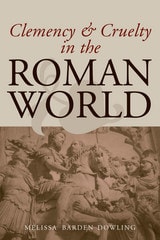
Clemency and Cruelty in the Roman World
Melissa Barden Dowling
University of Michigan Press, 2006
When the Roman democratic republic fell and the monarchical empire rose, a new vocabulary of power was needed to help balance the awesome abilities of the state to inflict harm and the need of its people for individual protection. In Clemency and Cruelty in the Roman World, Melissa Barden Dowling explores the formation of clemency as a human and social value in the Roman Empire, a topic that has been curiously neglected despite its obvious importance to our understanding of Roman society and the workings of the penal system.
In this first thorough study of the origins of clemency, Dowling provides a vivid look at the ideology of clemency and new philosophies of mercy and cruelty in Western society, through an examination of ancient art, literature, historical documents, and archaeological artifacts. By illuminating the emergence of mercy and forgiveness as social concepts, and the mechanisms by which peoples are transformed in response to changes in power structures, Dowling makes an important contribution to the study of the ancient Roman world, as well as to modern Western culture.
In this first thorough study of the origins of clemency, Dowling provides a vivid look at the ideology of clemency and new philosophies of mercy and cruelty in Western society, through an examination of ancient art, literature, historical documents, and archaeological artifacts. By illuminating the emergence of mercy and forgiveness as social concepts, and the mechanisms by which peoples are transformed in response to changes in power structures, Dowling makes an important contribution to the study of the ancient Roman world, as well as to modern Western culture.
[more]
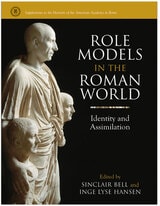
Role Models in the Roman World
Identity and AssimilationSinclair Bell and Inge Lyse Hansen, Editors
University of Michigan Press, 2008
The tendency of ancient Romans to look to mythical and historical figures for role models is everywhere evident in their surviving literary and material culture. This book broadens the horizon of the long-standing scholarly interest in role models in several ways, looking beyond the more familiar famous heroes---such as Achilles and Alexander the Great---and the paternal figures, both mythological and historical, that gave inspiration to later leaders and authors. From the adoption of specific aspects of a favored role model, to the creation of new visual languages for different social groups, to the deliberate counter of common models, this collection demonstrates the importance of exemplary figures in inspiring imitation and assimilation in the creation of new identities. Featuring world-renowned scholars and essays from a broad range of fields, including literature, art, and historiography, Role Models in the Roman World is a groundbreaking collection at the cusp of the newest scholarship of the classical world. "Role Models in the Roman World is an exciting collection, striking for the interdisciplinary range of its contributors and for their vigorous debates---indeed, strong disagreements---about ideas that are currently of fundamental importance in Roman studies: identity construction, exemplarity, memory, monumentality. In framing these crucial issues, and in displaying the range and diversity of current approaches to them, this collection will be useful to every student of the Roman world." ---Matthew Roller, Professor of Classics, Johns Hopkins University "This collection covers a full range of topics, from how the Romans interpreted their origins from the ashes of Troy on through themes in Roman literature, historiography, declamation, and art, ending with how Christians may have defined their self-presentation in part through reference to earlier, non-Christian models. The editors have shown themselves wonderfully adept at their task, and the result is a uniformly fine volume that will be widely consulted." ---Anthony Corbeill, Professor and Graduate Advisor, Department of Classics, University of Kansas "Significant essays by leading archaeologists, philologists, and art historians on a theme of central importance in the Roman world." ---Barbara Kellum, Professor and Chair, Department of Art, Smith College Jacket illustration: Side view of statue of Togato Barberini © Araldo de Luca/CORBIS
[more]
Staging Masculinity
The Rhetoric of Performance in the Roman WorldErik Gunderson
University of Michigan Press, 2000
Performance was one of the five canonical branches of oratory in the classical period, but it presents special problems that distinguish it from concerns such as composition and memory. The ancient performer was supposed to be a "good man" and his performance a manifestation of an authentic and authoritative manliness. But how can the orator be distinguished from a mere actor? And what is the proper role for the body, given that it is a potential object of desire?
Erik Gunderson explores these and other questions in ancient rhetorical theory using a variety of theoretical approaches, drawing in particular on the works of Judith Butler, Michel Foucault, and Jacques Lacan. His study examines the status of rhetorical theory qua theory, the production of a specific version of body in the course of its theoretical description, oratory as a form of self-mastery, the actor as the orator's despised double, the dangers of homoerotic pleasure, and Cicero's De Oratore, as what good theory and practice ought to look like.
Erik Gunderson is Assistant Professor of Greek and Latin, Ohio State University.
[more]
The Economy of Prostitution in the Roman World
A Study of Social History and the BrothelThomas A. J. McGinn
University of Michigan Press, 2004
In recent years, a number of classical scholars have turned their attention to prostitution in the ancient world. Close examination of the social and legal position of Roman meretrices and Greek hetairai have enriched our understanding of ancient sexual relationships and the status of women in these societies. These studies have focused, however, almost exclusively on the legal and literary evidence.
McGinn approaches the issues from a new direction, by studying the physical venues that existed for the sale of sex, in the context of the Roman economy. Combining textual and material evidence, he provides a detailed study of Roman brothels and other venues of venal sex (from imperial palaces and privates houses to taverns, circuses, and back alleys) focusing on their forms, functions, and urban locations.
The book covers the central period of Roman history, roughly from 200 B.C. to A.D. 250. It will especially interest social and legal historians of the ancient world, and students of gender, sexuality, and the family.
Thomas A. J. McGinn is Associate Professor of Classical Studies at Vanderbilt University.
[more]