Results by title
4 books match the query 'Romantics'
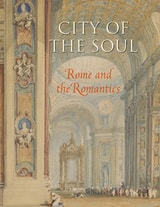
City of the Soul
Rome and the RomanticsJohn A. Pinto
University Press of New England, 2016
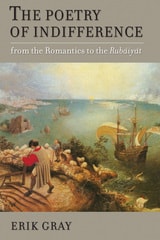
The Poetry of Indifference
From the Romantics to the RubaiyatErik Irving Gray
University of Massachusetts Press, 2005
of poetic indifference began to emerge.
The Poetry of Indifference analyzes nineteenth-century works by Wordsworth, Keats, Byron, Tennyson, Robert Browning, and Edward FitzGerald, among others—works that do not merely declare themselves to be indifferent but formally enact the indifference they describe. Each poem consciously disregards some aspect of poetry that is usually considered to be crucial or definitive, even at the risk of seeming "indifferent" in the sense of "mediocre." Such gestures discourage critical attention, since the poetry of indifference refuses to make claims for itself.
This is particularly true of FitzGerald's Rubáiyát, one of the most popular poems of the nineteenth century, but one that recent critics have almost entirely ignored. In concentrating on this underexplored mode of poetry, Gray not only traces a major shift in recent literary history, from a Romantic poetics of sympathy to a Modernist poetics of alienation, but also considers how this literature can help us understand the sometimes embarrassing but unavoidable presence of indifference in our lives.

Unruly Women
200 Years of Philosophers, Romantics, and RevolutionariesKristin Gjesdal
University of Chicago Press, 0
A vivid account of the powerful ideas and remarkable lives of eleven women philosophers across two centuries.
When you think of modern philosophers, who comes to mind? Likely, they are popular figures such as Kant, Hegel, Marx, and Nietzsche. But what if the history of philosophy we know is missing some of its most vital voices?
As Kristin Gjesdal shows us in Unruly Women, there is an abundance of important thinkers who were famous in their time, helped shape philosophy as we know it, and yet have been pushed into oblivion. She introduces eleven iconic women philosophers, from Germaine de Staël in Paris during the French Revolution to Angela Davis during the Black freedom movement in the US, whose ideas challenged and revolutionized the intellectual orthodoxies of their time. Moving across centuries, traditions, and political contexts, Unruly Women illustrates how the work of these philosophers engaged with questions that remain urgent now: What does freedom imply? How are power and inequality produced and sustained? What roles do gender, race, and class play in shaping our lives? And who gets to define what counts as knowledge, reason, and philosophy?
More than just an act of historical recovery, this book places these forgotten thinkers in conversation with one another, revealing a new history of philosophy—one shaped not only by abstract systems and canonical texts, but also by struggles over justice, emancipation, and political change. The result is a vibrant and accessible account of philosophy as something lived, contested, and deeply connected to the world around us—with unruly ideas that still matter today.
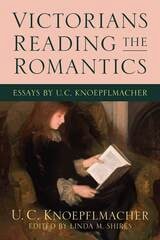
Victorians Reading the Romantics
Essays by U. C. KnoepflmacherEssays by U. C. Knoepflmacher, edited by Linda M. Shires
The Ohio State University Press, 2016
Victorians Reading the Romantics: Essays by U. C. Knoepflmacher, edited by LindaM. Shires, offers a compelling new perspective on the long and influential publishing career and thought of Knoepflmacher, a leading critic of the novel and Victorian poetry. This volume draws together essays on nineteenth-century literature written between 1963 and 2012.An introductory essay and new scaffolding emphasize the interrelations among the essays, which together form a consistent approach to literary criticism.
Knoepflmacher’s vision of texts and readersstressesthe emotional knowledge afforded by reading, writing about, and teaching literary texts.Each chapter links Romantic texts to those of later writers. Shelley and Keats try to revise Wordsworth, but they are themselves recast by Browning and Hardy. Similarly, George Eliot and Virginia Woolf’s reliance on Romantic tropes are fruitfully examined. Above all, however, these chapters stress the impact of Wordsworth on his many contemporaries and successors. Knoepflmacher probes into their texts to find, as Wordsworth did, a momentaryfusionof opposites.He posits a reader who is flexible—able to move in multiple directions by paying attention to spatial, verbal, and imagistic coordinates, across and down a page.Given the attention paid tothe translation of affect into thought,this collectionwillcontribute to Victorian studiesas well as enhance our understanding of the affective dynamics of nineteenth-century literature.