Results by title
20 books match the query 'Roosevelt, Franklin D. (Franklin Delano)'
A Quiet Victory for Latino Rights
FDR and the Controversy Over "Whiteness"Patrick D. Lukens
University of Arizona Press, 2012
In 1935 a federal court judge handed down a ruling that could have been disastrous for Mexicans, Mexican Americans, and all Latinos in the United States. However, in an unprecedented move, the Roosevelt administration wielded the power of "administrative law" to neutralize the decision and thereby dealt a severe blow to the nativist movement. A Quiet Victory for Latino Rights recounts this important but little-known story.
To the dismay of some nativist groups, the Immigration Act of 1924, which limited the number of immigrants who could be admitted annually, did not apply to immigrants from Latin America. In response to nativist legal maneuverings, the 1935 decision said that the act could be applied to Mexican immigrants. That decision, which ruled that the Mexican petitioners were not "free white person[s]," might have paved the road to segregation for all Latinos.
The League of United Latin American Citizens (LULAC), founded in 1929, had worked to sensitize the Roosevelt administration to the tenuous position of Latinos in the United States. Advised by LULAC, the Mexican government, and the US State Department, the administration used its authority under administrative law to have all Mexican immigrants—and Mexican Americans—classified as "white." It implemented the policy when the federal judiciary "acquiesced" to the New Deal, which in effect prevented further rulings.
In recounting this story, complete with colorful characters and unlikely bedfellows, Patrick D. Lukens adds a significant chapter to the racial history of the United States.
An Unplanned Life
A MemoirGeorge McKee Elsey
University of Missouri Press, 2005
Elsey’s duties continued with Harry Truman’s succession to the presidency. He decoded the famous message from Secretary of War Henry Stimson reporting the dropping of the atomic bomb on Hiroshima and carried it to President Truman. In 1947, he shed his Naval Reserve uniform and joined the White House’s civilian staff as assistant to the special counsel to the president. In 1949, he became administrative assistant to the president, and, in 1952, he became a member of the Mutual Security Agency staff. During those years, he grew very close to Harry Truman, and thus, a major portion of An Unplanned Life relates to his experiences then.
In the first postwar winter, Elsey was frequently the only staff member who accompanied President Truman on the USS Williamsburg. In September 1946, Elsey submitted a report to Truman on U.S.-Soviet relations, which came to be well known as the “Clifford-Elsey Report.” Providing Truman with notes for some two hundred of his “back-of-the-train” informal talks, Elsey played a part in the best remembered feature of the “Whistle-Stop Campaign” that resulted in “the political upset of the century.” In addition to his years at the White House, Elsey also touches on his post–White House years—his time in private industry, his months with Clark Clifford when Clifford was trying unsuccessfully to extricate America from Vietnam, and his long association with the American Red Cross.
An Unplanned Life is a fascinating look at the life of an extraordinary individual who played an important and unprecedented part in two different presidents’ decisions and affected the course of our nation. Anyone with an interest in history will find this memoir fascinating and invaluable.

F. D. R. and the Press
Graham J. White
University of Chicago Press, 1979
White challenges and disproves Roosevelt's contention that the press was unusually severe and slanted in its treatment of the Roosevelt years. His original work traces FDR's hostile assessment of the press to his own political philosophy: an ideology that ordained him a champion of the people, whose task it was to preserve American democracy against the recurring attempt by Hamiltonian minorities (newspaper publishers and captive reporters) to wrest control of their destiny from the masses.
White recounts Roosevelt's initial victory over the press corps, and the effect his wily manipulations had on press coverage of his administrations and on his own public image. He believes Roosevelt's denunciation of the press was less an accurate description of the press's behavior towards his administrations than a product of his own preconceptions about the nature of the Presidency. White concludes that Roosevelt's plan was to disarm those he saw as the foes of democracy by accusing them of unfairly maligning him.
FDR & Stalin
A Not So Grand Alliance, 1943–1945Amos Perlmutter
University of Missouri Press, 1993
Perlmutter's hard-hitting, revisionist history of Roosevelt's foreign policy explores FDR's not-so-grand alliance with the ruthless Soviet leader. As the first Western scholar granted access to key foreign ministry documents recently declassified in the former Soviet Union, Perlmutter provides a provocative portrait of a popular leader whose failure to comprehend Stalin's long-range goals had devastating results for the postwar world.
FDR and the Spanish Civil War
Neutrality and Commitment in the Struggle that Divided AmericaDominic Tierney
Duke University Press, 2007
Between 1936 and 1939, Roosevelt’s perceptions of the Spanish Civil War were transformed. Initially indifferent toward which side won, FDR became an increasingly committed supporter of the leftist government. He believed that German and Italian intervention in Spain was part of a broader program of fascist aggression, and he worried that the Spanish Civil War would inspire fascist revolutions in Latin America. In response, Roosevelt tried to send food to Spain as well as illegal covert aid to the Spanish government, and to mediate a compromise solution to the civil war. However unsuccessful these initiatives proved in the end, they represented an important stage in Roosevelt’s emerging strategy to aid democracy in Europe.
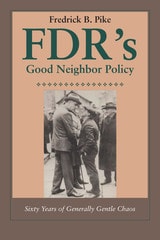
FDR's Good Neighbor Policy
Sixty Years of Generally Gentle ChaosBy Fredrick B. Pike
University of Texas Press, 1995
During the 1930s, the United States began to look more favorably on its southern neighbors. Latin America offered expanded markets to an economy crippled by the Great Depression, while threats of war abroad nurtured in many Americans isolationist tendencies and a desire for improved hemispheric relations.
One of these Americans was Franklin Delano Roosevelt, the primary author of America's Good Neighbor Policy. In this thought-provoking book, Fredrick Pike takes a wide-ranging look at FDR's motives for pursuing the Good Neighbor Policy, at how he implemented it, and at how its themes have played out up to the mid-1990s.
Pike's investigation goes far beyond standard studies of foreign and economic policy. He explores how FDR's personality and Eleanor Roosevelt's social activism made them uniquely simpático to Latin Americans. He also demonstrates how Latin culture flowed north to influence U.S. literature, film, and opera. The book will be essential reading for everyone interested in hemispheric relations.
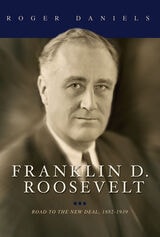
Franklin D. Roosevelt
Road to the New Deal, 1882-1939Roger Daniels
University of Illinois Press, 2015
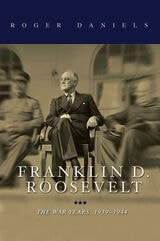
Franklin D. Roosevelt
The War Years, 1939-1945Roger Daniels
University of Illinois Press, 2016
History Is Embarrassing
Karen Chase
CavanKerry Press, 2024
Filled with profound reflections and snapshots from the past, Karen Chase’s History is Embarrassing weaves together threads from one single life—a girl suffering from polio, a poet, a Jewish woman, a writer, and a painter. Like Chase, the characters who populate these essays are outsiders—undercover cops, a gay couple in 1500s India, bear poachers, psychiatric patients, and even a president—each a meaningful part of history. Divided into three parts—histories, pleasures, and horrors—History is Embarrassing is an assortment of thought-provoking essays that are sure to resonate with many readers.
J. Edgar Hoover and the Anti-interventionists
FBI Political Surveillance and the Rise of the Domestic Security State, 1939–1945Douglas M. Charles
The Ohio State University Press, 2007
Liberalism and Leadership
The Irony of Arthur Schlesinger, Jr.Emile Lester
University of Michigan Press, 2019
Most scholars and pundits today view Franklin Delano Roosevelt and John F. Kennedy as aggressive liberal leaders, while viewing Schlesinger’s famous histories of their presidencies as celebrations of their steadfast progressive leadership. A more careful reading of Schlesinger’s work demonstrates that he preferred an ironic political outlook emphasizing the virtues of restraint, patience, and discipline. For Schlesinger, Roosevelt and Kennedy were liberal heroes and models as much because they respected the constraints on their power and ideals as because they tested traditional institutions and redefined the boundaries of presidential power.
Aggressive liberalism involves the use of inspirational rhetoric and cunning political tactics to expand civil liberties and insure economic equality. Schlesinger’s emphasis on the crucial role that irony has played and should play in liberalism poses a challenge to the aggressive liberalism advocated by liberal activists, political thinkers, and pundits. That his counsel was grounded in conservative insights as well as liberal values makes it accessible to leaders across the political spectrum.
Mr. Democrat
Jim Farley, the New Deal and the Making of Modern American PoliticsDaniel Scroop
University of Michigan Press, 2006
Mr. Democrat tells the story of Jim Farley, Franklin D. Roosevelt's campaign manager. As party boss, Farley experienced unprecedented success in the New Deal years. And like his modern counterpart Karl Rove, Farley enjoyed unparalleled access and power. Unlike Rove, however, Farley was instrumental in the creation of an overwhelming new majority in American politics, as the emergence of the New Deal transformed the political landscape of its time.
Mr. Democrat is timely and indispensable not just because Farley was a fascinating and unduly neglected figure, but also because an understanding of his career advances our knowledge of how and why he revolutionized the Democratic Party and American politics in the age of the New Deal.
Daniel Scroop is Lecturer in American History, University of Liverpool School of History.
New Deal Modernism
American Literature and the Invention of the Welfare StateMichael Szalay
Duke University Press, 2000
Szalay situates his study within a liberal culture bent on security, a culture galvanized by its imagined need for private and public insurance.
Taking up prominent exponents of social and economic security—such as Franklin Delano Roosevelt, John Maynard Keynes, and John Dewey—Szalay demonstrates how the New Deal’s revision of free-market culture required rethinking the political function of aesthetics. Focusing in particular on the modernist fascination with the relation between form and audience, Szalay offers innovative accounts of Busby Berkeley, Jack London, James M. Cain, Robert Frost, Ayn Rand, Betty Smith, and Gertrude Stein, as well as extended analyses of the works of Ernest Hemingway, John Steinbeck, and Richard Wright.
Political Vocabularies
FDR, the Clergy Letters, and the Elements of Political ArgumentMary E. Stuckey
Michigan State University Press, 2018
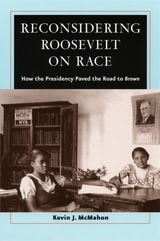
Reconsidering Roosevelt on Race
How the Presidency Paved the Road to BrownKevin J. McMahon
University of Chicago Press, 2003
McMahon shows how FDR's attempt to strengthen the presidency and undermine the power of conservative Southern Democrats dovetailed with his efforts to seek racial equality through the federal courts. By appointing a majority of rights-based liberals deferential to presidential power, Roosevelt ensured that the Supreme Court would be receptive to civil rights claims, especially when those claims had the support of the executive branch.
The Dying President
Franklin D. Roosevelt, 1944-1945Robert H. Ferrell
University of Missouri Press, 1998
In this authoritative account, Robert H. Ferrell shows how the treatment of President Franklin D. Roosevelt's illness in 1944- 1945 was managed by none other than the president himself. Although this powerful American president knew that he suffered from cardiovascular disease, he went to great lengths to hide that fact—both from his physician and from the public. Why Roosevelt disguised the nature of his illness may be impossible to discern fully. He was a secretive man who liked to assign only parts of tasks to his assistants so that he, the president, would be the only one who knew the whole story. The presidency was his life, and he did not wish to give it up.
The president's duplicity, though not easily measurable, had a critical effect on his performance. Placed on a four-hour-a-day schedule by his physicians, Roosevelt could apply very little time to his presidential duties. He took long vacations in South Carolina, Warm Springs, the Catoctin Mountains, and Hyde Park, as well as lengthy journeys to Hawaii, Canada, and Yalta. Important decisions were delayed or poorly made. America's policy toward Germany was temporarily abandoned in favor of the so-called Morgenthau Plan, which proposed the "pastoralization" of Germany, turning the industrial heart of Europe into farmland. Roosevelt nearly ruined the choice of Senator Harry S. Truman as his running mate in 1944 by wavering in the days prior to the party's national convention. He negotiated an agreement with Winston Churchill on sharing postwar development of nuclear weapons but failed to let the State Department know. And, in perhaps the most profoundly unwise decision, Roosevelt accepted a fourth term when he could not possibly survive it.
In his final year, a year in which he faced crucial responsibility regarding World War II and American foreign policy, Franklin D. Roosevelt failed to serve the nation as a healthy president would have. Reading like a mystery story, The Dying President clears up many of the myths and misunderstandings that have surrounded Roosevelt's last year, finally revealing the truth about this missing chapter in FDR's life.
The Good Neighbor
Franklin D. Roosevelt and the Rhetoric of American PowerMary E. Stuckey
Michigan State University Press, 2013
No modern president has had as much influence on American national politics as Franklin D. Roosevelt. During FDR’s administration, power shifted from states and localities to the federal government; within the federal government it shifted from Congress to the president; and internationally, it moved from Europe to the United States. All of these changes required significant effort on the part of the president, who triumphed over fierce opposition and succeeded in remaking the American political system in ways that continue to shape our politics today. Using the metaphor of the good neighbor, Mary E. Stuckey examines the persuasive work that took place to authorize these changes. Through the metaphor, FDR’s administration can be better understood: his emphasis on communal values; the importance of national mobilization in domestic as well as foreign affairs in defense of those values; his use of what he considered a particularly democratic approach to public communication; his treatment of friends and his delineation of enemies; and finally, the ways in which he used this rhetoric to broaden his neighborhood from the limits of the United States to encompass the entire world, laying the groundwork for American ideological dominance in the post–World War II era.
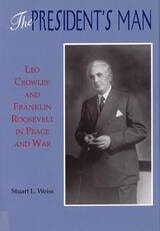
The President's Man
Leo Crowley and Franklin Roosevelt in Peace and WarStuart L. Weiss
Southern Illinois University Press, 1996
Leo Crowley has been known only as the administrator condemned by President Truman for cutting off Soviet lend-lease after V-E Day. Stuart L. Weiss revises this view while exploring Crowley’s long, significant state and federal career, emphasizing his service as Franklin D. Roosevelt’s man for all seasons.
Weiss deals effectively with Crowley’s flaws and virtues as well as those of the administrations he served. Crowley was confirmed as chair of the FDIC in 1934 despite a charge, unknown to President Roosevelt, that Crowley had committed fraud as a banker in Wisconsin. Crowley then served with distinction for more than eleven years as the administration twice buried a 1935 Treasury Department report that, had it been handed to Wisconsin authorities, could have sent him to prison: Roosevelt valued Crowley’s political and administrative talents too highly to allow that to happen.
In 1939, Roosevelt, anxious to have business support for stopping the Axis powers, encouraged Crowley to take the chair of a holding company about to be prosecuted by the SEC. After Pearl Harbor, like priorities prompted the president first to name Crowley alien property custodian, then chair of the Board of Economic Warfare to supplant Roosevelt’s politically troublesome vice president, and, finally, foreign economic administrator, the person responsible for civilian lend-lease activity
In this vibrant biography, Weiss furnishes the reader with detailed portraits of a man faithful to his president even when he disagreed with him and of a president willing to do what he felt was necessary for the good of the country.
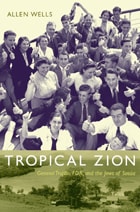
Tropical Zion
General Trujillo, FDR, and the Jews of SosúaAllen Wells
Duke University Press, 2009
Why did a dictator admit these desperate refugees when so few nations would accept those fleeing fascism? Eager to mollify international critics after his army had massacred 15,000 unarmed Haitians, Trujillo sent representatives to Évian, France, in July, 1938 for a conference on refugees from Nazism. Proposed by FDR to deflect criticism from his administration’s restrictive immigration policies, the Évian Conference proved an abject failure. The Dominican Republic was the only nation that agreed to open its doors. Obsessed with stemming the tide of Haitian migration across his nation’s border, the opportunistic Trujillo sought to “whiten” the Dominican populace, welcoming Jewish refugees who were themselves subject to racist scorn in Europe.
The Roosevelt administration sanctioned the Sosúa colony. Since the United States did not accept Jewish refugees in significant numbers, it encouraged Latin America to do so. That prodding, paired with FDR’s overriding preoccupation with fighting fascism, strengthened U.S. relations with Latin American dictatorships for decades to come. Meanwhile, as Jewish organizations worked to get Jews out of Europe, discussions about the fate of worldwide Jewry exposed fault lines between Zionists and Non-Zionists. Throughout his discussion of these broad dynamics, Wells weaves vivid narratives about the founding of Sosúa, the original settlers and their families, and the life of the unconventional beach-front colony.
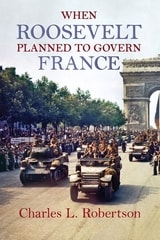
When Roosevelt Planned to Govern France
Charles L. Robertson
University of Massachusetts Press, 2011
This book tells the story of a plan put forth by President Franklin Roosevelt during World War II for an Allied military occupation of France in the aftermath of liberation, and of General Charles de Gaulle's efforts as self-appointed leader of the Free French Movement to thwart FDR's intentions. Charles L. Robertson frames the narrative as a mystery in which he plays the role of detective. He begins at a dinner party thirty years ago, where he first learned of the alleged plan from an elderly former aide to de Gaulle. Yet it wasn't until 2004, when he heard the same story repeated during the 60th commemoration of D-Day, that he set out to investigate whether it was true.
Many French are aware of this episode and believe, on the basis of later Gaullist officials' writings, that until the last moment a military occupation of their country was imminent. This view, across the years, has helped darken relations between France and the United States. Yet few if any Americans have ever heard of this plan, and in the event, no Allied military government of France was ever established.
How and why it never came to be, and why the French still believe it almost did, is the subject of this book. Robertson recounts how the president of the most powerful nation in the world was outmaneuvered in both his earlier plans for an occupation of France and his subsequent attempts to keep General de Gaulle from “seizing” power—in a France that ultimately, despite Roosevelt's intentions and expectations, regained its place among the victorious powers under de Gaulle's leadership.