Results by title
2 books match the query 'Roskies, David G.'
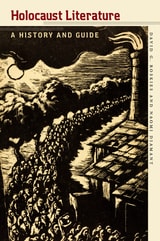
Holocaust Literature
A History and GuideDavid G. Roskies and Naomi Diamant
Brandeis University Press, 2013
What is Holocaust literature? When does it begin and how is it changing? Is there an essential core that consists of diaries, eyewitness accounts of the concentration camps, and tales of individual survival? Is it the same everywhere: West and East, in Australia as in the Americas, in poetry as in prose? Is this literature sacred and separate, or can it be studied alongside other responses to catastrophe? What works of Holocaust literature will be read a hundred years from now—and why? Here, for the first time, is a historical survey of Holocaust literature in all genres, countries, and major languages. Beginning in wartime, it proceeds from the literature of mobilization and mourning in the Free World to the vast literature produced in Nazi-occupied ghettos, bunkers and places of hiding, transit and concentration camps. No less remarkable is the new memorial literature that begins to take shape within weeks and months of the liberation. Moving from Europe to Israel, the United States, and beyond, the authors situate the writings by real and proxy witnesses within three distinct postwar periods: “communal memory,” still internal and internecine; “provisional memory” in the 1960s and 1970s, when a self-conscious Holocaust genre is born; and “authorized memory,” in which we live today. Twenty book covers—first editions in their original languages—and a guide to the “first hundred books” show the multilingual scope, historical depth, and artistic range of this extraordinary body of writing.
[more]
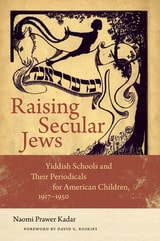
Raising Secular Jews
Yiddish Schools and Their Periodicals for American Children, 1917–1950Naomi Prawer Kadar
Brandeis University Press, 2016
This unique literary study of Yiddish children’s periodicals casts new light on secular Yiddish schools in America in the first half of the twentieth century. Rejecting the traditional religious education of the Talmud Torahs and congregational schools, these Yiddish schools chose Yiddish itself as the primary conduit of Jewish identity and culture. Four Yiddish school networks emerged, which despite their political and ideological differences were all committed to propagating the Yiddish language, supporting social justice, and preparing their students for participation in both Jewish and American culture. Focusing on the Yiddish children’s periodicals produced by the Labor Zionist Farband, the secular Sholem Aleichem schools, the socialist Workmen’s Circle, and the Ordn schools of the Communist-aligned International Workers Order, Naomi Kadar shows how secular immigrant Jews sought to pass on their identity and values as they prepared their youth to become full-fledged Americans.
[more]