Results by title
3 books match the query 'Rowland, Ingrid D.'
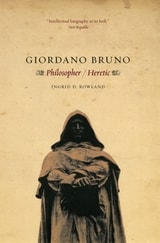
Giordano Bruno
Philosopher / HereticIngrid D. Rowland
University of Chicago Press, 2009
Giordano Bruno (1548–1600) is one of the great figures of early modern Europe, and one of the least understood. Ingrid D. Rowland’s biography establishes him once and for all as a peer of Erasmus, Shakespeare, and Galileo—a thinker whose vision of the world prefigures ours.
Writing with great verve and erudition, Rowland traces Bruno’s wanderings through a sixteenth-century Europe where every certainty of religion and philosophy has been called into question, and reveals how he valiantly defended his ideas to the very end, when he was burned at the stake as a heretic on Rome’s Campo de’ Fiori.
“A loving and thoughtful account of [Bruno’s] life and thought, satires and sonnets, dialogues and lesson plans, vagabond days and star-spangled nights. . . . Ingrid D. Rowland has her reasons for preferring Bruno to Copernicus, Tycho Brahe, Johannes Kepler, even Galileo and Leonardo, and they’re good ones.”—John Leonard, Harper’s
“Whatever else Bruno was, he was wild-minded and extreme, and Rowland communicates this, together with a sense of the excitement that his ideas gave him. . . . It’s that feeling for the explosiveness of the period, and [Rowland’s] admiration of Bruno for participating in it—indeed, dying for it—that is the central and most cherishable quality of the biography.”—Joan Acocella, New Yorker
“Rowland tells this great story in moving, vivid prose, concentrating as much on Bruno’s thought as on his life. . . . His restless mind, as she makes clear, not only explored but transformed the heavens.”—Anthony Grafton, New York Review of Books
“[Bruno] seems to have been an unclassifiable mixture of foul-mouthed Neapolitan mountebank, loquacious poet, religious reformer, scholastic philosopher, and slightly wacky astronomer.”—Anthony Gottlieb, New York Times Book Review
“A marvelous feat of scholarship. . . . This is intellectual biography at its best.”—Peter N. Miller, New Republic
“An excellent starting point for anyone who wants to rediscover the historical figure concealed beneath the cowl on Campo de’ Fiori.”—Paula Findlen, Nation
The Divine Spark of Syracuse
Ingrid D. Rowland
Brandeis University Press, 2018
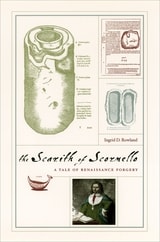
The Scarith of Scornello
A Tale of Renaissance ForgeryIngrid D. Rowland
University of Chicago Press, 2004
As recounted here with relish by Ingrid D. Rowland, Curzio preyed on the Italian fixation with ancestry to forge an array of ancient Latin and Etruscan documents. For authenticity's sake, he stashed the counterfeit treasure in scarith (capsules made of hair and mud) near Scornello. To the seventeenth-century Tuscans who were so eager to establish proof of their heritage and history, the scarith symbolized a link to the prestigious culture of their past. But because none of these proud Italians could actually read the ancient Etruscan language, they couldn't know for certain that the documents were frauds. The Scarith of Scornello traces the career of this young scam artist whose "discoveries" reached the Vatican shortly after Galileo was condemned by the Inquisition, inspiring participants on both sides of the affair to clash again—this time over Etruscan history.
An expert on the Italian Renaissance and one of only a few people in the world to work with the Etruscan language, Rowland writes a tale so enchanting it seems it could only be fiction. In her investigation of this seventeenth-century caper, Rowland will captivate readers with her sense of humor and obvious delight in Curzio's far-reaching prank. And even long after the inauthenticity of Curzio's creation had been established, this practical joke endured: the scarith were stolen in the 1980s by a thief who mistook them for the real thing.