Results by title
2 books match the query 'Rowson, Mrs.'
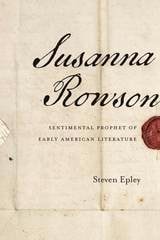
Susanna Rowson
Sentimental Prophet of Early American LiteratureSteven Epley
Northwestern University Press, 2016
Susanna Rowson: Sentimental Prophet of Early American Literature opens the early American writer’s works to new, provocative interpretations based on the theory that her responses to social issues incorporate notions of righteousness, justice, accountability, and loyalty drawn from prophets in the Hebrew Bible. Steven Epley argues that Rowson’s sentimentalism—a literary mode that portrays characters undergoing strong emotions and evokes similar responses from readers—reflects the rhetorical style of the Bible’s first prophet, Moses, and its understanding of the “heart” not just as a metaphor for human kindness and tenderness but also as a source of wickedness. Epley relocates the widespread introduction of Jewish values into American discourse from the height of Jewish immigration (roughly 1890 to 1940) to the early republic, given Rowson’s vast audience and influence on American letters. Her novel Charlotte Temple outsold every other American work of fiction until Harriet Beecher Stowe’s Uncle Tom’s Cabin in the 1850s.
[more]
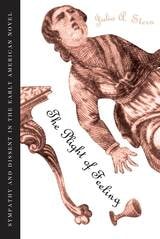
The Plight of Feeling
Sympathy and Dissent in the Early American NovelJulia A. Stern
University of Chicago Press, 1997
American novels written in the wake of the Revolution overflow with self-conscious theatricality and impassioned excess. In The Plight of Feeling, Julia A. Stern shows that these sentimental, melodramatic, and gothic works can be read as an emotional history of the early republic, reflecting the hate, anger, fear, and grief that tormented the Federalist era.
Stern argues that these novels gave voice to a collective mourning over the violence of the Revolution and the foreclosure of liberty for the nation's noncitizens—women, the poor, Native and African Americans. Properly placed in the context of late eighteenth-century thought, the republican novel emerges as essentially political, offering its audience gothic and feminized counternarratives to read against the dominant male-authored accounts of national legitimation.
Drawing upon insights from cultural history and gender studies as well as psychoanalytic, narrative, and genre theory, Stern convincingly exposes the foundation of the republic as an unquiet crypt housing those invisible Americans who contributed to its construction.
[more]