Results by title
2 books match the query 'Royal Navy'

Bombast And Broadsides
The Lives of George JohnstoneRobin F. A. Fabel
University of Alabama Press, 1987
Presents the first coherent picture of George Johnstone, a controversial naval commander and governor of West Florida
George Johnstone has never received the scholarly attention he fully merits. Historians have assessed him, usually briefly, as governor of West Florida, or as naval commander, or as a member of parliament. Nevertheless, none has considered his important role in East India Company politics, nor, until Bombast and Broadsides, has one synthesized the various roles in which Johnstone was entrusted with high responsibilities.
Through research in Cardiff, Edinburgh, Kew, London, Philadelphia, and Washington in largely unpublished manuscripts, together with the use of secondary sources, the author has been able to present the first coherent picture of Johnstone, a vigorous and intelligent but turbulent and always controversial figure. Johnstone was effective as a colonial governor at a difficult time; in the navy he performed several coups de main; in parliament he was formidable in debate but an opportunist; and at East India House he was a doughty, conservative, and largely successful defender of the proprietary interest.
[more]
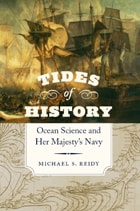
Tides of History
Ocean Science and Her Majesty's NavyMichael S. Reidy
University of Chicago Press, 2008
In the first half of the nineteenth century, the British sought to master the physical properties of the oceans; in the second half, they lorded over large portions of the oceans’ outer rim. The dominance of Her Majesty’s navy was due in no small part to collaboration between the British Admiralty, the maritime community, and the scientific elite. Together, they transformed the vast emptiness of the ocean into an ordered and bounded grid. In the process, the modern scientist emerged. Science itself expanded from a limited and local undertaking receiving parsimonious state support to worldwide and relatively well financed research involving a hierarchy of practitioners.
Analyzing the economic, political, social, and scientific changes on which the British sailed to power, Tides of History shows how the British Admiralty collaborated closely not only with scholars, such as William Whewell, but also with the maritime community —sailors, local tide table makers, dockyard officials, and harbormasters—in order to systematize knowledge of the world’s oceans, coasts, ports, and estuaries. As Michael S. Reidy points out, Britain’s security and prosperity as a maritime nation depended on its ability to maneuver through the oceans and dominate coasts and channels. The practice of science and the rise of the scientist became inextricably linked to the process of European expansion.
Analyzing the economic, political, social, and scientific changes on which the British sailed to power, Tides of History shows how the British Admiralty collaborated closely not only with scholars, such as William Whewell, but also with the maritime community —sailors, local tide table makers, dockyard officials, and harbormasters—in order to systematize knowledge of the world’s oceans, coasts, ports, and estuaries. As Michael S. Reidy points out, Britain’s security and prosperity as a maritime nation depended on its ability to maneuver through the oceans and dominate coasts and channels. The practice of science and the rise of the scientist became inextricably linked to the process of European expansion.
[more]