Results by title
6 books match the query 'Rugeley, Terry'
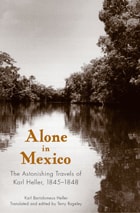
Alone in Mexico
The Astonishing Travels of Karl Heller, 1845–1848Karl Bartolomeus Heller, and translated and edited by Terry Rugeley
University of Alabama Press, 2007
This volume is the first-ever English translation of the memoirs of Karl Heller, a twenty-year-old aspiring Austrian botanist who traveled to Mexico in 1845 to collect specimens. He passed through the Caribbean, lived for a time in the mountains of Veracruz, and journeyed to Mexico City through the cities of Puebla and Cholula. After a brief residence in the capital, Heller moved westward to examine the volcanoes and silver mines near Toluca. When the United States invaded Mexico in 1846–47 conditions became chaotic, and the enterprising botanist was forced to flee to Yucatán. Heller lived in the port city of Campeche, but visited Mèrida, the ruins of Uxmal, and the remote southern area of the Champotòn River. From there Heller, traveling by canoe, journeyed through southern Tabasco and northern Chiapas and finally returned to Vienna through Cuba and the United States bringing back thousands of samples of Mexican plants and animals.
Heller's account is one of the few documents we have from travelers who visited Mexico in this period, and it is particularly useful in describing conditions outside the capital of Mexico City. In 1853 Heller published his German-language account as Reisen in Mexiko, but the work has remained virtually unknown to English or Spanish readers. This edition now provides a complete, annotated, and highly readable translation.
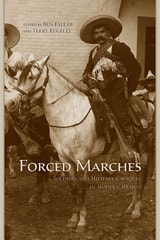
Forced Marches
Soldiers and Military Caciques in Modern MexicoEdited by Ben Fallaw and Terry Rugeley
University of Arizona Press, 2012
When Mexico first became a nation, its military and militias were two of the country’s few major institutions besides the Catholic Church. The army and local provincial militias functioned both as political pillars, providing institutional stability of a crude sort, and as springboards for the ambitions of individual officers. Military service provided upward social mobility, and it taught a variety of useful skills, such as mathematics and bookkeeping.
In the postcolonial era, however, militia units devoured state budgets, spending most of the national revenue and encouraging locales to incur debts to support them. Men with rifles provided the principal means for maintaining law and order, but they also constituted a breeding-ground for rowdiness and discontent. As these chapters make clear, understanding the history of state-making in Mexico requires coming to terms with its military past.
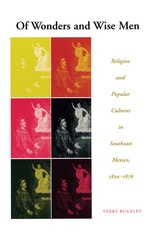
Of Wonders and Wise Men
Religion and Popular Cultures in Southeast Mexico, 1800-1876By Terry Rugeley
University of Texas Press, 2001
2004 – Harvey L. Johnson Award – Southwest Council of Latin American Studies
In the tumultuous decades following Mexico's independence from Spain, religion provided a unifying force among the Mexican people, who otherwise varied greatly in ethnicity and socioeconomic status. Accordingly, religion and the popular cultures surrounding it form the lens through which Terry Rugeley focuses this cultural history of southeast Mexico from independence (1821) to the rise of the dictator Porfirio Díaz in 1876.
Drawing on a wealth of previously unused archival material, Rugeley vividly reconstructs the folklore, beliefs, attitudes, and cultural practices of the Maya and Hispanic peoples of the Yucatán. In engagingly written chapters, he explores folklore and folk wisdom, urban piety, iconography, and anticlericalism. Interspersed among the chapters are detailed portraits of individual people, places, and institutions, that, with the archival evidence, offer a full and fascinating history of the outlooks, entertainments, and daily lives of the inhabitants of southeast Mexico in the nineteenth century. Rugeley also links this rich local history with larger events to show how macro changes in Mexico affected ordinary people.
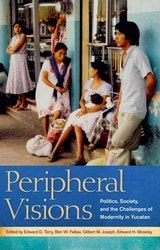
Peripheral Visions
Politics, Society, and the Challenges of Modernity in YucatanEdward D. Terry
University of Alabama Press, 2010
The essays in this collection illuminate both the processes of change and the negative reactions that they frequently elicited
Yucatan has been called “a world apart”—cut off from the rest of Mexico by geography and culture. Yet, despite its peripheral location, the region experienced substantial change in the decades after independence. As elsewhere in Mexico, apostles of modernization introduced policies intended to remold Yucatan in the image of the advanced nations of the day. Indeed, modernizing change began in the late colonial era and continued throughout the 19th century as traditional patterns of land tenure were altered and efforts were made to divest the Catholic Church of its wealth and political and intellectual influence. Some changes, however, produced fierce resistance from both elites and humbler Yucatecans and modernizers were frequently forced to retreat or at least reach accommodation with their foes.
Covering topics from the early 19th century to the late 20th century, the essays in this collection illuminate both the processes of change and the negative reactions that they frequently elicited. The diversity of disciplines covered by this volume—history, anthropology, sociology, economics—illuminates at least three overriding challenges for study of the peninsula today. One is politics after the decline of the Institutional Revolutionary Party: What are the important institutions, practices, and discourses of politics in a post-postrevolutionary era? A second trend is the scholarly demystification of the Maya: Anthropologists have shown the difficulties of applying monolithic terms like Maya in a society where ethnic relations are often situational and ethnic boundaries are fluid. And a third consideration: researchers are only now beginning to grapple with the region’s transition to a post-henequen economy based on tourism, migration, and the assembly plants known as maquiladoras. Challenges from agribusiness and industry will no doubt continue to affect the peninsula’s fragile Karst topography and unique environments.
Contributors: Eric N. Baklanoff, Helen Delpar, Paul K. Eiss, Ben W. Fallaw, Gilbert M. Joseph, Marie Lapointe, Othón Baños Ramírez, Hernán Menéndez Rodríguez, Lynda S. Morrison, Terry Rugeley, Stephanie J. Smith
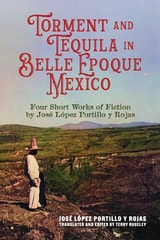
Torment and Tequila in Belle Epoque Mexico
Four Short Works of Fiction by José López Portillo y RojasJosé López Portillo y Rojas, translated and edited by Terry Rugeley
University of Alabama Press, 2025
This captivating collection of translated short works by José López Portillo y Rojas, one of Mexico’s most significant literary figures, explores themes of social frustration, loss, and heartache in late-nineteenth-century Mexico.
Torment and Tequila in Belle Epoque Mexico is the first English-language collection of selected fiction by the influential Mexican author and political figure José López Portillo y Rojas (1850–1923). His distinguished career spanned the late nineteenth century to the tumultuous years of the Mexican Revolution.
López Portillo y Rojas’s prose is characterized by rich vocabulary and fluid progression, offering readers moments of deep reflection. The stories boast finely drawn characters and evocative settings, including that of the author’s native Jalisco. He adeptly addresses the grand issues of Porfirian times, seamlessly blending social and personal themes of suffering, ambition, desire, and betrayal, and anchors his stories in the realities of human experience.
Three masterfully translated short stories and one novella make up the collection, beginning with “The Lottery Ticket,” a critique of social hypocrisy that follows a dreamer whose fortunes slip through his fingers at the hands of his own family. “The Mirror” explores the eerie depths of grief and guilt, echoing the gothic brilliance of Edgar Allan Poe. “Nieves” is a gripping novella of love and power in which a young woman’s fate becomes entangled in a decaying estate and a brewing rebellion. “The Bracelet,” examines the tragic weight of the past, as a locked piece of jewelry seals the fate of an engaged couple. These translations offer an unforgettable glimpse into one of Mexico’s most brilliant minds and restore López Portillo y Rojas to his rightful place in Mexican literary history.
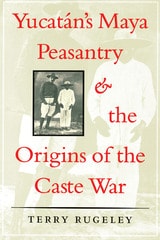
Yucatán's Maya Peasantry and the Origins of the Caste War
By Terry Rugeley
University of Texas Press, 1996
Conflicts between native Maya peoples and European-derived governments have punctuated Mexican history from the Conquest in the sixteenth century to the current Zapatista uprising in Chiapas. In this deeply researched study, Terry Rugeley delves into the 1800-1847 origins of the Caste War, the largest and most successful of these peasant rebellions.
Rugeley refutes earlier studies that seek to explain the Caste War in terms of a single issue. Instead, he explores the interactions of several major social forces, including the church, the hacienda, and peasant villagers. He uncovers a complex web of issues that led to the outbreak of war, including the loss of communal lands, substandard living conditions, the counterpoise of Catholicism versus traditional Maya beliefs, and an increasingly heavy tax burden.
Drawn from a wealth of primary documents, this book represents the first real attempt to reconstruct the history of the pre-Caste War period. In addition to its obvious importance for Mexican history, it will be illuminating background reading for everyone seeking to understand the ongoing conflict in Chiapas.