Results by title
4 books match the query 'Ruins, Modern'
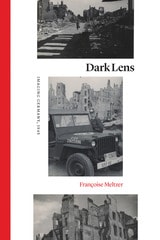
Dark Lens
Imaging Germany, 1945Françoise Meltzer
University of Chicago Press, 2019
The ruins of war have long held the power to stupefy and appall. Can such ruins ever be persuasively depicted and comprehended? Can images of ruins force us to identify with the suffering of the enemy and raise uncomfortable questions about forgiveness and revenge?
Françoise Meltzer explores these questions in Dark Lens, which uses the images of war ruins in Nazi Germany to investigate problems of aestheticization and the representation of catastrophe. Through texts that give accounts of bombed-out towns in Germany in the last years of the war, painters’ attempts to depict the destruction, and her own mother’s photographs taken in 1945, Meltzer asks if any medium offers a direct experience of war ruins for the viewer. Refreshingly accessible and deeply personal, Dark Lens is a compelling look at the role images play in constructing memory.
Rubble
The Afterlife of DestructionGastón R. Gordillo
Duke University Press, 2014
Ruins of Modernity
Julia Hell and Andreas Schönle, eds.
Duke University Press, 2009
Several contributors discuss ideas about ruins developed by philosophers such as Immanuel Kant, Georg Simmel, and Walter Benjamin. One contributor examines how W. G. Sebald’s novel The Rings of Saturn betrays the ruins erased or forgotten in the Hegelian philosophy of history. Another analyzes the repressed specter of being bombed out of existence that underpins post-Second World War modernist architecture, especially Le Corbusier’s plans for Paris. Still another compares the ways that formerly dominant white populations relate to urban-industrial ruins in Detroit and to colonial ruins in Namibia. Other topics include atomic ruins at a Nevada test site, the connection between the cinema and ruins, the various narratives that have accrued around the Inca ruin of Vilcashuamán, Tolstoy’s response in War and Peace to the destruction of Moscow in the fire of 1812, the Nazis’ obsession with imperial ruins, and the emergence in Mumbai of a new “kinetic city” on what some might consider the ruins of a modernist city. By focusing on the concept of ruin, this collection sheds new light on modernity and its vast ramifications and complexities.
Contributors. Kerstin Barndt, Jon Beasley-Murray, Russell A. Berman, Jonathan Bolton, Svetlana Boym, Amir Eshel, Julia Hell, Daniel Herwitz, Andreas Huyssen, Rahul Mehrotra, Johannes von Moltke, Vladimir Paperny, Helen Petrovsky, Todd Presner, Helmut Puff, Alexander Regier, Eric Rentschler, Lucia Saks, Andreas Schönle, Tatiana Smoliarova, George Steinmetz, Jonathan Veitch, Gustavo Verdesio, Anthony Vidler
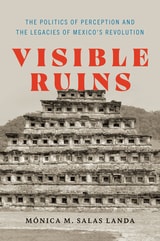
Visible Ruins
The Politics of Perception and the Legacies of Mexico's RevolutionMónica M. Salas Landa
University of Texas Press, 2024
2026 Honorable Mention, Mejor Libro, Historia Reciente y Memoria Section of the Latin American Studies Association
An examination of the failures of the Mexican Revolution through the visual and material records.
The Mexican Revolution (1910–1920) introduced a series of state-led initiatives promising modernity, progress, national grandeur, and stability; state surveyors assessed land for agrarian reform, engineers used nationalized oil for industrialization, archaeologists reconstructed pre-Hispanic monuments for tourism, and anthropologists studied and photographed Indigenous populations to achieve their acculturation. Far from accomplishing their stated goals, however, these initiatives concealed violence, and permitted land invasions, forced displacement, environmental damage, loss of democratic freedom, and mass killings. Mónica M. Salas Landa uses the history of northern Veracruz to demonstrate how these state-led efforts reshaped the region's social and material landscapes, affecting what was and is visible. Relying on archival sources and ethnography, she uncovers a visual order of ongoing significance that was established through postrevolutionary projects and that perpetuates inequality based on imperceptibility.