Results by title
4 books match the query 'Ruins in literature'
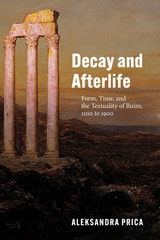
Decay and Afterlife
Form, Time, and the Textuality of Ruins, 1100 to 1900Aleksandra Prica
University of Chicago Press, 2022
Western ruins have long been understood as objects riddled with temporal contradictions, whether they appear in baroque poetry and drama, Romanticism’s nostalgic view of history, eighteenth-century paintings of classical subjects, or even recent photographic histories of the ruins of postindustrial Detroit. Decay and Afterlife pivots away from our immediate, visual fascination with ruins, focusing instead on the textuality of ruins in works about disintegration and survival. Combining an impressive array of literary, philosophical, and historiographical works both canonical and neglected, and encompassing Latin, Italian, French, German, and English sources, Aleksandra Prica addresses ruins as textual forms, examining them in their extraordinary geographical and temporal breadth, highlighting their variability and reflexivity, and uncovering new lines of aesthetic and intellectual affinity. Through close readings, she traverses eight hundred years of intellectual and literary history, from Seneca and Petrarch to Hegel, Goethe, and Georg Simmel. She tracks European discourses on ruins as they metamorphose over time, identifying surprising resemblances and resonances, ignored contrasts and tensions, as well as the shared apprehensions and ideas that come to light in the excavation of these discourses.
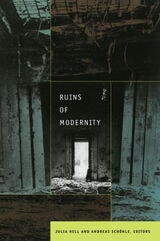
Ruins of Modernity
Julia Hell and Andreas Schönle, eds.
Duke University Press, 2009
Several contributors discuss ideas about ruins developed by philosophers such as Immanuel Kant, Georg Simmel, and Walter Benjamin. One contributor examines how W. G. Sebald’s novel The Rings of Saturn betrays the ruins erased or forgotten in the Hegelian philosophy of history. Another analyzes the repressed specter of being bombed out of existence that underpins post-Second World War modernist architecture, especially Le Corbusier’s plans for Paris. Still another compares the ways that formerly dominant white populations relate to urban-industrial ruins in Detroit and to colonial ruins in Namibia. Other topics include atomic ruins at a Nevada test site, the connection between the cinema and ruins, the various narratives that have accrued around the Inca ruin of Vilcashuamán, Tolstoy’s response in War and Peace to the destruction of Moscow in the fire of 1812, the Nazis’ obsession with imperial ruins, and the emergence in Mumbai of a new “kinetic city” on what some might consider the ruins of a modernist city. By focusing on the concept of ruin, this collection sheds new light on modernity and its vast ramifications and complexities.
Contributors. Kerstin Barndt, Jon Beasley-Murray, Russell A. Berman, Jonathan Bolton, Svetlana Boym, Amir Eshel, Julia Hell, Daniel Herwitz, Andreas Huyssen, Rahul Mehrotra, Johannes von Moltke, Vladimir Paperny, Helen Petrovsky, Todd Presner, Helmut Puff, Alexander Regier, Eric Rentschler, Lucia Saks, Andreas Schönle, Tatiana Smoliarova, George Steinmetz, Jonathan Veitch, Gustavo Verdesio, Anthony Vidler
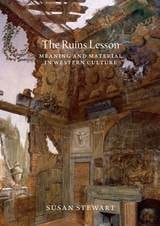
The Ruins Lesson
Meaning and Material in Western CultureSusan Stewart
University of Chicago Press, 2019
Stewart takes us on a sweeping journey through founding legends of broken covenants and original sin, the Christian appropriation of the classical past, and images of decay in early modern allegory. Stewart looks in depth at the works of Goethe, Piranesi, Blake, and Wordsworth, each of whom found in ruins a means of reinventing his art. Lively and engaging, The Ruins Lesson ultimately asks what can resist ruination—and finds in the self-transforming, ever-fleeting practices of language and thought a clue to what might truly endure.
Untimely Ruins
An Archaeology of American Urban Modernity, 1819-1919Nick Yablon
University of Chicago Press, 2009
American ruins have become increasingly prominent, whether in discussions of “urban blight” and home foreclosures, in commemorations of 9/11, or in postapocalyptic movies. In this highly original book, Nick Yablon argues that the association between American cities and ruins dates back to a much earlier period in the nation’s history. Recovering numerous scenes of urban desolation—from failed banks, abandoned towns, and dilapidated tenements to the crumbling skyscrapers and bridges envisioned in science fiction and cartoons—Untimely Ruins challenges the myth that ruins were absent or insignificant objects in nineteenth-century America.
The first book to document an American cult of the ruin, Untimely Ruins traces its deviations as well as derivations from European conventions. Unlike classical and Gothic ruins, which decayed gracefully over centuries and inspired philosophical meditations about the fate of civilizations, America’s ruins were often “untimely,” appearing unpredictably and disappearing before they could accrue an aura of age. As modern ruins of steel and iron, they stimulated critical reflections about contemporary cities, and the unfamiliar kinds of experience they enabled. Unearthing evocative sources everywhere from the archives of amateur photographers to the contents of time-capsules, Untimely Ruins exposes crucial debates about the economic, technological, and cultural transformations known as urban modernity. The result is a fascinating cultural history that uncovers fresh perspectives on the American city.