Results by title
3 books match the query 'Runyon, Randolph Paul'
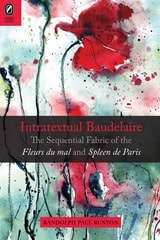
Intratextual Baudelaire
The Sequential Fabric of the Fleurs du mal and Spleen de ParisRandolph Paul Runyon
The Ohio State University Press, 2010
Intratextual Baudelaire: The Sequential Fabric of the Fleurs du mal and Spleen de Paris by Randolph Paul Runyon provides a new and provocative answer to the question that has intrigued readers for years: did the poet arrange the Fleurs du mal in a meaningful order? Runyon believes so, but not in the way most have conceived the question.
Barbey d’Aurevilly’s claim that there was a “secret architecture” hidden in the Fleurs has long misled scholars by leading them to look for some overarching hierarchical organization, when they should have been looking for how the poems actually fit together, each to each, in the sequential fabric of the text. This is what Runyon has done, in a meticulous reading of every poem and its place in the sequence. Intratextual Baudelaire provides the most thorough analysis available of the textual changes Baudelaire made between the first and second editions and shows why he made them: so that the sequential structure would be preserved despite the addition of new poems and the deletion of those judged obscene.
Extending his analysis to the Spleen de Paris with the same attention to detail and awareness of textual changes, Runyon shows that Baudelaire’s prose-poem collection displays the same rigorous sequential structure. Both collections are revealed as marvels of self-referential intratextuality. Whether one agrees with Runyon or not, Intratextual Baudelaire will certainly generate discussion among French studies scholars.
[more]
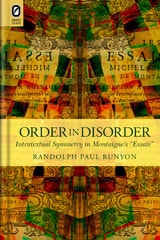
Order in Disorder
Intratextual Symmetry in Montaigne's “Essais”Randolph Paul Runyon
The Ohio State University Press, 2013
Montaigne’s Essays are treasured for their philosophical and moral insights and the fascinating portrait they give us of the man who wrote them, but another of their undoubted delights is that they tantalize the reader, offering beneath an apparent disorder some hints of a hidden plan. After all, though the essayist kept adding new pages, except when he added the third and final book he never added a new chapter, but worked within the structure already in place.
Order in Disorder: Intratextual Symmetry in Montaigne’s “Essais,” by Randolph Paul Runyon, offers a new answer to the question of how ordered the Essays may be. Following up on Montaigne’s likening them to a painter’s “grotesques” surrounding a central image, and seeing in this an allusion to the ancient Roman decorative style, rediscovered in the Renaissance, of symmetrical motifs on either side of a central image, Runyon uncovers an extensive network of symmetrical verbal echoes linking every chapter with another. Often two chapters of greatly different length and apparent importance (one on thumbs, for instance, balanced against one on the limits of human understanding) will in this way be brought together—not without, Runyon finds, an intended irony. The Essays emerge as even more self-reflexive than we thought, an amazingly intratextual work.
Order in Disorder: Intratextual Symmetry in Montaigne’s “Essais,” by Randolph Paul Runyon, offers a new answer to the question of how ordered the Essays may be. Following up on Montaigne’s likening them to a painter’s “grotesques” surrounding a central image, and seeing in this an allusion to the ancient Roman decorative style, rediscovered in the Renaissance, of symmetrical motifs on either side of a central image, Runyon uncovers an extensive network of symmetrical verbal echoes linking every chapter with another. Often two chapters of greatly different length and apparent importance (one on thumbs, for instance, balanced against one on the limits of human understanding) will in this way be brought together—not without, Runyon finds, an intended irony. The Essays emerge as even more self-reflexive than we thought, an amazingly intratextual work.
[more]

The Taciturn Text
The Fiction of Robert Penn WarrenRandolph Paul Runyon
The Ohio State University Press, 1900
[more]