Results by title
6 books match the query 'Rupp, Leila J.'
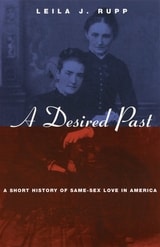
A Desired Past
A Short History of Same-Sex Love in AmericaLeila J. Rupp
University of Chicago Press, 1999
"Most extraordinary about Leila J. Rupp's indeed short, two-hundred-page history of 'same-sex love and sexuality' is not that it manages to account for such a variety of individuals, races, and classes or take in such a broad chronological and thematic range, but rather that it does all this with such verve, lucidity, and analytical rigor. . . . [A]n elegant, inspiring survey." —John Howard, Journal of American History

America on the World Stage
A Global Approach to U.S. HistoryOrganization of American Historians. Edited by Gary Reichard and Ted Dickson
University of Illinois Press, 2007
Recognizing the urgent need for students to understand the emergence of the United States' power and prestige in relation to world events, Gary W. Reichard and Ted Dickson reframe the teaching of American history in a global context. Each essay covers a specific chronological period and approaches fundamental topics and events in United States history from an international perspective, emphasizing how the development of the United States has always depended on its transactions with other nations for commodities, cultural values, and populations. For each historical period, the authors also provide practical guidance on bringing this international approach to the classroom, with suggested lesson plans and activities. Ranging from the colonial period to the civil rights era and everywhere in between, this collection will help prepare Americans for success in an era of global competition and collaboration.
Contributors are David Armitage, Stephen Aron, Edward L. Ayers, Thomas Bender, Stuart M. Blumin, J. D. Bowers, Orville Vernon Burton, Lawrence Charap, Jonathan Chu, Kathleen Dalton, Betty A. Dessants, Ted Dickson, Kevin Gaines, Fred Jordan, Melvyn P. Leffler, Louisa Bond Moffitt, Philip D. Morgan, Mark A. Noll, Gary W. Reichard, Daniel T. Rodgers, Leila J. Rupp, Brenda Santos, Gloria Sesso, Carole Shammas, Suzanne M. Sinke, Omar Valerio-Jimenez, Penny M. Von Eschen, Patrick Wolfe, and Pingchao Zhu.
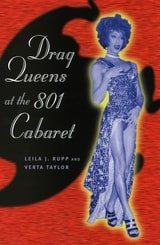
Drag Queens at the 801 Cabaret
Leila J. Rupp and Verta Taylor
University of Chicago Press, 2003
In this lively book, Leila J. Rupp and Verta Taylor take us on an entertaining tour through one of America's most overlooked subcultures: the world of the drag queen. They offer a penetrating glimpse into the lives of the 801 Girls, the troupe of queens who perform nightly at the 801 Cabaret for tourists and locals. Weaving together their fascinating life stories, their lavish costumes and eclectic music, their flamboyance and bitchiness, and their bawdy exchanges with one another and their audiences, the authors explore how drag queens smash the boundaries between gay and straight, man and woman, to make people think more deeply and realistically about sex and gender in America today. They also consider how the queens create a space that encourages camaraderie and acceptance among everyday people, no matter what their sexual preferences might be.
Based on countless interviews with more than a dozen drag queens, more than three years of attendance at their outrageous performances, and even the authors' participation in the shows themselves, Drag Queens at the 801 Cabaret is a witty and poignant portrait of gay life and culture. When they said life is a cabaret, they clearly meant the 801.

Nazi Ideology before 1933
A DocumentationIntroduced and translated by Barbara Miller Lane and Leila J. Rupp
University of Texas Press, 1978
This volume brings together a hitherto scattered and inaccessible body of material crucial to the understanding of the evolution of Nazi political thought. Before the publication of this volume, scholars had virtually ignored the extensive writings and programs published by leading Nazi ideologues before 1933. Barbara Miller Lane and Leila J. Rupp have collected the political writings of Nazi theorists—Dietrich Eckart, Alfred Rosenberg, Gottfried Feder, Joseph Goebbels, Gregor and Otto Strasser, Heinrich Himmler, and Richard Walther Darré—during the period before the National Socialists came to power. The Strassers are given considerable space because of their great intellectual importance within the party before 1933. In commentary by the editors, the significance of each Nazi theorist is weighed and evaluated at each stage of the history of the party.
Lane and Rupp conclude that Nazi ideology, before 1933 at least, was not a consistent whole but a doctrine in the process of rapid development to which new ideas were continually introduced. By the time the Nazis came to power, however, a group of interrelated assertions and official promises had been made to party followers and to the public. Hitler and the Third Reich had to accommodate this ideology, even when not implementing it. Hitler’s role in the development of Nazi ideology, interpreted here as a very permissive one, is thoroughly assessed. His own writings, however, have been omitted since they are readily available elsewhere.
The twenty-eight documents included in this book illustrate themes and phases in Nazi ideology which are discussed in the introduction and the detailed prefatory notes. Long selections, as often as possible full-length, are provided to allow the reader to follow the arguments. Each selection is accompanied by an introductory note and annotations which clarify its relationship to other works of the author and other writings of the period. Also included are original translations of the “Twenty-Five Points” and a number of little-known official party statements.
Queer Millennials on Campus
At the Vanguard of Sexual FluidityLeila J. Rupp
University of Chicago Press, 2027
An intimate portrayal of the college experiences of queer and non-binary millennials and what they tell us about the shifting shape of desires and identities in the twenty-first century.
College has long been considered a distinct place for self-discovery. This is particularly true when it comes to gender and sexual identities. In Queer Millennials on Campus, Leila J. Rupp draws on a host of remarkably open and honest interviews with queer women and nonbinary assigned-female-at-birth students at the University of California, Santa Barbara. The accessible narrative wends its way through their lives, from their first experiences of queer desires, through their intimacies and relationships, negotiating their identities, and coming out (or not) to friends and family members. Rupp sheds new light on the Millennial generation, who played a pivotal role in popularizing and embracing the concept of sexual fluidity, helping to challenge older notions of stable sexual and gender identities.
Ultimately, the voices in the book argue that self-awareness about one’s desires, intimate relationships, and identities should be acknowledged and celebrated. Written with deep empathy and understanding, Queer Millennials on Campus honors queer sexual awareness and joy.
Understanding and Teaching U.S. Lesbian, Gay, Bisexual, and Transgender History
Edited by Leila J. Rupp and Susan K. Freeman
University of Wisconsin Press, 2017