Results by title

4 books match the query 'Rural health services'
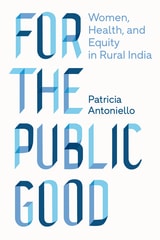
cover of For the Public Good: Women, Health, and Equity in Rural India

For the Public Good

Women, Health, and Equity in Rural India

Patricia Antoniello

Vanderbilt University Press, 2020

For the Public Good details the role of the Comprehensive Rural Health Project (CRHP), a groundbreaking, internationally recognized primary health care model that uses local solutions to solve intractable global health problems. Emphasizing equity and community participation, this grassroots approach recruits local women to be educated as village-based health workers. In turn, women village health workers collaborate to overcome the dominant double prejudices in local villages—caste and gender inequality.

In one generation, village health workers have progressed from child brides and sequestered wives to knowledgeable health practitioners, valued teachers, and community leaders. Through collective efforts, CRHP has reduced infant and maternal mortality, eliminated some endemic health problems, and advanced economic well-being in villages with women's cooperative lending groups.

This book describes how the recognition and elimination of embedded inequalities—in this case caste discrimination, gender subordination, and class injustice—promote health and well-being and collaboratively establish the public good.
[more]
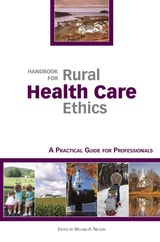
cover of Handbook for Rural Health Care Ethics: A Practical Guide for Professionals

Handbook for Rural Health Care Ethics

A Practical Guide for Professionals

Edited by William A. Nelson

Dartmouth College Press, 2010
The rural community presents not only distinct health care delivery challenges but also ethical problems for clinicians and administrators of small, rural health care facilities. Health care delivered in a rural context—in closely knit, tightly interdependent small community settings—poses unique ethical considerations for clinical practitioners. For example, a provider in a resource-poor rural setting may be faced with treating a family member, friend, business associate, or neighbor, since the role separation between clinician and patient that predominates in the urban setting is less likely to occur in a small town. Because of the unique rural context, the solutions that health care providers develop to resolve complex ethics dilemmas may differ from solutions reached in urban areas. The Handbook for Rural Health Care Ethics is designed to be a useful resource for clinicians and administrators in rural settings. It draws on the available research and real-life examples to paint a picture of challenging, yet all-too-familiar ethics conflicts while offering strategies for a proactive, preventive approach to ethical issues.
[more]
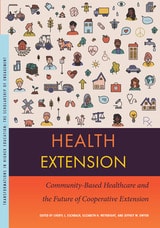
cover of Health Extension: Community-Based Healthcare and the Future of Cooperative Extension

Health Extension

Community-Based Healthcare and the Future of Cooperative Extension

Cheryl L. Eschbach

Michigan State University Press, 2024
Health Extension: Community-Based Healthcare and the Future of Cooperative Extension explores innovation in extension health programs, engaged scholarship promoting research-based information in communities, and the evaluation and documentation of community programs and their impacts. This volume provides land-grant and university-based colleagues up-to-date information on using the Cooperative Extension System (CES) for community engagement in healthcare while also familiarizing those outside CES and the academy with a roadmap for improvement. The contributions of a diverse array of scholars challenge the status quo in extension programs by characterizing the introspection, understanding, creativity, partnerships, and leadership that will be required to improve lives and communities  in the twenty-first century. This perspective underscores the role of CES as foundational to the future of Health Extension and offers an alternative to approaches that utilize the CES as a model without the accompanying advantages of history, community embeddedness, and sustainability.
[more]
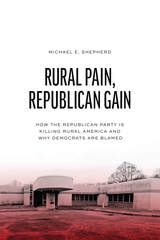
cover of Rural Pain, Republican Gain: How the Republican Party Is Killing Rural America and Why Democrats Are Blamed

Rural Pain, Republican Gain

How the Republican Party Is Killing Rural America and Why Democrats Are Blamed

Michael E. Shepherd

University of Chicago Press, 2026

An eye-opening look at how Republican policies have affected health outcomes in rural communities and why poor, rural white voters are turning to the Republican Party—not despite this harm, but because of it.

Over the last four decades, the health of rural Americans has been in free fall. Just as opioid and gun deaths have ripped apart rural communities, hospitals have closed at alarming rates, leaving millions desperately far from care. At the same time, voters in struggling rural communities have increasingly come to vote for the Republican Party.

In Rural Pain, Republican Gain, Michael E. Shepherd demonstrates that these two trends are closely connected. At both the federal and state levels, the Republican Party has increasingly enacted policies that worsen rural health. Rural voters are not indifferent to this development (quite the contrary), but they misassign blame, in part, because the Democratic Party is more commonly associated with health-related policy initiatives and has ownership of health as an issue area. Republican politicians can reap rewards from their own destructive policies by appealing to the shared grievances of rural people.

Shepherd draws on new, wide-ranging data, including in-depth studies of the opioid epidemic, hospital closures, and COVID-19. In so doing, he quantifies the harm of Republican policymaking and its disproportionate effect on rural communities, recasting how readers understand growing Republican support among less healthy, lower-income rural white Americans.

[more]