Results by title
6 books match the query 'Russell, Bertrand'
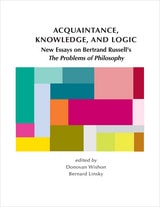
Acquaintance, Knowledge, and Logic
New Essays on Bertrand Russell's "The Problems of Philosophy"Edited and with an Introduction by Donovan Wishon and Bernard Linsky
CSLI, 2015
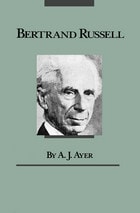
Bertrand Russell
A. J. Ayer
University of Chicago Press, 1988
"I am sure [this] is the best introduction of any length to Russell, and I suspect that it might serve as one of the best introductions to modern philosophy. . . . Ayer begins with a brief, austere, and balanced account of Russell's life: as in Russell's autobiography this means his thought, books, women, and politics. Tacitus (and Russell) would have found the account exemplary. Ayer ends with a sympathetic and surprisingly detailed survey of Russell's social philosophy. But the bulk of this book consists of a chapter on Russell's work in logic and the foundations of mathematics, followed by a chapter on his epistemological views and one on metaphysics. . . . I find it impossible to imagine that this book will not remain indefinitely the very best book of its sort."—Review of Metaphysics
"The confrontation or conjunction of Ayer and Russell is a notable event and has produced a remarkable book—brilliantly argued and written."—Martin Lebowitz, The Nation
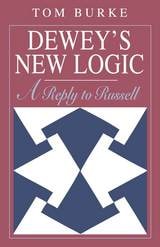
Dewey's New Logic
A Reply to RussellTom Burke
University of Chicago Press, 1994
Burke demonstrates that Russell misunderstood crucial aspects of Dewey's theory and contends that logic today has progressed beyond Russell and is approaching Dewey's broader perspective.
"[This] book should be of substantial interest not only to Dewey scholars and other historians of twentieth-century philosophy, but also to devotees of situation theory, formal semantics, philosophy of mind, cognitive science, and Artificial Intelligence."—Georges Dicker, Transactions of the C.S. Peirce Society
"No scholar, thus far, has offered such a sophisticated and detailed version of central themes and contentions in Dewey's Logic. This is a pathbreaking study."—John J. McDermott, editor of The Philosophy of John Dewey
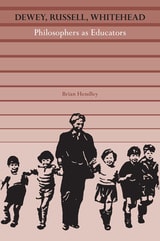
Dewey, Russell, Whitehead
Philosophers as EducatorsBrian Patrick Hendley
Southern Illinois University Press, 1986
In Philosophers as Educators Brian Patrick Hendley argues that philosophers of education should reject their preoccupation with defining terms and analyzing concepts and embrace the philosophical task of constructing general theories of education. Hendley discusses in detail the educational philosophies of John Dewey, Bertrand Russell, and Alfred North Whitehead. He sees in these men excellent role models that contemporary philosophers might well follow. Hendley believes that, like these mentors, philosophers should take a more active, practical role in education. Dewey and Russell ran their own schools, and Whitehead served as a university administrator and as a member of many committees created to study education.
Russell's Metaphysical Logic
Bernard Linsky
CSLI, 1999

Word and Object in Husserl, Frege, and Russell
The Roots of Twentieth-Century PhilosophyClaire Oritz Hill
Ohio University Press, 2001
In search of the origins of some of the most fundamental problems that have beset philosophers in English-speaking countries in the past century, Claire Ortiz Hill maintains that philosophers are treating symptoms of ills whose causes lie buried in history. Substantial linguistic hurdles have blocked access to Gottlob Frege's thought and even to Bertrand Russell's work to remedy the problems he found in it. Misleading translations of key concepts like intention, content, presentation, idea, meaning, concept, etc., severed analytic philosophy from its roots.
Hill argues that once linguistic and historical barriers are removed, Edmund Husserl's critical study of Frege's logic in his 1891 Philosophy of Arithmetic provides important insights into issues in philosophy now.
She supports her conclusions with analyses of Frege's, Husserl's, and Russell's works, including Principia Mathematica, and with linguistic analyses of the principal concepts of analytic philosophy. She re-establishes links that existed between English and Continental thought to show Husserl's expertise as a philosopher of mathematics and logic who had been Weierstrass's assistant and had long maintained ties with Cantor, Hilbert, and Zermelo.