Results by title
2 books match the query 'Russell, Rinaldina'
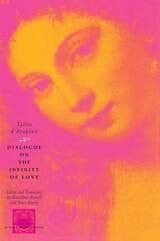
Dialogue on the Infinity of Love
Tullia d'Aragona
University of Chicago Press, 1997
Celebrated as a courtesan and poet, and as a woman of great intelligence and wit, Tullia d'Aragona (1510–56) entered the debate about the morality of love that engaged the best and most famous male intellects of sixteenth-century Italy. First published in Venice in 1547, but never before published in English, Dialogue on the Infinity of Love casts a woman rather than a man as the main disputant on the ethics of love.
Sexually liberated and financially independent, Tullia d'Aragona dared to argue that the only moral form of love between woman and man is one that recognizes both the sensual and the spiritual needs of humankind. Declaring sexual drives to be fundamentally irrepressible and blameless, she challenged the Platonic and religious orthodoxy of her time, which condemned all forms of sensual experience, denied the rationality of women, and relegated femininity to the realm of physicality and sin. Human beings, she argued, consist of body and soul, sense and intellect, and honorable love must be based on this real nature.
By exposing the intrinsic misogyny of prevailing theories of love, Aragona vindicates all women, proposing a morality of love that restores them to intellectual and sexual parity with men. Through Aragona's sharp reasoning, her sense of irony and humor, and her renowned linguistic skill, a rare picture unfolds of an intelligent and thoughtful woman fighting sixteenth-century stereotypes of women and sexuality.
[more]
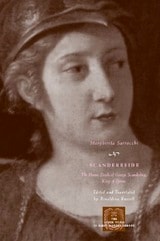
Scanderbeide
The Heroic Deeds of George Scanderbeg, King of EpirusMargherita Sarrocchi
University of Chicago Press, 2006
The first historical heroic epic authored by a woman, Scanderbeide recounts the exploits of fifteenth-century Albanian warrior-prince George Scanderbeg and his war of resistance against the Ottoman sultanate. Filled with scenes of intense and suspenseful battles contrasted with romantic episodes, Scanderbeide combines the action and fantasy characteristic of the genre with analysis of its characters’ motivations. In selecting a military campaign as her material and epic poetry as her medium, Margherita Sarrocchi (1560?–1617) not only engages in the masculine subjects of political conflict and warfare but also tackles a genre that was, until that point, the sole purview of men.
First published posthumously in 1623, Scanderbeide reemerges here in an adroit English prose translation that maintains the suspense of the original text and gives ample context to its rich cultural implications.
First published posthumously in 1623, Scanderbeide reemerges here in an adroit English prose translation that maintains the suspense of the original text and gives ample context to its rich cultural implications.
[more]