Results by title

3 books match the query 'Russia Eastern Europe'

cover of And They Lived Happily Ever After: Norms and Everyday Practices of Family and Parenthood in Russia and Eastern Europe

And They Lived Happily Ever After

Norms and Everyday Practices of Family and Parenthood in Russia and Eastern Europe

Helene Carlback

Central European University Press, 2012
Takes a comparative perspective on family life and childhood in the past half century in Russia and Eastern Europe, highlighting similarities and differences. Focuses on the problematic domains of the institutions and laws devised to cope with family difficulties, and discusses the social strains created by the transition from communist to post-communist national systems. In addition to the substantial historic analysis, actual challenges are also discussed. The essays examine the changing gender roles, alterations in legal systems, the burdens faced by married and unmarried women who are mothers, the contrasts between government rhteoric and the implementation of policies toward marriage, children and parenthood. By addressing the specifics of welfare politics under the Communist rule and the directions of their transformation in 1990–2000s, this book contributes to the understanding of social institutions and family policies in these countries and the problems of dealing with the socialist past that this region face.
[more]
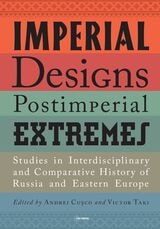
cover of Imperial Designs, Postimperial Extremes: Studies in Interdisciplinary and Comparative History of Russia and Eastern Europe

Imperial Designs, Postimperial Extremes

Studies in Interdisciplinary and Comparative History of Russia and Eastern Europe

Andrei Cusco

Central European University Press, 2023

Anchored in the Russian Empire, but not limited to it, the eight studies in this volume explore the nineteenth-century imperial responses to the challenge of modernity, the dramatic disruptions of World War I, the radical scenarios of the interwar period and post-communist endgames at the different edges of Eurasia. The book continues and amplifies the historiographic momentum created by Alfred J. Rieber’s long and fruitful scholarly career.

First, the volume addresses the attempts of Russian imperial rulers and elites to overcome the economic backwardness of the empire with respect to the West. The ensuing rivalry of several interest groups (entrepreneurs, engineers, economists) created new social forms in the subsequent rounds of modernization. The studies explore the dynamics of the metamorphoses of what Rieber famously conceptualized as a “sedimentary society” in the pre-revolutionary and early Soviet settings.

Second, the volume also expands and dwells on the concept of frontier zones as dynamic, mutable, shifting areas, characterized by multi-ethnicity, religious diversity, unstable loyalties, overlapping and contradictory models of governance, and an uneasy balance between peaceful co-existence and bloody military clashes. In this connection, studies pay special attention to forced and spontaneous migrations, and population politics in modern Eurasia.
[more]
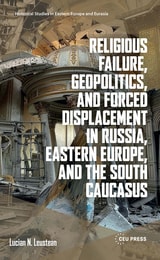
cover of Religious Failure, Geopolitics, and Forced Displacement in Russia, Eastern Europe, and the South Caucasus

Religious Failure, Geopolitics, and Forced Displacement in Russia, Eastern Europe, and the South Caucasus

Lucian N. Leustean

Central European University Press, 2026

What happens when states fail to provide support to populations in need? What are the mechanisms of religious and political engagement with populations affected by organized violence, displacement, and resettlement? The book argues that when state structures fail to respond to violence, religious institutions are often among the first actors to assist and empower forcibly displaced populations. Establishing humanitarian initiatives, fostering transnational conservative networks, and promoting geopolitical interests has defined the interplay between religion, politics, and society in the Eastern Christian world from the end of the Cold War to the present day. This book advances a Religious Failure Index, which highlights the ways in which religious institutions engage with state governance, geopolitics, and international affairs. It offers a rigorous narrative of the ways in which Eastern Orthodox and Oriental Christian communities exert authority in a multi-faith geographical space marked by political rivalry, conflict, inequality, and forced displacement in Armenia, Bulgaria, Georgia, Moldova, Russia, Serbia, and Ukraine.
[more]