Results by title
13 books match the query 'Russian'
Configuring Topic and Focus in Russian
Tracy Holloway King
CSLI, 1995
Dreaming in Russian
The Cuban Soviet ImaginaryBy Jacqueline Loss
University of Texas Press, 2013
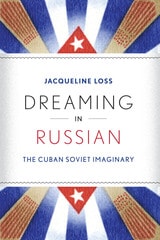
The specter of the Soviet Union lingers in Cuba, yet until now there has been no book-length work on the ways Cubans process their country’s relationship with the Soviet bloc. Dreaming in Russian at last brings into the light the reality that for nearly three decades, the Soviet Union subsidized the island economically, intervened in military matters, and exported distinct pedagogical and cultural models to Cuba. Drawing on interviews with Cuban artists and intellectuals, as well as treasures from cinematographic and bibliographic archives, Jacqueline Loss delivers the first book to show that Cuba remembers and retains many aspects of the Soviet era, far from shedding those cultural facets as relics of the Cold War.
Weaving together intriguing, seldom-seen images, Dreaming in Russian showcases the ways in which Cuba’s relationship to its Soviet benefactors lingered after the disintegration of the U.S.S.R. in 1991. Analyzing numerous literary texts and works of visual art, Loss also incorporates aspects of architecture, popular culture, the space race, and other strands to create a captivating new perspective on Cuban society. Among the luminaries featured are poet Reina María Rodríguez, writer Antonio José Ponte, visual artist Tonel, and novelist Wendy Guerra. A departure from traditional cultural history, Loss’s approach instead presents a kaleidoscopic series of facets, reflecting the hybrid nature of the self-images that emerged in the aftermath of the Soviet aegis. As speculations about Cuba’s future under Fidel Castro’s heir apparent continue, the portrait that emerges in Dreaming in Russian is both timely and mesmerizing.
Exploring and Mapping Alaska
The Russian America Era, 1741-1867Alexey Postnikov and Marvin Falk
University of Alaska Press, 2015
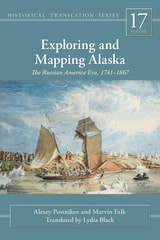
Exploring and Mapping Alaska focuses on this foundational period in Arctic cartography. Russia spurred a golden era of cartographic exploration, while shrouding their efforts in a veil of secrecy. They drew both on old systems developed by early fur traders and new methodologies created in Europe. With Great Britain, France, and Spain following close behind, their expeditions led to an astounding increase in the world’s knowledge of North America.
Through engrossing descriptions of the explorations and expert navigators, aided by informative illustrations, readers can clearly trace the evolution of the maps of the era, watching as a once-mysterious region came into sharper focus. The result of years of cross-continental research, Exploring and Mapping Alaska is a fascinating study of the trials and triumphs of one of the last great eras of historic mapmaking.

From Pushkin to Tolstoy
An Advanced Russian ReaderKonstantin Reichardt
University of Minnesota Press, 1944

Hot Coal, Cold Steel
Russian and Ukrainian Workers from the End of the Soviet Union to the Post-Communist TransformationsStephen Crowley
University of Michigan Press, 1997
Interpreting America
Russian and Soviet Studies of the History of American ThoughtJohn Ryder
Vanderbilt University Press, 1999
In his pioneering new book Interpreting America John Ryder makes available for the first time to English-speaking readers Russian views of the full range of American philosophical thought: from seventeenth-century Puritanism through the colonial and revolutionary periods, nineteenth- century idealism, pragmatism, naturalism, and other twentieth-century movements and figures. Using his own accurate translations, he clearly reconstructs a chain of core ideas, emphasizes the most essential concepts of each writer's work, and gives a multidimensional reconstruction of the arguments of each author.
By taking mainstream Soviet philosophical commentators like Baskin, Bogomolov, Karimsky, Melvil, Pokrovsky, Sidorov, and Yulina seriously and letting them speak for themselves, Ryder shows not only what Soviet philosophers and scholars thought of American philosophy (and why they were so interested in the first place) but also the nuances of the internal disagreements among Soviet thinkers about what American philosophers were saying. He also reveals a strong continuity between contemporary, post-Soviet Russian philosophy and earlier Soviet work.
Perhaps no other book has ever explored in such a systematic manner the ways in which one philosophical system has regarded another. Ryder's revealing study of how others have viewed us helps to clarify the depth, richness, and complexity of our own American philosophical heritage.
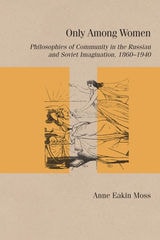
Only Among Women
Philosophies of Community in the Russian and Soviet Imagination, 1860–1940Anne Eakin Moss
Northwestern University Press, 2020
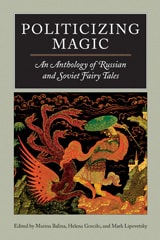
Politicizing Magic
An Anthology of Russian and Soviet Fairy TalesBalina/Goscilo/Lipovetsky
Northwestern University Press, 2005
We were born to make fairy tales come true. As one of Stalinism's more memorable slogans, this one suggests that the fairy tale figured in Soviet culture as far more than a category of children's literature. How much more-and how cannily Russian fairy tales reflect and interpret Soviet culture, especially in its utopian ambitions-becomes clear for the first time in Politicizing Magic, a compendium of folkloric, literary, and critical texts that demonstrate the degree to which ancient fairy-tale fantasies acquired political and historical meanings during the catastrophic twentieth century.
Introducing Western readers to the most representative texts of Russian folkloric and literary tales, this book documents a rich exploration of this colorful genre through all periods of Soviet literary production (1920-1985) by authors with varied political and aesthetic allegiances. Here are traditional Russian folkloric tales and transformations of these tales that, adopting the didacticism of Soviet ideology, proved significant for the official discourse of Socialist Realism. Here, too, are narratives produced during the same era that use the fairy-tale paradigm as a deconstructive device aimed at the very underpinnings of the Soviet system. The editors' introductory essays acquaint readers with the fairy-tale paradigm and the permutations it underwent within the utopian dream of Soviet culture, deftly placing each-from traditional folklore to fairy tales of Socialist Realism, to real-life events recast as fairy tales for ironic effect-in its literary, historical, and political context.

Russians in Alaska
1732-1867Lydia Black
University of Alaska Press, 2004
Black's work challenges the standard perspective on the Russian period in Alaska as a time of unbridled exploitation of Native inhabitants and natural resources. Without glossing over the harsher aspects of the period, Black acknowledges the complexity of relations between Russians and Native peoples.
She chronicles the lives of ordinary men and women, the merchants and naval officers, laborers and clergy, who established Russian outposts in Alaska. These early colonists carried with them the Orthodox faith and the Russian language; their legacy endures in architecture and place names from Baranof Island to the Pribilofs.
This deluxe volume features fold-out maps and color illustrations of rare paintings and sketches from Russian, American, Japanese, and European sources, many have never before been published. An invaluable source for historians and anthropologists, this accessible volume brings to life a dynamic period in Russian and Alaskan history. A tribute to Black's life as a scholar and educator, Russians in Alaska will become a classic in the field.

Slavic Excursions
Essays on Russian and Polish LiteratureDonald Davie
University of Chicago Press, 1991
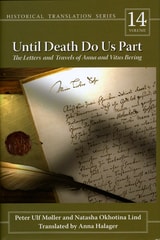
Until Death Do Us Part
The Letters and Travels of Anna and Vitus BeringEdited by Peter Ulf Møller and Natasha Okhotina Lind
University of Alaska Press, 2008
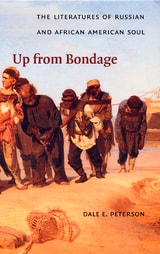
Up from Bondage
The Literatures of Russian and African American SoulDale E. Peterson
Duke University Press, 2000
Illuminating a remarkably widespread cross-pollination between the two cultural and intellectual traditions, Dale E. Peterson frames much of his argument around W. E. B. DuBois’s concept of “double-consciousness,” wherein members of an oppressed section of society view themselves simultaneously through their own self-awareness and through the internalized standards of the dominant culture. He shows how the writings of Dostoevsky, Hurston, Chesnutt, Turgenev, Ellison, Wright, Gorky, and Naylor—texts that enacted and described this sense of double awareness—were used both to perform and to contest the established genres of Western literacy. Woven through Peterson’s textual analyses is his consideration of cultural hybridism and its effects: The writers he examines find multiple ways to testify to and challenge the symptoms of postcolonial trauma. After discussing the strong and significant affinity expressed by contemporary African American cultural theorists for the dialogic thought of Russian linguist Mikhail Bakhtin, Peterson argues that a fuller appreciation of the historic connection between the two cultures will enrich the complicated meanings of being black or Russian in a world that has traditionally avoided acknowledging pluralistic standards of civilization and cultural excellence.
This investigation of comparable moments in the development of Russian and African American ethnic self-consciousness will be valuable to students and scholars of comparative literature, philosophy, cultural theory, ethnicity, linguistics, and postcolonialism, in addition to Slavic and African American studies.
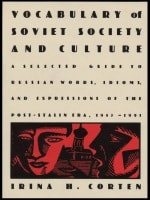
Vocabulary of Soviet Society and Culture
A Selected Guide to Russian Words, Idioms, and Expressions of the Post-Stalin Era, 1953–1991Irina H. Corten
Duke University Press, 1992
The entries are listed alphabetically in English transliteration followed by the Cyrillic, although readers familiar with Russian may prefer to use the Cyrillic alphabet listing included in this volume. In each entry, the author provides a succinct but full explanation of the term and, whenever possible, cross-references to other entries, authentic examples of its use, and samples of relevant Soviet jokes. A reader may approach the lexicon either sequentially or with the aid of a subject thesaurus that divides the material into specific topics. A listing of complementary sources of reference appears in a useful bibliography.
With this fascinating lexicon of "Sovietisms," Corten provides an invaluable and easily accessible medium for those general readers and scholars of the Russian language and Soviet culture interested in understanding contemporary Soviet life.
Selected entries from the Vocabulary of Soviet Society and Culture
Anekdótchik (anekdótchitsa) (cyrillic spelling) (n.)
1: A person who tells jokes (anekdoty); 2: coll. since the late Stalin era, a person arrested and given a prison sentence for the telling of political jokes. The phenomenon indicates the important role of the political joke in Soviet culture and, specifically, in the dissident movement. See iazychnik; sident.
The following jokes were popular during the Brezhnev era:
1. "Comrade Brezhnev, what is your hobby?"
"Collecting jokes about myself."
"And how many have you collected so far?"
"Two and a half labor camps."
2. Question: What is a marked-down joke?
Answer: A joke which, under Stalin, got you ten years in a labor camp, and now gets you only five.
egoístiki (cyrillic) (n.; pl.). Lit., little egotists; coll. since the 1970s referring to headsets worn by music lovers, especially teenage fans of rock music. The idea is that, by wearing headsets, one shuts out the world and becomes indifferent to everything except oneself.
zhrál'nia (cyrillic) (n.). Der. zhrat', to gorge, devour (vulg.); coll. since the 1970s denoting an eating establishment with inexpensive and often bad-tasting food. In the late 1980s, the term also has been applied to new fast-food restaurants which have been built in Soviet cities by Western concerns, for example, McDonald's. See amerikanka; stekliashka; stoiachka.