Results by title
3 books match the query 'Russian Empire'
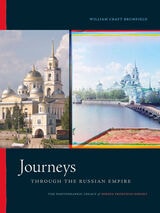
Journeys through the Russian Empire
The Photographic Legacy of Sergey Prokudin-GorskyWilliam Craft Brumfield
Duke University Press, 2020
In 1918 Prokudin-Gorsky escaped an increasingly chaotic, violent Russia and regained nearly 2,000 of his bulky glass negatives. His subsequent peripatetic existence before settling in Paris makes his collection's survival all the more miraculous. The U.S. Library of Congress acquired Prokudin-Gorsky's collection in 1948, and since then it has become a touchstone for understanding pre-revolutionary Russia. Now digitized and publicly available, his images are a sensation in Russia, where people visit websites dedicated to them.
William Craft Brumfield—photographer, scholar, and the leading authority on Russian architecture in the West—began working with Prokudin-Gorsky's photographs in 1985. He curated the first public exhibition of them in the United States and has annotated the entire collection. In Journeys through the Russian Empire, Brumfield—who has spent decades traversing Russia and photographing buildings and landscapes in their various stages of disintegration or restoration—juxtaposes Prokudin-Gorsky's images against those he took of the same buildings and areas. In examining the intersections between his own photography and that of Prokudin-Gorsky, Brumfield assesses the state of preservation of Russia's architectural heritage and calls into question the nostalgic assumptions of those who see Prokudin-Gorsky's images as the recovery of the lost past of an idyllic, pre-Soviet Russia.
This lavishly illustrated volume—which features some 400 stunning full-color images of ancient churches and mosques, railways and monasteries, towns and remote natural landscapes—is a testament to two brilliant photographers whose work prompts and illuminates, monument by monument, questions of conservation, restoration, and cultural identity and memory.

Tableaux Vivants of the Russian Empire
Yelena Severina
University of Wisconsin Press, 2027
The practice of tableaux vivants, or “living pictures,” involves arranging people and objects into a motionless scene, often re-creating a work of art. After emerging in France, this dramatic art form quickly burst national boundaries, becoming a popular pastime. It took strong root in Russia toward the end of the eighteenth century, traversing the social and political scene, from its debut as an aristocratic parlor game to common street performance; from the inner circles of the tsarist court to agitprop theater and cinema; and from political meetings to public schools and city parades.
In this book, the first English-language history of tableaux vivants in Russia, Yelena Severina traces the development of this art form from the late eighteenth into the early twentieth century. She links its introduction, rise, influence on later entertainments like photography and film, and ultimate decline to concomitant changes in Russian society, politics, and technology, arguing that while this art form may now be nearly forgotten, it should be remembered and studied for its critical role in Imperial Russian culture.

The Ukrainian Question
Russian Empire and Nationalism in the 19th CenturyAlexei Miller
Central European University Press, 2003