Results by title

9 books match the query 'Russian drama'
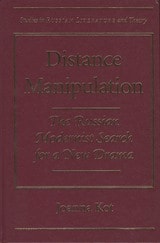
cover of Distance Manipulation: The Russian Modernist Search for a New Drama

Distance Manipulation

The Russian Modernist Search for a New Drama

Joanna Kot

Northwestern University Press, 1999

At the turn of the century, there appeared in the Western world a stream of literary and dramatic works that confused their audiences to an unprecedented degree. Many of these works continue to confuse to this day and are avoided by theatre managers wishing to fill seats. Choosing for analysis a selection of five early-twentieth-century Russian plays, this book examines in detail the techniques, devices, and elements that the playwrights applied in order to undercut the traditional dramatic and theatrical expectations of their audiences.

Kot studies experimental dramas by Gippius, Sologub, Blok, and Ivanov, but the centerpiece of the book is Chekhov's Cherry Orchard his last and greatest play. Kot argues that it presents a subtle balance of distancing and emotive techniques.

An invaluable guide to the often bewildering nature of so-called "innovative" twentieth-century works, this book will appeal to anyone interested in modern theater.
[more]
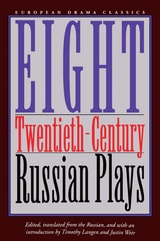
cover of Eight Twentieth-Century Russian Plays

Eight Twentieth-Century Russian Plays

Timothy Langen and Justin Weir

Northwestern University Press, 2000

Russia produced more notable dramas in the twentieth century than at any other time in its history, yet many of the plays from this period have been only sporadically available in English, and others have never been translated before. For each of these eight works, Timothy Langen and Justin Weir provide an insightful introduction to the literary, cultural, and political contexts in which the plays first appeared, considering the influence that various literary movements had on the development of Russian drama and exploring the effect of the increasingly politicized climate of the new Soviet state.

Included in this volume:

Sacred Blood, by Zinaida Gippius; The Unknown Woman, by Alexander Blok; Vladimir Mayakovsky, by Vladimir Mayakosky; The Case of the Entry Room, by Victor Ardov; Squaring the Circle, by Valentin Kataev; Elizaveta Bam, by Daniil Kharms; Grain, by Vladimir Kirshon; and The Guests, by Leonid Zorin.
[more]
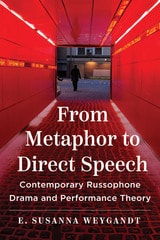
cover of From Metaphor to Direct Speech: Contemporary Russophone Drama and Performance Theory

From Metaphor to Direct Speech

Contemporary Russophone Drama and Performance Theory

E. Susanna Weygandt

University of Wisconsin Press, 2025

New Drama—a collection of actors, directors, and playwrights in Russia, Ukraine, and Belarus—is one of the most active and vibrant artistic movements in the Russophone world today yet remains understudied in the West. E. Susanna Weygandt demonstrates that the major innovation of New Drama is a sonic turn, an aesthetic development that moves away from traditional, Stanislavskian embodied performance to something almost purely aural. New Drama, which began in the tumult following the collapse of the Soviet Union and continues even in an increasingly censorious Russia today, emphasizes contemporary social issues and privileges disadvantaged voices, using documentary modes to literally bring the voices of the dispossessed to the ears of the audience members.

As a result, the Russophone New Dramatists speak dissent and dramatize resistance. Ultimately, they shift theatrical productions from something constrained and limited, in both place and time, to an ephemeral but unbounded gateway for social activism. The sonic stage thus effectively functions as a social forum, transposing action from the actors to the audience. From Metaphor to Direct Speech therefore contributes to cultural as well as performance studies, offering a compelling look not just at developments in theatrical modes but also at dissent and cultural aesthetics in Russia today.
[more]
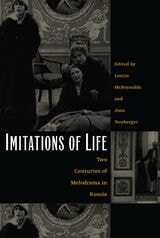
cover of Imitations of Life: Two Centuries of Melodrama in Russia

Imitations of Life

Two Centuries of Melodrama in Russia

Louise McReynolds and Joan Neuberger, eds.

Duke University Press, 2002

Imitations of Life views Russian melodrama from the eighteenth century to today as an unexpectedly hospitable forum for considering social issues. The contributors follow the evolution of the genre through a variety of cultural practices and changing political scenarios. They argue that Russian audiences have found a particular type of comfort in this mode of entertainment that invites them to respond emotionally rather than politically to social turmoil.
Drawing on a wide variety of sources, including plays, lachrymose novels, popular movies, and even highly publicized funerals and political trials, the essays in Imitations of Life argue that melodrama has consistently offered models of behavior for times of transition, and that contemporary televised versions of melodrama continue to help Russians cope with national events that they understand implicitly but are not yet able to articulate. In contrast to previous studies, this collection argues for a reading that takes into account the subtle but pointed challenges to national politics and to gender and class hierarchies made in melodramatic works from both the nineteenth and twentieth centuries. Collectively, the contributors shift and cross borders, illustrating how the cultural dismissal of melodrama as fundamentally escapist and targeted primarily at the politically disenfranchised has subverted the drama’s own intrinsically subversive virtues.
Imitations of Life will interest students and scholars of contemporary Russia, and Russian history, literature, and theater.

Contributors. Otto Boele, Julie Buckler, Julie Cassiday, Susan Costanzo, Helena Goscilo, Beth Holmgren, Lars Lih, Louise McReynolds, Joan Neuberger, Alexander Prokhorov, Richard Stites


[more]
cover of Performing Violence: Literary and Theatrical Experiments of New Russian Drama

Performing Violence

Literary and Theatrical Experiments of New Russian Drama

Birgit Beumers and Mark Lipovetsky

Intellect Books, 2009

The so-called “New Russian Drama” emerged at the end of the twentieth century, following a long period of decline in dramatic writing in the late Soviet and post-Soviet era. In Performing Violence, Birgit Beumers and Mark Lipovetsky examine the representation of violence in these new dramatic works by young Russian playwrights. Reflecting the disappointment in Yeltsin’s democratic reforms and Putin’s neoconservative politics, the plays focus on political and social representations of violence, its performances, and its justifications.

As the first English-language study of Russian drama and theatre in the twenty-first century, Performing Violence seeks a vantage point for the analysis of brutality in post-Soviet culture. While previous generations had preferred poetry and prose, this new breed of authors—the Presnyakov brothers, Evgeni Grishkovets, and Vasili Sigarev among them—have garnered international recognition for their fierce plays. This book investigates the violent portrayal of the identity crisis of a generation as represented in their theatrical works, and will be a key text for students and scholars of drama, Russian studies, and literature.
[more]
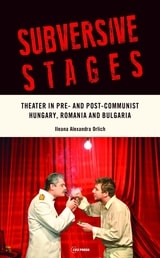
cover of Subversive Stages: Theater in Pre- and Post-Communist Hungary, Romania and Bulgaria

Subversive Stages

Theater in Pre- and Post-Communist Hungary, Romania and Bulgaria

Ileana Alexandra Orlich

Central European University Press, 2017
Exploring theater practices in communist and post-communist Hungary, Romania and Bulgaria, this book analyzes intertextuality or "inter-theatricality" as a political strategy, designed to criticize contemporary political conditions while at the same time trying to circumvent censorship. Plays by Romanian, Hungarian and Bulgarian dramatists are examined, who are "retrofitting" the past by adapting the political crimes and horrifying tactics of totalitarianism to the classical theatre (with Shakespeare a favorite) to reveal the region's traumatic history. By the sustained analysis of the aesthetic devices used as political tools, Orlich makes a very strong case for the continued relevance of the theater as one of the subtlest media in the public sphere. She embeds her close readings in a thorough historical analysis and displays a profound knowledge of the political role of theater history. In the Soviet bloc the theater of the absurd, experimentation, irony, and intertextual distancing (estrangement) are not seen as mere aesthetic language games but as political strategies that use indirection to say what cannot be said directly.
[more]
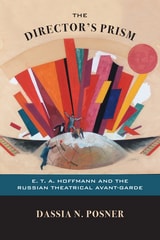
cover of The Director's Prism: E. T. A. Hoffmann and the Russian Theatrical Avant-Garde

The Director's Prism

E. T. A. Hoffmann and the Russian Theatrical Avant-Garde

Dassia N. Posner

Northwestern University Press, 2016

Finalist, 2017 Theatre Library Association George Freedley Memorial Award
Shortlist, 2019 Prague Quadrennial Best Scenography and Design Publication Award


The Director's Prism investigates how and why three of Russia's most innovative directors— Vsevolod Meyerhold, Alexander Tairov, and Sergei Eisenstein—used the fantastical tales of German Romantic writer E. T. A. Hoffmann to reinvent the rules of theatrical practice. Because the rise of the director and the Russian cult of Hoffmann closely coincided, Posner argues, many characteristics we associate with avant-garde theater—subjective perspective, breaking through the fourth wall, activating the spectator as a co-creator—become uniquely legible in the context of this engagement. Posner examines the artistic poetics of Meyerhold's grotesque, Tairov's mime-drama, and Eisenstein's theatrical attraction through production analyses, based on extensive archival research, that challenge the notion of theater as a mirror to life, instead viewing the director as a prism through whom life is refracted. A resource for scholars and practitioners alike, this groundbreaking study provides a fresh, provocative perspective on experimental theater, intercultural borrowings, and the nature of the creative process.
[more]
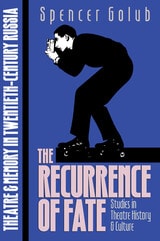
cover of The Recurrence of Fate: Theatre and Memory in Twentieth-Century Russia

The Recurrence of Fate

Theatre and Memory in Twentieth-Century Russia

Spencer Jay Golub

University of Iowa Press, 1994

How, why, and according to whose definitions and requirements does a culture self-consciously create memory and project its fate? In this remarkable book—the first in English to treat Russian history as theatre and cultural performance—Spencer Golub reveals the performative nature of Russian history in the twentieth century and the romantic imprisonment/self-imprisonment of the creative intelligentsia within this scenario.
[more]
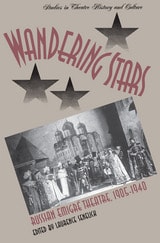
cover of Wandering Stars: Russian Emigré Theatre, 1905-1940

Wandering Stars

Russian Emigré Theatre, 1905-1940

Laurence Senelick

University of Iowa Press, 1992

From the beginning of this century, wars, pogroms, revolution, and economic hardship have impelled Russian cultural figures to seek their fortunes abroad—and theatre people have been no exception. This movement was a windfall for Western Europe and North America, for often the most talented and exciting actors and directors put down roots in foreign lands. Their styles and messages were transmuted in the process, but the inspiration they provided was tremendous.
Now, Wandering Stars is the first book in any language to look closely at this theatrical emigration. Essays by Russian and American scholars and practitioners examine the ways in which the process of transplanting art distorted, magnified, or otherwise altered originals and how expectations on both sides led to disappointments and achievements. A particular strength of this collection is its attention to the question of the transmission of one culture to another.
The thirteen essays in Wandering Stars, originally presented at a landmark 1991 conference at Harvard University, approach a host of historical, cultural, and theatrical issues. The effects of the pioneer touring companies of Pavel Orlenev, Alla Nazimova, and, most significantly, the Moscow Art Theatre are traced. The fates of actors like Maria Germanova and directors like Theodore Komisarjevsky who settled in the West receive careful inquiry. The techniques and influences of charismatic teachers such as Michael Chekhov and Andrius Jilinsky are examined, and the fortunes of cabarets like the Chauve-Souris and experimental playwrights like Nikolay Evreinov are given careful study. In addition, essays analyze the fascination America has held for Russian artists throughout history and the problems which face any emigrant who tries to preserve the best of his or her culture in an alien environment.
With the continuing interest in interculturalism evinced in the academy, popular literature, and the media, Wandering Stars makes a vital and timely contribution to the ongoing inquiry and debate. This book should be of interest to all students of theatre and Russian life and all those with an abiding interest in the realities of a global society. 
[more]