Results by title

5 books match the query 'Russian prose literature'
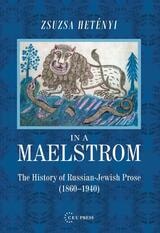
cover of In a Maelstrom: The History of Russian-Jewish Prose, 1860–1940

In a Maelstrom

The History of Russian-Jewish Prose, 1860–1940

Zsuzsa Hetényi

Central European University Press, 2008
The first concise history of Russian-Jewish literary prose, this book discusses Russian-Jewish literarature in four periods, analyzing the turning points (1881–82, 1897, 1917) and proposing that the selected epoch (1860–1940) represents a special strand that was unfairly left out of both Russian and Jewish national literatures. Based on theoretical sources on the subject, the book establishes the criteria of dual cultural affiliation, and in a survey of Russian-Jewish literature presents the pitfalls of assimilation and discusses different forms of anti-Semitism. After showing the oeuvre of 18 representative authors as a whole, the book analyzes a number of characteristic novels and short stories in terms of contemporary literary studies. Many texts discussed have not been reprinted since their first publication. The material offers indispensable information not only for comparative and literary studies but for multicultural, historical, ethnographic, Judaist, religious and linguistic investigations as well.
[more]
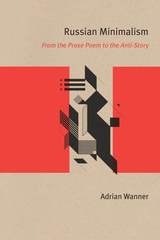
cover of Russian Minimalism: From the Prose Poem to the Anti-Story

Russian Minimalism

From the Prose Poem to the Anti-Story

Adrian Wanner

Northwestern University Press, 2003

Russian Minimalism is the first book to apply the theoretical debate on the nature of the prose poem to Russian literature. Challenging traditional concepts of poetry and narrative prose, the prose poem is by nature a "subversive" form—and as such has drawn extensive interest in literature and criticism during the past two decades. In Russian Minimalism, Adrian Wanner uses the notion of minimalism, borrowed from the realm of American visual arts, as a critical tool for a historical investigation of the genesis and development of the Russian prose miniature, going back to the nineteenth and early twentieth century.

The paradoxical genre of the prose poem, developed by the French poet Charles Baudelaire, provides Wanner with an overarching theoretical rubric for a variety of works of Russian literature, ranging from Ivan Turgenev's "Poems in Prose" to a host of decadent, symbolist, realist, and futurist miniatures, including Fedor Sologub's "Little Fairy Tales," Aleksei Remizov's dreams, Vasilii Kandinskii's prose poems, and Daniil Kharms' absurdist ministories. His book demonstrates how the negativity inherent in the form of the prose poem transformed the overwrought lyricism of fin de siècle prose into the ascetic starkness of the twentieth-century minimalist anti-story.
[more]
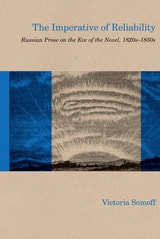
cover of The Imperative of Reliability: Russian Prose on the Eve of the Novel, 1820s-1850s

The Imperative of Reliability

Russian Prose on the Eve of the Novel, 1820s-1850s

Victoria Somoff

Northwestern University Press, 2015

The Imperative of Reliability examines the development of nineteenth-century Russian prose and the remarkably swift emergence of the Russian novel. Victoria Somoff identifies an unprecedented situation in the production and perception of the utterance that came to define nascent novelistic fictionality both in European and Russian prose, where the utterance itself—whether an oral story or a “found” manuscript—became the object of representation within the compositional format of the frame narrative. This circumstance generated a narrative perspective from which both the events and their representation appeared as concomitant in time and space: the events did not precede their narration but rather occurred and developed along with and within the narration itself. Somoff establishes this story-discourse convergence as a major factor in enabling the transition from shorter forms of Russian prose to the full-fledged realist novel.
 

[more]
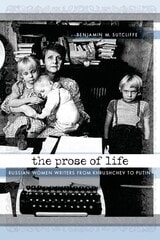
cover of The Prose of Life: Russian Women Writers from Khrushchev to Putin

The Prose of Life

Russian Women Writers from Khrushchev to Putin

Benjamin M. Sutcliffe

University of Wisconsin Press, 2009

Both before and after the collapse of the Soviet Union, everyday life and the domestic sphere served as an ideological battleground, simultaneously threatening Stalinist control and challenging traditional Russian gender norms that had been shaken by the Second World War. The Prose of Life examines how six female authors employed images of daily life to depict women’s experience in Russian culture from the 1960s to the present. Byt, a term connoting both the everyday and its many petty problems, is an enduring yet neglected theme in Russian literature: its very ordinariness causes many critics to ignore it. Benjamin Sutcliffe’s study is the first sustained examination of how and why everyday life as a literary and philosophical category catalyzed the development of post-Stalinist Russian women’s prose, particularly since the collapse of the Soviet Union.
    A focus on the representation of everyday life in women’s prose reveals that a first generation of female writers (Natal’ia Baranskaia, Irina Grekova) both legitimated and limited their successors (Liudmila Petrushevskaia, Tat’iana Tolstaia, Liudmila Ulitskaia, and Svetlana Vasilenko) in their choice of literary topics. The Prose of Life traces the development, and intriguing ruptures, of recent Russian women’s prose, becoming a must-read for readers interested in Russian literature and gender studies.

2009 Outstanding Academic Title, Choice Magazine
[more]
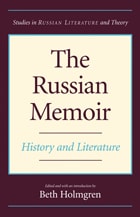
cover of The Russian Memoir: History and Literature

The Russian Memoir

History and Literature

Beth Holmgren

Northwestern University Press, 2007

Essays map the aesthetic form and social and political functions of the memoir in modern Russian culture
[more]