Results by title
5 books match the query 'Russo-Ukrainian War, 2014-'
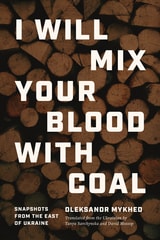
I Will Mix Your Blood with Coal
Snapshots from the East of UkraineOleksandr Mykhed, Tanya Savchynska, and David Mossop
Northwestern University Press, 2025
In 2014, the Russian army, with support from local militants, occupied parts of Ukraine’s two easternmost regions—once the beating industrial heart of the Soviet Union—where coal extraction has since exhausted both the human population and the natural resources. In late 2016, Oleksandr Mykhed set out on a research trip to explore the deep history and contested present of the area from the perspective of a fellow countryman who’d never been there.
Mykhed brings us on a painful yet hopeful journey across the Ukrainian east, sharing conversations with locals, snippets from archival documents, and the complicated perspectives of prominent cultural figures, such as writer Serhiy Zhadan, historian Olena Stiazhkina, and philosopher Ihor Kozlovsky, who was imprisoned and tortured for nearly two years.
I Will Mix Your Blood with Coal invites us to meet generations of coal miners. To learn about the Belgian and British investors who founded the east’s industrial cities. To remember the harrowing events of the First and Second World Wars and the incalculable brutality of Soviet history. To see the activists who are even now working to improve the country. To hear sweet memories of a lost utopia that never existed. Mykhed provides a unique portrait of life in the east during the war, before the full-scale invasion that would change everything.
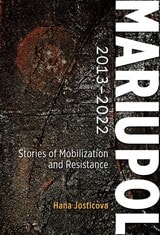
Mariupol 2013-2022
Stories of Mobilization and ResistanceHana Josticova
Central European University Press, 2024
The chapters in this book represent successive phases of one story – that of Mariupol, formerly Ukraine’s tenth largest city, and the second largest in the Donbas region. The author, a young Slovak academic, conducted her ethnographic fieldwork in this coastal town between November 2018 and August 2021. She was one of the last academics to do research in Mariupol before its invasion and eventual occupation by Russia.
During these years, Hana Jošticová was overwhelmed by acts of mobilization and resistance that went in opposite directions: support for a Western direction of Ukraine’s future, and support for the status quo that the victory of the Euromaidan seemed to threaten.
She noted the sequence of events presented in the media and through the lens of individual frames and narratives. Her book is a collection and interpretation of memories and testimonies from both sides: those who actively resisted Russian influence; and those who sparked their own revolution, the ‘Russian Spring.’ Her focus is on self-mobilized individuals who resorted to action outside of established organizational structures spontaneously, autonomously, without resources and guarantees of safety. Her evidence indicates that popular support for the Russian Spring had less to do with Russia than with the social, economic, or cultural characteristics of the Donetsk region.
Years of immersive research convinced the author that individuals are as important as masses, ideas are as powerful as material resources, and beliefs and emotions are as critical as weapons.
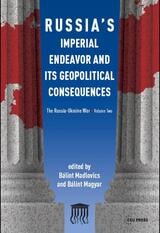
Russia's Imperial Endeavor and Its Geopolitical Consequences
The Russia-Ukraine War, Volume TwoBálint Madlovics
Central European University Press, 2024
Aside from the near-complete devastation of a sovereign state and reversal of the global balance of power, the Russian invasion of Ukraine in 2022 is leading to a radical transformation in the Eastern European and Eurasian regions – including Russia itself.
The 13 chapters in this volume examine the main geopolitical consequences of the resurgent imperialist aspirations of the Russian Federation. They examine the ideological tools of history falsification as an integral part of hybrid warfare. Turning to the economy, the book discusses how the war and economic sanctions imposed on Russia are redrawing the geopolitical map and how economic relations would change following a regime transformation. The book discusses the reactions of members of the international community to the invasion, whether threatened or neutral parties or allies. The collection therefore offers a comprehensive picture of the main consequences of the resurgent imperialist aspirations of the Russian Federation. Equipped with the conceptual tools of the analysis with a focus on the patronal features of the political-economic system, the book considers the aftermath of the war. This collection complements the book entitled Ukraine. Patronal Democracy and the Russian Invasion.
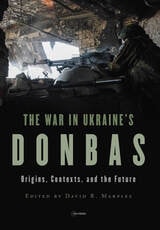
The War in Ukraine’s Donbas
Origins, Contexts, and the FutureDavid R. Marples
Central European University Press, 2022
This collective work analyzes the ongoing conflict in Ukraine, providing a coherent picture of Ukraine and Eastern Europe in the period 2013–2020. Giving voice to different social groups, scholarly communities and agencies relevant to Ukraine’s recent history, The War in Ukraine's Donbas goes beyond simplistic media interpretations that limit the analysis to Vladimir Putin and Russian aims to annex Ukraine. Instead, the authors identify the deeper roots linked to the autonomy and history of Donbas as a region. The contributions explore local society and traditions and the alienation from Ukraine caused by the events of Euromaidan, which saw the removal of the Donetsk-based president Viktor Yanukovych. Other chapters address the refugee crisis, the Minsk Accords in 2014 and the impact of the new president Volodymyr Zelensky and his efforts to bring the war to an end by negotiations among Russia, Ukraine, France, and Germany.
The book concludes with four proposals for a durable peace in Donbas: territorial power-sharing; the conversion of rebels into legitimate political parties; amnesty for all participants of the armed conflict; and a transitional period of several years until political institutions are fully re-established.
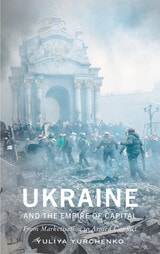
Ukraine and the Empire of Capital
From Marketisation to Armed ConflictYuliya Yurchenko
Pluto Press, 2017
Providing distinctive and unexplored reflections on the origins of the conflict, Yurchenko unpacks the four central myths that underlie Ukraine's post-Soviet reality: the myth of transition, the myth of democracy, the myth of two Ukraines, and the myth of 'the other'. In doing so, she sheds light on the current intensification of class rivalries in Ukraine, the kleptocracy, resource wars and analyses existing and potential dangers of the rightwing shift in Ukraine's polity, stressing a historic opportunity for change.
Critiquing the concept of Ukraine as ‘transition space’, she provides a sweeping analysis which includes the wider neoliberal restructuring of global political economy since the 1970s, with particular focus on Ukraine's relations with the US, the EU and Russia. This is a book for those wanting to understand the current conflict as a dangerous product of neoliberalism, of the empire of capital.