Results by title
4 books match the query 'Rybin, Steven'
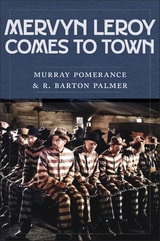
Mervyn LeRoy Comes to Town
Murray Pomerance
Rutgers University Press, 2025
Mervyn LeRoy Comes to Town is the first book devoted to the career of one of the director/producers who in the early years of sound cinema was instrumental in establishing the Hollywood model of production that would endure for more than half a century. As a director and producer, LeRoy was responsible for turning out more than sixty feature films in a career that spanned five decades; as a studio executive, he contributed substantially to the success of the industry during the challenging period of the Depression and also in the period of realignment and readjustment that followed the end of World War II. This book offers chapters devoted to individual films such as Little Caesar, Waterloo Bridge, 30 Seconds over Tokyo, Gypsy, and Quo Vadis.
[more]
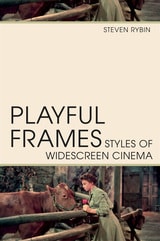
Playful Frames
Styles of Widescreen CinemaSteven Rybin
Rutgers University Press, 2024
A widescreen frame in cinema beckons the eye to playfully, creatively roam. Such technology also gives inventive filmmakers room to disrupt and redirect audience expectations, surprising viewers through the use of a wider, more expansive screen. Playful Frames: Styles of Widescreen Cinema studies the poetics of the auteur-driven widescreen image, offering nimble, expansive analyses of the work of four distinctive filmmakers – Jean Negulesco, Blake Edwards, Robert Altman, and John Carpenter – who creatively inhabited the nooks and crannies of widescreen moviemaking during the final decades of the twentieth century. Exploring the relationship between aspect ratio and subject matter, Playful Frames shows how directors make puckish use of widescreen technology. All four of these distinctive filmmakers reimagined popular genres (such as melodrama, slapstick comedy, film noir, science fiction, and horror cinema) through their use of the wide frame, and each brings a range of intermedial interests (painting, performance, and music) to their use of the widescreen image. This study looks specifically at the technological underpinnings, aesthetic shapes, and interpretive implications of these four directors’ creative use of widescreen, offering a way to reconsider the way wide imagery still has the potential to amaze and move us today.
[more]
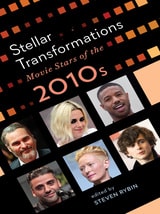
Stellar Transformations
Movie Stars of the 2010sSteven Rybin
Rutgers University Press, 2022
Stellar Transformations: Movie Stars of the 2010s circles around questions of stardom, performance, and their cultural contexts in ways that remind us of the alluring magic of stars while also bringing to the fore the changing ways in which viewers engaged with them during the last decade. A salient idea that guides much of the collection is the one of transformation, expressed in these pages as the way in which post-millennial movie stars are in one way or another reshaping ideas of performance and star presence, either through the self-conscious revision of aspects of their own personas or in redirecting or progressing some earlier aspect of the culture. Including a diverse lineup of stars such as Oscar Isaac, Kristen Stewart, Tilda Swinton, and Tyler Perry, the chapters in Stellar Transformations paint the portrait of the meaning of star images during the complex decade of the 2010s, and in doing so will offer useful case studies for scholars and students engaged in the study of stardom, celebrity, and performance in cinema.
[more]
Thinking in the Dark
Cinema, Theory, PracticePomerance, Murray
Rutgers University Press, 2015
Today’s film scholars draw from a dizzying range of theoretical perspectives—they’re just as likely to cite philosopher Gilles Deleuze as they are to quote classic film theorist André Bazin. To students first encountering them, these theoretical lenses for viewing film can seem exhilarating, but also overwhelming.
Thinking in the Dark introduces readers to twenty-one key theorists whose work has made a great impact on film scholarship today, including Rudolf Arnheim, Sergei Eisenstein, Michel Foucault, Siegfried Kracauer, and Judith Butler. Rather than just discussing each theorist’s ideas in the abstract, the book shows how those concepts might be applied when interpreting specific films by including an analysis of both a classic film and a contemporary one. It thus demonstrates how theory can help us better appreciate films from all eras and genres: from Hugo to Vertigo, from City Lights to Sunset Blvd., and from Young Mr. Lincoln to A.I. and Wall-E.
The volume’s contributors are all experts on their chosen theorist’s work and, furthermore, are skilled at explaining that thinker’s key ideas and terms to readers who are not yet familiar with them. Thinking in the Dark is not only a valuable resource for teachers and students of film, it’s also a fun read, one that teaches us all how to view familiar films through new eyes.
Theorists examined in this volume are: Rudolf Arnheim, Béla Balázs, Roland Barthes, André Bazin, Walter Benjamin, Judith Butler, Stanley Cavell, Michel Chion, Gilles Deleuze, Jean Douchet, Sergei Eisenstein, Jean Epstein, Michel Foucault, Siegfried Kracauer, Jacques Lacan, Vachel Lindsay, Christian Metz, Hugo Münsterberg, V. F. Perkins, Jacques Rancière, and Jean Rouch.
[more]