Results by title
4 books match the query 'Sánchez, Joseph P.'
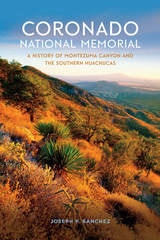
Coronado National Memorial
A History of Montezuma Canyon and the Southern HuachucasJoseph P. Sánchez
University of Nevada Press, 2017
Sánchez is the foremost historian of the area, and he shifts through and decodes a number of key Spanish and English language documents from different archives that tell the story of an historical drama of epic proportions. He combines the regional and the global, starting with the prehistory of the area. He covers Spanish colonial contact, settlement missions, the Mexican Territorial period, land grants, and the ultimate formation of the international border that set the stage for the creation of the Coronado National Memorial in 1952.
Much has been written about southwestern Arizona and northeastern Sonora, and in many ways this book complements those efforts and delivers details about the region’s colorful past.
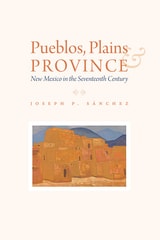
Pueblos, Plains, and Province
New Mexico in the Seventeenth CenturyJoseph P. Sánchez
University Press of Colorado, 2024
In Pueblos, Plains, and Province Joseph P. Sánchez offers an in-depth examination of sociopolitical conflict in seventeenth-century New Mexico, detailing the effects of Spanish colonial policies on settlers’, missionaries’, and Indigenous peoples’ struggle for economic and cultural control of the region. Sánchez explores the rich archival documentation that provides cultural, linguistic, and legal perspectives of the values of the period.
Spanish dual Indian policies for Pueblo and Plains tribes challenged Indigenous political and social systems to conform to the imperial structure for pacification purposes. Meanwhile, missionary efforts to supplant Indigenous religious beliefs with a Christian worldview resulted, in part, in a syncretism of the two worlds. Indigenous resentment of these policies reflected the contentious disagreements between Spanish clergymen and civil authorities, who feuded over Indigenous labor and encroachment on tribal sovereignties with demands for sworn loyalty to Spanish governance. The little-studied “starvation period” adversely affected Spanish-Pueblo relationships for the remainder of the century and contributed significantly to the battle at Acoma, the Jumano War, and the Pueblo Revolt of 1680.
Pueblos, Plains, and Province shows how history, culture, and tradition in New Mexico shaped the heritage shared by Spain, Mexico, the United States, and Native American tribes and will be of interest to scholars and students of Indigenous, colonial, and borderlands history.
The Encomenderos of New Spain, 1521-1555
By Robert Himmerich y Valencia
University of Texas Press, 1991
While the Spanish conquistadors have been stereotyped as rapacious treasure seekers, many firstcomers to the New World realized that its greatest wealth lay in the native populations whose labor could be harnessed to build a new Spain. Hence, the early arrivals in Mexico sought encomiendas—"a grant of the Indians of a prescribed indigenous polity, who were to provide the grantee (the encomendero) tribute in the form of commoditiesand service in return for protection and religious instruction."
This study profiles the 506 known encomenderos in New Spain (present-day Mexico) during the years 1521-1555, using their life histories to chart the rise, florescence, and decline of the encomienda system. The first part draws general conclusions about the actual workings of the encomienda system. The second part provides concise biographies of the encomenderos themselves.
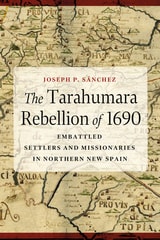
The Tarahumara Rebellion of 1690
Embattled Settlers and Missionaries in Northern New SpainJoseph P. Sánchez
University of Arizona Press, 2025
Previous histories have interpreted this revolt, and other borderlands uprisings, as localized and spontaneous events aimed at rectifying specific grievances. Historian Joseph P. Sánchez argues that the revolts of the Tepehuanes and the Tarahumaras in northern New Spain, or Nueva Vizcaya, were well-planned, inspired by outside events, and drew in multiple communities and ethnicities. Drawing on a wealth of primary sources, including Jesuit accounts and archival documents, Sánchez offers a comprehensive narrative that challenges conventional interpretations of colonial Mexican uprisings.
Far from localized, the Indigenous rebellions in the northern Mexican borderlands during the colonial period were part of the overall Indigenous struggle for defense of homeland throughout the Americas. The Tarahumara Rebellion of 1690 brings together a rich history of localized events and broader historical trends and offers a compelling narrative that enriches our understanding of the colonial experience in northern New Spain.