Results by title
2 books match the query 'Ṣafavid dynasty, 1501-1736'
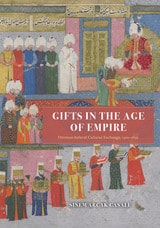
Gifts in the Age of Empire
Ottoman-Safavid Cultural Exchange, 1500–1639Sinem Arcak Casale
University of Chicago Press, 2023
Explores the Safavid and Ottoman empires through the lens of gifts.
When the Safavid dynasty, founded in 1501, built a state that championed Iranian identity and Twelver Shi'ism, it prompted the more established Ottoman Empire to align itself definitively with Sunni legalism. The political, religious, and military conflicts that arose have since been widely studied, but little attention has been paid to their diplomatic relationship. Sinem Arcak Casale here sets out to explore these two major Muslim empires through a surprising lens: gifts. Countless treasures—such as intricate carpets, gilded silver cups, and ivory-tusk knives—flowed from the Safavid to the Ottoman Empire throughout the sixteenth century. While only a handful now survive, records of these gifts exist in court chronicles, treasury records, poems, epistolary documents, ambassadorial reports, and travel narratives. Tracing this elaborate archive, Casale treats gifts as representative of the complicated Ottoman-Safavid coexistence, demonstrating how their rivalry was shaped as much by culture and aesthetics as it was by religious or military conflict. Gifts in the Age of Empire explores how gifts were no mere accessories to diplomacy but functioned as a mechanism of competitive interaction between these early modern Muslim courts.
When the Safavid dynasty, founded in 1501, built a state that championed Iranian identity and Twelver Shi'ism, it prompted the more established Ottoman Empire to align itself definitively with Sunni legalism. The political, religious, and military conflicts that arose have since been widely studied, but little attention has been paid to their diplomatic relationship. Sinem Arcak Casale here sets out to explore these two major Muslim empires through a surprising lens: gifts. Countless treasures—such as intricate carpets, gilded silver cups, and ivory-tusk knives—flowed from the Safavid to the Ottoman Empire throughout the sixteenth century. While only a handful now survive, records of these gifts exist in court chronicles, treasury records, poems, epistolary documents, ambassadorial reports, and travel narratives. Tracing this elaborate archive, Casale treats gifts as representative of the complicated Ottoman-Safavid coexistence, demonstrating how their rivalry was shaped as much by culture and aesthetics as it was by religious or military conflict. Gifts in the Age of Empire explores how gifts were no mere accessories to diplomacy but functioned as a mechanism of competitive interaction between these early modern Muslim courts.
[more]

Safavid Iran and Her Neighbors
Michel M. Mazzaoui
University of Utah Press, 2013
The Safavid dynasty (1501–1786) had its origins in one of the many Turkish, possibly Kurdish, dervish orders begun shortly after the Mongol invasion. By the late fifteenth century it had taken on both Shi'a ideology and a military aspect. Its founder, Isma'il, took advantage of the chaotic political situation at the end of the century to establish control over the territory that comprises most of current-day Iran. Under Safavid rule, Persia moved from Sunni to Shi'i Islam and has remained so into the present.
Safavid Iran and Her Neighbors focuses primarily on Persian external relations during this period. The wide-ranging contributions to this volume cover dervish orders, the Central Asian hajj, developments in Shi'i legal theory, cultural relations between Persia and Mughal India, and diplomatic relations between Iran, Russia, and Ottoman Turkey.
Safavid Iran and Her Neighbors focuses primarily on Persian external relations during this period. The wide-ranging contributions to this volume cover dervish orders, the Central Asian hajj, developments in Shi'i legal theory, cultural relations between Persia and Mughal India, and diplomatic relations between Iran, Russia, and Ottoman Turkey.
[more]