Results by title
6 books match the query 'Sag, Ivan A.'
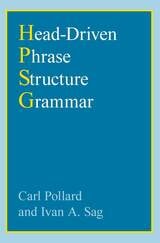
Head-Driven Phrase Structure Grammar
Carl Pollard and Ivan A. Sag
University of Chicago Press, 1994
This book presents the most complete exposition of the theory of head-driven phrase structure grammar (HPSG), introduced in the authors' Information-Based Syntax and Semantics. HPSG provides an integration of key ideas from the various disciplines of cognitive science, drawing on results from diverse approaches to syntactic theory, situation semantics, data type theory, and knowledge representation. The result is a conception of grammar as a set of declarative and order-independent constraints, a conception well suited to modelling human language processing.
This self-contained volume demonstrates the applicability of the HPSG approach to a wide range of empirical problems, including a number which have occupied center-stage within syntactic theory for well over twenty years: the control of "understood" subjects, long-distance dependencies conventionally treated in terms of wh-movement, and syntactic constraints on the relationship between various kinds of pronouns and their antecedents. The authors make clear how their approach compares with and improves upon approaches undertaken in other frameworks, including in particular the government-binding theory of Noam Chomsky.
This self-contained volume demonstrates the applicability of the HPSG approach to a wide range of empirical problems, including a number which have occupied center-stage within syntactic theory for well over twenty years: the control of "understood" subjects, long-distance dependencies conventionally treated in terms of wh-movement, and syntactic constraints on the relationship between various kinds of pronouns and their antecedents. The authors make clear how their approach compares with and improves upon approaches undertaken in other frameworks, including in particular the government-binding theory of Noam Chomsky.
[more]
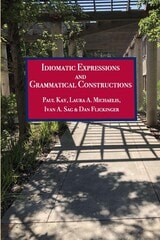
Idiomatic Expressions and Grammatical Constructions
Paul Kay, Laura A. Michaelis, Ivan A. Sag, and Dan Flickinger
CSLI, 2025
A thorough investigation into idioms and their grand meaning, including how best to analyze them.
Any theory of idioms should be part and parcel of a general theory of grammar, adding as little machinery to one's overall grammatical approach as possible in describing both the syntactic and semantic idiosyncrasies and regularities of this large class of linguistic expressions. This volume presents several lexicalist analyses of idioms within the framework of Sign-Based Construction Grammar, reflecting three guiding principles: many but not all idioms are syntactically and semantically compositional, dividing into distinct classes; idioms are analyzable in terms of a suitably rich lexicon and a set of constructions (lexical and syntactic rules) with corresponding meaning representations; and idiomaticity is a gradient phenomenon, exhibiting wide variation in degree of syntactic flexibility and meaning.
Any theory of idioms should be part and parcel of a general theory of grammar, adding as little machinery to one's overall grammatical approach as possible in describing both the syntactic and semantic idiosyncrasies and regularities of this large class of linguistic expressions. This volume presents several lexicalist analyses of idioms within the framework of Sign-Based Construction Grammar, reflecting three guiding principles: many but not all idioms are syntactically and semantically compositional, dividing into distinct classes; idioms are analyzable in terms of a suitably rich lexicon and a set of constructions (lexical and syntactic rules) with corresponding meaning representations; and idiomaticity is a gradient phenomenon, exhibiting wide variation in degree of syntactic flexibility and meaning.
[more]
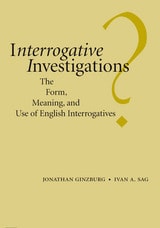
Interrogative Investigations
The Form, Meaning, and Use of English InterrogativesJonathan Ginzburg and Ivan A. Sag
CSLI, 2001
Interrogative constructions are the linguistic forms by which questions are expressed. Their analysis is of great interest to linguists, as well as to computer scientists, human-computer interface designers, and philosophers. Interrogative constructions have played a central role in the development of modern syntactic theory. Nonetheless, to date most syntactic work has taken place quite separately from formal semantic and pragmatic work on interrogatives. Although there has by now been a significant amount of work on interrogatives across a variety of languages, there exist few syntactic and semantic treatments that provide a comprehensive account of a wide range of interrogative constructions and uses in a single language.
This book closes the gap in research on this subject. By developing the frameworks of Head Driven Phrase Structure Grammar and Situation Semantics, the authors provide an account that rigorously integrates syntactic, semantic, and contextual dimensions of interrogatives. The challenge of providing exhaustive coverage of the interrogative constructions of English, including various constructions that occur solely in dialogue interaction, leads to new insights about a variety of contentious theoretical issues. These include matters of semantic ontology, the quantificational status of wh-phrases, the semantic effect of wh-fronting, the status of constructions in grammatical theory, the integration of illocutionary information in the grammar, and the nature of ellipsis resolution in dialogue. The account is stated with sufficient rigor to enable fairly direct computational implementation.
This book closes the gap in research on this subject. By developing the frameworks of Head Driven Phrase Structure Grammar and Situation Semantics, the authors provide an account that rigorously integrates syntactic, semantic, and contextual dimensions of interrogatives. The challenge of providing exhaustive coverage of the interrogative constructions of English, including various constructions that occur solely in dialogue interaction, leads to new insights about a variety of contentious theoretical issues. These include matters of semantic ontology, the quantificational status of wh-phrases, the semantic effect of wh-fronting, the status of constructions in grammatical theory, the integration of illocutionary information in the grammar, and the nature of ellipsis resolution in dialogue. The account is stated with sufficient rigor to enable fairly direct computational implementation.
[more]
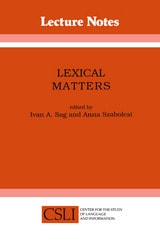
Lexical Matters
Edited by Ivan A. Sag and Anna Szabolcsi
CSLI, 1992
This volume contains new research on the lexicon and its relation to other aspects of linguistics. These essays put forth empirical arguments to claim that specific theoretical assumptions concerning the lexicon play a crucial role in resolving problems pertaining to other componenets of grammer.
Topics include: syntactic/semantic interface in the areas of aspect, argument structure, and thematic roles; lexicon-based accounts of quirky case, anaphora, and control; the boundary between the lexicon and the syntax in the domains of sentence comprehension and nominal compounding; and the possibility of extending nthe concpet of blocking beyond the traditional lexicon.
Ivan Sag is a professor of linguistics at Stanford University. Anna Szabolcsi is an associate professor of linguistics at UCLA.
Center for the Study of Language and Information- Lecture Notes, Number 24
[more]
Sign-Based Construction Grammar
Edited by Hans C. Boas and Ivan A. Sag
CSLI, 2012
This book offers a long-awaited unified and precise treatise on construction-based grammar. The approach to grammar presented here is the union of Berkeley Construction Grammar, as represented by the early work of Charles J. Fillmore and Paul Kay, with construction HPSG as pioneered by Ivan Sag, Carl Pollard, and others. The presentation of this theory in a detailed chapter by Sag presents the full outlines of a new approach to grammar. It reflects the confluence of two separate, although converging, traditions, and constitutes a novel synthesis.
[more]
Syntactic Theory
A Formal Introduction, 2nd EditionIvan A. Sag, Thomas Wasow, and Emily M. Bender
CSLI, 2003
This second edition of Syntactic Theory: A Formal Introduction expands and improves upon a truly unique introductory syntax textbook. Like the first edition, its focus is on the development of precisely formulated grammars whose empirical predictions can be directly tested. There is also considerable emphasis on the prediction and evaluation of grammatical hypotheses, as well as on integrating syntactic hypotheses with matters of semantic analysis.
The book covers the core areas of English syntax from the last quarter century, including complementation, control, "raising constructions," passives, the auxiliary system, and the analysis of long distance dependency constructions. Syntactic Theory's step-by-step introduction to a consistent grammar in these core areas is complemented by extensive problem sets drawing from a variety of languages.
The book's theoretical perspective is presented in the context of current models of language processing, and the practical value of the constraint-based, lexicalist grammatical architecture proposed has already been demonstrated in computer language processing applications. This thoroughly reworked second edition includes revised and extended problem sets, updated analyses, additional examples, and more detailed exposition throughout.
Praise for the first edition:
"Syntactic Theory sets a new standard for introductory syntax volumes that all future books should be measured against."—Gert Webelhuth, Journal of Linguistics
[more]