Results by title
4 books match the query 'Sahara'

Between Sea and Sahara
An Algerian JournalEugene Fromentin
Ohio University Press, 1999
Between Sea and Sahara gives us Algeria in the third decade of colonization. Written in the 1850s by the gifted painter and extraordinary writer Eugene Fromentin, the many-faceted work is travelogue, fiction, stylized memoir, and essay on art. Fromentin paints a compelling word picture of Algeria and its people, questioning France’s—and his own—role there. He shows French dynamism tending to arrogance, tinged with malaise, as well as the complexity of the Algerians and their canny survival tactics. In his efforts to capture the non-Western world on paper as well as on canvas, Fromentin reveals much about the roots of a colonial relationship that continues to affect the Algeria of today. He also reveals his own development as painter, writer—and human being.
Now available for the first time in English, Between Sea and Sahara appeals to today’s reader on many levels—as a story of color, romance, and dramatic tension; as an eywitness account of the colonial experience in Algeria; as a study in trans-genre text, foreshadowing Fromentin’s psychological masterpiece, the novel Dominique. And, as Valérie Orlando points out in her introduction, Fromentin opens a window on the ethos informing the fashion of Orientalism that flourished with colonialism.
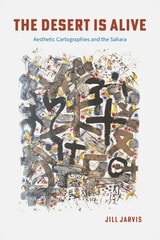
The Desert Is Alive
Aesthetic Cartographies and the SaharaJill Jarvis
University of Chicago Press, 0
How contemporary writers and filmmakers from across the African Sahara confront the colonial ideology of desert emptiness.
Jill Jarvis’s The Desert Is Alive challenges the image of the Sahara desert as a historical and cultural blank zone through a new “aesthetic cartography” that combines literary and film study with interdisciplinary thinking about space, borders, and infrastructures. In fields that still bear the imprint of a French colonial mindset, the Sahara has long been overlooked as a site of intellectual and cultural vitality. The Desert Is Alive breaks with a longstanding conceptual divide between “North” and “Subsaharan” Africa by resolutely centering the African Sahara and recognizing that the desert is not just full, but “peopled” in unexpected ways.
Jarvis accounts for colonial transformations of Saharan land during the twentieth century, attesting to the tactical and symbolic allure that this desert’s purported “emptiness” has held for French empire-building. Jarvis also considers how such tactics have been repurposed by postcolonial states. She takes up the last manuscript composed by Swiss writer Isabelle Eberhardt, who died in a flood at Aïn Sefra, Algeria in 1904, and examines the first novel published by French writer and aviator Antoine de Saint-Exupéry, composed while he worked as a pilot at Tarfaya, Morocco, in order to build the first trans-Saharan flight line during the 1920s. Jarvis then explores depictions of Timbuktu (Mali) and Nouadhibou (Mauretania) in films by Mauritanian-French director Abderrahmane Sissako. Jarvis concludes with chapters that unfold the unfinished history of French nuclear violence in the Sahara. First, she discusses multimedia and documentary works that reckon with the enduring impact of the seventeen nuclear bombs that France detonated in the Algerian desert in the 1960s. Finally, Jarvis turns to works by Tuareg poet and artist Hawad that confront the ongoing legacy of uranium mining on Indigenous land in northern Niger. The result is a rich contribution to Francophone cultural studies, African studies, postcolonial studies, and ecocriticism.

The Dying Sahara
US Imperialism and Terror in AfricaJeremy Keenan
Pluto Press, 2013
In The Dark Sahara (Pluto, 2009), Jeremy Keenan exposed the collusion between the US and Algeria in fabricating terrorism to justify a new ‘Saharan front’ in Washington’s War on Terror. Now, in The Dying Sahara, he reveals how the designation of the region as a ‘Terror Zone’ has destroyed the lives and livelihoods of thousands of innocent people.
Beginning in 2004, with what local people called the US ‘invasion’ of the Sahel, The Dying Sahara shows how repressive, authoritarian regimes - cashing in on US terrorism ‘rents’ - provoked Tuareg rebellions in both Niger and Mali. Further, he argues that US activity has unleashed a new, narco-trafficking branch of Al-Qaeda.
Keenan's chillingly detailed research shows that the US and its new combatant African command (AFRICOM) have created instability in a region the size of western Europe.
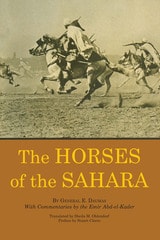
The Horses of the Sahara
By General E. Daumas
University of Texas Press, 1968
The Arabs created one of the world's finest breeds of saddle horses, the Arabian, and they have long possessed an immense store of knowledge regarding the care, training, and breeding of this splendid horse. In the nineteenth century, General Melchior Joseph Eugene Daumas had access to their knowledge even though, as he pointed out, "it requires a great deal of patience and tact for a Christian to obtain from the Mohammedans even the most insignificant of details . . ." General Daumas was, because of his unique relationship with the Arabs, probably the first European to produce a comprehensive study of Arabian horses. And to add even greater value to The Horses of the Sahara, he was able to secure for the ninth edition, here translated, extended commentaries on all aspects of Arabian horsemanship by the Emir Abd-el-Kadar, one of the most important nineteenth-century Arab leaders and certainly one of the foremost authorities on the subject.
The Horses of the Sahara will be of interest not only to equestrians but also to historians and other scholars interested in the customs of the North African desert tribes and in the complex backgrounds of European–North African relations. General Daumas took part in the conquest of Algeria by France, so distinguishing himself that he was named Director of the Bureau of Algerian Affairs in the French Ministry of War. During the campaigns and the occupation that followed, he studied and attempted to understand the native peoples, with an objectivity and sympathy unusual among the colonialists of the period. His book provides fascinating sidelights on many aspects of Arab life, including customs, superstitions, religion, and family life.
Sheila M. Ohlendorf was uniquely suited to translate The Horses of the Sahara. An excellent rider herself, thoroughly experienced with the animals and the techniques being discussed, she also spoke fluent French, having received her B.A. degree in languages from Texas Western University (now the University of Texas at El Paso). As curator of the Hall of the Horsemen, the large collection at the University of Texas at Austin, she had access to a wide variety of supplementary authorities, which enriched both her translation and the notes that accompany the book.