Results by title
5 books match the query 'Saint Petersburg'
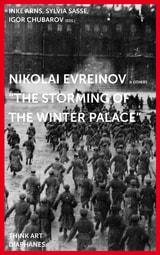
Nikolai Evreinov & Others
»The Storming of the Winter Palace«Edited by Inke Arns, Sylvia Sasse, and Igor Chubarov
Diaphanes, 2017
In 1920, on the third anniversary of the October Revolution, dramatist Nikolai Evreinov directed a cast of 10,000 actors, dancers, and circus performers—as well as a convoy of armored cars and tanks—in The Storming of the Winter Palace. The mass spectacle, presented in and around the real Winter Palace in Petrograd, was intended to recall the storming as the beginning of the October Revolution. But it was a deceptive reenactment because, in producing the events it sought to reenact, it created a new kind of theater, agit-drama, promulgating political propaganda and deliberately breaking down the distinction between performers and spectators.
Nikolaj Evreinov: “The Storming of the Winter Palace” tells the fascinating story of this production. Taking readers through the relevant history, the authors describe the role of The Storming of the Winter Palace in commemorating Soviet power. With a wealth of illustrations, they also show how photographs of Evreinov’s theatrical storming eventually became historical documents of the October Revolution themselves.
Nikolaj Evreinov: “The Storming of the Winter Palace” tells the fascinating story of this production. Taking readers through the relevant history, the authors describe the role of The Storming of the Winter Palace in commemorating Soviet power. With a wealth of illustrations, they also show how photographs of Evreinov’s theatrical storming eventually became historical documents of the October Revolution themselves.
[more]

Shock Therapy
Psychology, Precarity, and Well-Being in Postsocialist RussiaTomas Matza
Duke University Press, 2018
After the collapse of the Soviet Union, Russia witnessed a dramatic increase in psychotherapeutic options, which promoted social connection while advancing new forms of capitalist subjectivity amid often-wrenching social and economic transformations. In Shock Therapy Tomas Matza provides an ethnography of post-Soviet Saint Petersburg, following psychotherapists, psychologists, and their clients as they navigate the challenges of post-Soviet life. Juxtaposing personal growth and success seminars for elites with crisis counseling and remedial interventions for those on public assistance, Matza shows how profound inequalities are emerging in contemporary Russia in increasingly intimate ways as matters of selfhood. Extending anthropologies of neoliberalism and care in new directions, Matza offers a profound meditation on the interplay between ethics, therapy, and biopolitics, as well as a sensitive portrait of everyday caring practices in the face of the confounding promise of postsocialist democracy.
[more]

The Mitki and the Art of Postmodern Protest in Russia
Alexandar Mihailovic
University of Wisconsin Press, 2019
During the late Soviet period, the art collective known as the Mitki emerged in Leningrad. Producing satirical poetry and prose, pop music, cinema, and conceptual performance art, this group fashioned a playful, emphatically countercultural identity with affinities to European avant-garde and American hippie movements.
More broadly, Alexandar Mihailovic shows, the Mitki pioneered a form of political protest art that has since become a centerpiece of activism in post-Soviet Russia, most visibly today in groups such as Pussy Riot. He draws on extensive interviews with members of the collective and illuminates their critique of the authoritarian state, militarism, and social strictures from the Brezhnev years to the present.
More broadly, Alexandar Mihailovic shows, the Mitki pioneered a form of political protest art that has since become a centerpiece of activism in post-Soviet Russia, most visibly today in groups such as Pussy Riot. He draws on extensive interviews with members of the collective and illuminates their critique of the authoritarian state, militarism, and social strictures from the Brezhnev years to the present.
[more]
The Writer in Petrograd and the House of Arts
Martha Weitzel Hickey
Northwestern University Press, 2009
Founded by Maksim Gorky and Kornei Chukovsky in 1919 and disbanded in 1922, the Petrograd House of Arts occupied a crucial moment in Russia's cultural history. By chronicling the rise and fall of this literary landmark, this book conveys in greater depth and detail than ever before a significant but little studied period in Soviet literature.
Poised between Russian culture's past and her Soviet future, between pre- and post-Revolutionary generations, this once lavish private home on the Nevsky Prospekt housed as many as fifty-six poets, novelists, critics, and artists at one time, during a period of great social and political turbulence. And as such, Hickey contends, the House of Arts served as a crucible for a literature in transition. Hickey shows how the House of Arts, though virtually ignored by Soviet-era cultural historians, played a critical role in shaping the lively literature of the next decade, a literature often straddling the border between fiction and non-fiction. Considering prose writers such as Yevgeny Zamyatin, Olga Forsh, the Serapion Brothers group, Viktor Shklovsky, Boris Eikhenbaum, as well as poets including Alexander Blok, Nikolay Gumilev, Anna Radlova, Osip Mandelstam, and Vladislav Khodasevich, she traces the comings and goings at the House of Arts: the meetings and readings and lectures and, most of all, the powerful influence of these interactions on those who briefly lived and worked there. In her work, the Petrograd House of Arts appears for the first time in all its complexity and importance, as a focal point for the social and cultural ferment of the day, and a turning point in the direction of Russian literature and criticism.
[more]
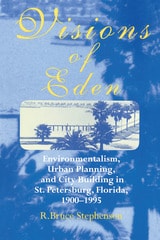
VISIONS OF EDEN
Environmentalism, Urban Planning, and City Building in St. Petersburg, Florida, 1900–1995R. Bruce Stephenson
The Ohio State University Press, 1997
"Stephenson's story of the rise, fall, and resurrections of a good idea takes the reader on a whirlwind tour through planning, political, and public works history. It also contains several messages we should all bear in mind. One is that any city planning should be truly comprehensive and environmentally responsible, considering both what we have built and what we have inherited, and balancing what we want with what we need. Another is that planners and zoning officers must share the same goals. The third is a timely and painful reminder to those of us who frequently lose patience with the way things work, and that is that no one really cares about the future when the present is glittering so brightly." --Environmental History
"This study is the first book-length treatment of St. Petersburg's development and is a major contribution to American urban and urban-planning history." --Choice
Florida enjoys the only subtropical climate in the continental United States. Its burgeoning population and robust tourist economy attest to the state's special allure. Innovative new towns like Miami Lakes and Seaside, along with established communities such as Winter Park and Coral Gables, exemplify Florida's beauty and potential.
St. Petersburg, the largest city in Florida's most urbanized county, epitomizes the best and the worst of the state's city planning history. Enterprise and technology transformed this once struggling backwater into an air-conditioned vision of Eden, but a heavy debt was accumulated in the process. Paradise is under siege: wetlands have been drained, mangroves cleared, sand dunes leveled, bays degraded and filled; water must be imported from inland wells. Although the city now has an innovative growth management system, it was perilously late in coming. In Visions of Eden, R. Bruce Stephenson examines how St. Petersburg learned to control its development.
Since the turn of the century, the opportunity to design a city nestled in a subtropical garden has attracted the nation's preeminent planners to St. Petersburg. The most ambitious plan was developed in 1923 by John Nolen, who believed that an interconnected system of preserves and parks would enhance the city's development and attract tourists for generations. His initiative failed miserably at the polls, however, because it threatened the conflicting notion of paradise held by hundreds of investors, who were profiting from the greatest real estate boom in the nation's history and feared that planning would curtail speculation. As Stephenson points out, a half century would pass until a series of ecological disasters in the 1970s finally compelled city officials to adopt an environmentally sound development plan that reflected Nolen's original vision.
Stephenson carefully explores St. Petersburg's slow awakening to ecological responsibility--to the importance of designing a community that meets both human needs and economic demands. As the debate over the "New Urbanism" moves forward, this book will serve as a useful guide for those who will plan, build, and inhabit the cities of the twenty-first century.
R. Bruce Stephenson is an associate professor and chair of the environmental studies department at Rollins College in Winter Park, Florida.
[more]