Results by title
2 books match the query 'Salah, Trish'
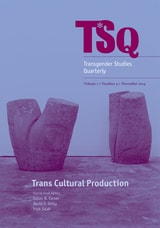
Trans*Cultural Production
Julian B. Carter, David J. Getsy, and Trish Salah, special issue editors
Duke University Press, 0
The editors of this issue have selected essays that document the wide range of contemporary trans cultural production, including work not only on literature but also on photography, film, architecture, dance, theater, performance art, new media, and curation. These essays offer the field of transgender studies a useful point of departure for the ongoing and potentially vast undertaking of trans cultural criticism and the interpretation of trans cultural production.
[more]
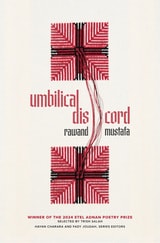
Umbilical Discord
Rawand Mustafa
University of Arkansas Press, 2024
Winner, 2024 Etel Adnan Poetry Prize
At its core, Rawand Mustafa’s Umbilical Discord is an impossible attempt. Ambitious in scope, it strives to trace the billion-branched reach of the Palestinian context within a fixed yet flowing form—columnar, helical, intertwining, tense, intense. Incorporating testimonies by elder Palestinian women who survived the Nakba, or Palestinian Catastrophe of 1948, Mustafa re-presents the ongoing shockwaves from this historical upheaval by interlacing witnesses’ stories with related recollections from her own family history. The overlapping accounts from Palestinian women that Mustafa has painstakingly translated or gathered from family members recall moments of supreme perseverance in the face of unimaginable violence, separation, and loss, while weaving together past and present, collective and individual, Arabic and English, memory and imagination, homeland and host country. As Trish Salah observes in the foreword for Umbilical Discord, “these are poems of yearning and of being, both in spite of and fractured by an impossible history. [. . .] Mustafa offers resistant traces of the geographies and names dis/re-membered in [. . .] efforts to erase the material architecture and cultural memory of Arab life in Palestine. What must be traversed in order to come to tell a history? As Mustafa writes in ‘dis cord,’ her opening poem, [. . .] ‘I attempt / my story / on a lost / foundation.’ ”
At its core, Rawand Mustafa’s Umbilical Discord is an impossible attempt. Ambitious in scope, it strives to trace the billion-branched reach of the Palestinian context within a fixed yet flowing form—columnar, helical, intertwining, tense, intense. Incorporating testimonies by elder Palestinian women who survived the Nakba, or Palestinian Catastrophe of 1948, Mustafa re-presents the ongoing shockwaves from this historical upheaval by interlacing witnesses’ stories with related recollections from her own family history. The overlapping accounts from Palestinian women that Mustafa has painstakingly translated or gathered from family members recall moments of supreme perseverance in the face of unimaginable violence, separation, and loss, while weaving together past and present, collective and individual, Arabic and English, memory and imagination, homeland and host country. As Trish Salah observes in the foreword for Umbilical Discord, “these are poems of yearning and of being, both in spite of and fractured by an impossible history. [. . .] Mustafa offers resistant traces of the geographies and names dis/re-membered in [. . .] efforts to erase the material architecture and cultural memory of Arab life in Palestine. What must be traversed in order to come to tell a history? As Mustafa writes in ‘dis cord,’ her opening poem, [. . .] ‘I attempt / my story / on a lost / foundation.’ ”
[more]