Results by title
8 books match the query 'Salaries, etc'
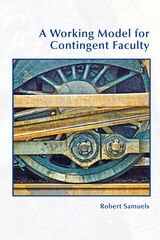
A Working Model for Contingent Faculty
Robert Samuels
University Press of Colorado, 2023
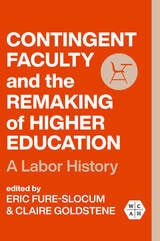
Contingent Faculty and the Remaking of Higher Education
A Labor HistoryEdited by Eric Fure-Slocum and Claire Goldstene
University of Illinois Press, 2024
In the United States today, almost three-quarters of the people teaching in two- and four-year colleges and universities work as contingent faculty. They share the hardships endemic in the gig economy: lack of job security and health care, professional disrespect, and poverty wages that require them to juggle multiple jobs.
This collection draws on a wide range of perspectives to examine the realities of the contingent faculty system through the lens of labor history. Essayists investigate structural changes that have caused the use of contingent faculty to skyrocket and illuminate how precarity shapes day-to-day experiences in the academic workplace. Other essays delve into the ways contingent faculty engage in collective action and other means to resist austerity measures, improve their working conditions, and instigate reforms in higher education. By challenging contingency, this volume issues a clear call to reclaim higher education’s public purpose.
Interdisciplinary in approach and multifaceted in perspective, Contingent Faculty and the Remaking of Higher Education surveys the adjunct system and its costs.
Contributors: Gwendolyn Alker, Diane Angell, Joe Berry, Sue Doe, Eric Fure-Slocum, Claire Goldstene, Trevor Griffey, Erin Hatton, William A. Herbert, Elizabeth Hohl, Miguel Juárez, Aimee Loiselle, Maria C. Maisto, Anne McLeer, Steven Parfitt, Jiyoon Park, Claire Raymond, Gary Rhoades, Jeff Schuhrke, Elizabeth Tandy Shermer, Steven Shulman, Joseph van der Naald, Anne Wiegard, Naomi R Williams, and Helena Worthen
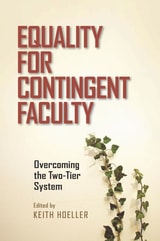
Equality for Contingent Faculty
Overcoming the Two-Tier SystemKeith Hoeller
Vanderbilt University Press, 2014
Equality for Contingent Faculty brings together eleven activists from the United States and Canada to describe the problem, share case histories, and offer concrete solutions. The book begins with three accounts of successful organizing efforts within the two-track system. The second part describes how the two-track system divides the faculty into haves and have-nots and leaves the majority without the benefit of academic freedom or the support of their institutions. The third part offers roadmaps for overcoming the deficiencies of the two-track system and providing equality for all professors, regardless of status or rank.
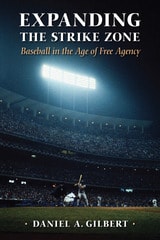
Expanding the Strike Zone
Baseball in the Age of Free AgencyDaniel A. Gilbert
University of Massachusetts Press, 2013
Readers encounter both legendary and unheralded figures in this sweeping history, which situates Major League Baseball as part of a larger culture industry. The book examines a labor history defined at once by the growing power of big league stars—from Juan Marichal and Curt Flood to Fernando Valenzuela and Ichiro Suzuki—and the collective struggles of players working to make a living throughout the baseball world. It also explores the territorial politics that have defined baseball's development as a form of transnational popular culture, from the impact of Dominican baseball academies to the organized campaign against stadium development by members of Seattle's Asian American community.
Based on a rich body of research along with new readings of popular journalism, fiction, and film, Expanding the Strike Zone highlights the ways in which baseball's players, owners, writers, and fans have shaped and reshaped the sport as a central element of popular culture from the postwar boom to the Great Recession.
Public Sector Payrolls
Edited by David A. Wise
University of Chicago Press, 1987
The volume, developed from a 1984 National Bureau of Economic Research conference, focuses on various labor issues in military and other governmental employment. Several contributors discuss compensation in the armed forces and its relationship to that in the private sector, as well as the interaction between the military and the private sector in the employment of youth. This latter is of particular interest because studies of youth employment have generally ignored the important influence of military hiring practices on labor market conditions. In other contributions, the response of wages and employment in the public sector to economic conditions is analyzed, and a detailed study of government pension plans is presented. Also included is a theoretical and empirical analysis of comparable worth in the public sector from the viewpoint of analytical labor economics. The volume concludes with a look at public school teachers' salaries in the context of current debates over improving the quality of American education.
A valuable resource to policymakers, Public Sector Payrolls will be an important addition to research in the field of labor economics.
Strike for the Common Good
Fighting for the Future of Public EducationRebecca Kolins Givan and Amy Schrager Lang, Editors
University of Michigan Press, 2020
In February 2018, 35,000 public school educators and staff walked off the job in West Virginia. More than 100,000 teachers in other states—both right-to-work states, like West Virginia, and those with a unionized workforce—followed them over the next year. From Arizona, Kentucky, and Oklahoma to Colorado and California, teachers announced to state legislators that not only their abysmal wages but the deplorable conditions of their work and the increasingly straitened circumstances of public education were unacceptable. These recent teacher walkouts affirm public education as a crucial public benefit and understand the rampant disinvestment in public education not simply as a local issue affecting teacher paychecks but also as a danger to communities and to democracy.
Strike for the Common Good gathers together original essays, written by teachers involved in strikes nationwide, by students and parents who have supported them, by journalists who have covered these strikes in depth, and by outside analysts (academic and otherwise). Together, the essays consider the place of these strikes in the broader landscape of recent labor organizing and battles over public education, and attend to the largely female workforce and, often, largely non-white student population of America’s schools.
The Money Pitch
Baseball Free Agency and Salary ArbitrationRoger I. Abrams
Temple University Press, 2000
Why are baseball players paid so much money? In this insightful book, legal scholar and salary arbitrator Roger Abrams tells the story of how a few thousand very talented young men obtain their extraordinary riches. Juggling personal experience and business economics, game theory and baseball history, he explains how agents negotiate compensation, how salary arbitration works, and how the free agency "auction" operates. In addition, he looks at the context in which these systems operate: the players' collective bargaining agreement, the distribution of quality players among the clubs, even the costs of other forms of entertainment with which baseball competes.
Throughout, Dean Abrams illustrates his explanations with stories and quotations -- even an occasional statistic, though following the dictum of star pitcher, club owner, and sporting goods tycoon Albert Spalding, he has kept the book as free of these as possible. He explains supply and demand by the cost of a bar of soap for Christy Mathewson's shower. He illustrates salary negotiation with an imaginary case based on Roy Hobbs, star of The National. He leads the reader through the breath-taking successes of agent Scott Boras to explain the intricacies of free agent negotiating.
Although studies have shown that increases in admissions prices precede rather than follow the rise in player salaries, fans are understandably bemused by skyrocketing salaries. Dean Abrams does not shy away from the question of whether it is "fair" for an athlete to earn more than $10,000,000 a year. He looks at issues of player (and team) loyalty and player attitudes, both today and historically, and at what increased salaries have meant for the national pastime, financially and in the eyes of its fans. The Money Pitch concludes that "the money pitch is a story of good fortune, good timing, and great leadership, all resulting from playing a child's game -- a story that is uniquely American."
Wage Justice
Comparable Worth and the Paradox of Technocratic ReformSara M. Evans and Barbara N. Nelson
University of Chicago Press, 1991
"A perceptive and judicious analysis of comparable worth."—Wendy Kaminer, New York Times Book Review
"Very well-crafted. . . . Wage Justice has admirably launched the scholarly evaluation of pay equity, revealing the unforeseen complexities of this key feminist public policy innovation."—Maurine Weiner Greenwald, Journal of American History
"An insightful glimpse of the policy process."—Marian Lief Palley, American Political Science Review