Results by title

6 books match the query 'Saldívar, José David'
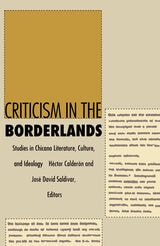
cover of Criticism in the Borderlands: Studies in Chicano Literature, Culture, and Ideology

Criticism in the Borderlands

Studies in Chicano Literature, Culture, and Ideology

Héctor Calderón and José David Saldívar, eds.

Duke University Press, 1991

This pathbreaking anthology of Chicano literary criticism, with essays on a remarkable range of texts—both old and new—draws on diverse perspectives in contemporary literary and cultural studies: from ethnographic to postmodernist, from Marxist to feminist, from cultural materialist to new historicist.
The editors have organized essays around four board themes: the situation of Chicano literary studies within American literary history and debates about the “canon”; representations of the Chicana/o subject; genre, ideology, and history; and the aesthetics of Chicano literature. The volume as a whole aims at generating new ways of understanding what counts as culture and “theory” and who counts as a theorist. A selected and annotated bibliography of contemporary Chicano literary criticism is also included.

By recovering neglected authors and texts and introducing readers to an emergent Chicano canon, by introducing new perspectives on American literary history, ethnicity, gender, culture, and the literary process itself, Criticism in the Borderlands is an agenda-setting collection that moves beyond previous scholarship to open up the field of Chicano literary studies and to define anew what is American literature.

Contributors. Norma Alarcón, Héctor Calderón, Angie Chabram, Barbara Harlow, Rolando Hinojosa, Luis Leal, José E. Limón, Terese McKenna, Elizabeth J. Ordóñez, Genero Padilla, Alvina E. Quintana, Renato Rosaldo, José David Saldívar, Sonia Saldívar-Hull, Rosaura Sánchez, Roberto Trujillo
[more]
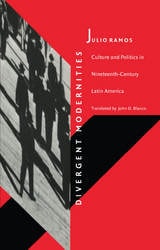
cover of Divergent Modernities: Culture and Politics in Nineteenth-Century Latin America

Divergent Modernities

Culture and Politics in Nineteenth-Century Latin America

Julio Ramos

Duke University Press, 2001

Since its first publication in Spanish nearly a decade ago, Julio Ramos’s Desenucuentros de la modernidad en America Latina por el siglo XIX has been recognized as one of the most important studies of modernity in the western hemisphere. Available for the first time in English—and now published with new material—Ramos’s study not only offers an analysis of the complex relationships between history, literature, and nation-building in the modern Latin American context but also takes crucial steps toward the development of a truly comparative inter-American cultural criticism.

With his focus on the nineteenth century, Ramos begins his genealogy of an emerging Latin Americanism with an examination of Argentinean Domingo Sarmiento and Chilean Andrés Bello, representing the “enlightened letrados” of tradition. In contrast to these “lettered men,” he turns to Cuban journalist, revolutionary, and poet José Martí, who, Ramos suggests, inaugurated a new kind of intellectual subject for the Americas. Though tracing Latin American modernity in general, it is the analysis of Martí—particularly his work in the United States—that becomes the focal point of Ramos’s study. Martí’s confrontation with the unequal modernization of the New World, the dependent status of Latin America, and the contrast between Latin America’s culture of elites and the northern mass culture of commodification are, for Ramos, key elements in understanding the complex Latin American experience of modernity.

Including two new chapters written for this edition, as well as translations of three of Martí’s most important works, Divergent Modernities will be indispensable for anyone seeking to understand development and modernity across the Americas.

[more]
cover of Junot Díaz and the Decolonial Imagination

Junot Díaz and the Decolonial Imagination

Monica Hanna, Jennifer Harford Vargas, José David Saldívar, editors

Duke University Press, 2016

The first sustained critical examination of the work of Dominican-American writer Junot Díaz, this interdisciplinary collection considers how Díaz's writing illuminates the world of Latino cultural expression and trans-American and diasporic literary history. Interested in conceptualizing Díaz's decolonial imagination and his radically re-envisioned world, the contributors show how his aesthetic and activist practice reflect a significant shift in American letters toward a hemispheric and planetary culture. They examine the intersections of race, Afro-Latinidad, gender, sexuality, disability, poverty, and power in Díaz's work. Essays in the volume explore issues of narration, language, and humor in The Brief Wondrous Life of Oscar Wao, the racialized constructions of gender and sexuality in Drown and This Is How You Lose Her, and the role of the zombie in the short story "Monstro." Collectively, they situate Díaz’s writing in relation to American and Latin American literary practices and reveal the author’s activist investments. The volume concludes with Paula Moya's interview with Díaz.

Contributors: Glenda R. Carpio, Arlene Dávila, Lyn Di Iorio, Junot Díaz, Monica Hanna, Jennifer Harford Vargas, Ylce Irizarry, Claudia Milian, Julie Avril Minich, Paula M. L. Moya, Sarah Quesada, José David Saldívar, Ramón Saldívar, Silvio Torres-Saillant, Deborah R. Vargas
[more]
cover of Junot Díaz: On the Half-Life of Love

Junot Díaz

On the Half-Life of Love

José David Saldívar

Duke University Press, 2022
In Junot Díaz: On the Half-Life of Love, José David Saldívar offers a critical examination of one of the leading American writers of his generation. He explores Díaz’s imaginative work and the diasporic and immigrant world he inhabits, showing how his influences converged in his fiction and how his writing—especially his Pulitzer Prize--winning novel The Brief Wondrous Life of Oscar Wao—radically changed the course of US Latinx literature and created a new way of viewing the decolonial world. Saldívar examines several aspects of Díaz’s career, from his vexed relationship to the literary aesthetics of Whiteness that dominated his MFA experience and his critiques of the colonialities of power, race, and gender in culture and societies of the Dominican Republic, United States, and the Américas to his use of the science-fiction imaginary to explore the capitalist zombification of our planet. Throughout, Saldívar shows how Díaz’s works exemplify the literary currents of the early twenty-first century.
[more]
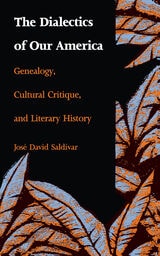
cover of The Dialectics of Our America: Genealogy, Cultural Critique, and Literary History

The Dialectics of Our America

Genealogy, Cultural Critique, and Literary History

José David Saldívar

Duke University Press, 1991

Joining the current debates in American literary history, José David Saldívar offers a challenging new perspective on what constitutes not only the canon in American literature, but also the notion of America itself. His aim is the articulation of a fresh, transgeographical conception of American culture, one more responsive to the geographical ties and political crosscurrents of the hemisphere than to narrow national ideologies.

Saldívar pursues this goal through an array of oppositional critical and creative practices. He analyzes a range of North American writers of color (Rolando Hinojosa, Gloria Anzaldúa, Arturo Islas, Ntozake Shange, and others) and Latin American authors (José Martí, Roberto Fernández Retamar, Gabriel García Márquez, and others), whose work forms a radical critique of the dominant culture, its politics, and its restrictive modes of expression. By doing so, Saldívar opens the traditional American canon to a dialog with other voices, not just the voices of national minorities, but those of regional cultures different from the prevalent anglocentric model.
The Dialectics of Our America, in its project to expand the “canon” and define a pan-American literary tradition, will make a critical difference in ongoing attempts to reconceptualize American literary history.
[more]
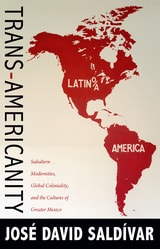
cover of Trans-Americanity: Subaltern Modernities, Global Coloniality, and the Cultures of Greater Mexico

Trans-Americanity

Subaltern Modernities, Global Coloniality, and the Cultures of Greater Mexico

José David Saldívar

Duke University Press, 2012

A founder of U.S.-Mexico border studies, José David Saldívar is a leading figure in efforts to expand the scope of American studies. In Trans-Americanity, he advances that critical project by arguing for a transnational, antinational, and "outernational" paradigm for American studies. Saldívar urges Americanists to adopt a world-system scale of analysis. "Americanity as a Concept," an essay by the Peruvian sociologist Aníbal Quijano and Immanuel Wallerstein, the architect of world-systems analysis, serves as a theoretical touchstone for Trans-Americanity. In conversation not only with Quijano and Wallerstein, but also with the theorists Gloria Anzaldúa, John Beverley, Ranajit Guha, Walter D. Mignolo, and Gayatri Chakravorty Spivak, Saldívar explores questions of the subaltern and the coloniality of power, emphasizing their location within postcolonial studies. Analyzing the work of José Martí, Sandra Cisneros, Toni Morrison, Arundhati Roy, and many other writers, he addresses concerns such as the "unspeakable" in subalternized African American, U.S. Latino and Latina, Cuban, and South Asian literature; the rhetorical form of postcolonial narratives; and constructions of subalternized identities. In Trans-Americanity, Saldívar demonstrates and makes the case for Americanist critique based on a globalized study of the Américas.
[more]