Results by title

2 books match the query 'Saldaña-Portillo, María Josefina'
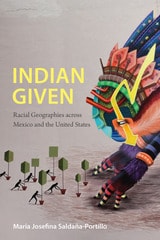
cover of Indian Given: Racial Geographies across Mexico and the United States

Indian Given

Racial Geographies across Mexico and the United States

María Josefina Saldaña-Portillo

Duke University Press, 2016

In Indian Given María Josefina Saldaña-Portillo addresses current racialized violence and resistance in Mexico and the United States with a genealogy that reaches back to the sixteenth century. Saldaña-Portillo formulates the central place of indigenous peoples in the construction of national spaces and racialized notions of citizenship, showing, for instance, how Chicanos/as in the U.S./Mexico borderlands might affirm or reject their indigenous background based on their location.  In this and other ways, she demonstrates how the legacies of colonial Spain's and Britain's differing approaches to encountering indigenous peoples continue to shape perceptions of the natural, racial, and cultural landscapes of the United States and Mexico. Drawing on a mix of archival, historical, literary, and legal texts, Saldaña-Portillo shows how los indios/Indians provided the condition of possibility for the emergence of Mexico and the United States.
 
[more]
cover of The Revolutionary Imagination in the Americas and the Age of Development

The Revolutionary Imagination in the Americas and the Age of Development

María Josefina Saldaña-Portillo

Duke University Press, 2003

In The Revolutionary Imagination in the Americas and the Age of Development, María Josefina Saldaña-Portillo boldly argues that crucial twentieth-century revolutionary challenges to colonialism and capitalism in the Americas have failed to resist—and in fact have been constitutively related to—the very developmentalist narratives that have justified and naturalized postwar capitalism. Saldaña-Portillo brings the critique of development discourse to bear on such exemplars of revolutionary and resistant political thought and practice as Ernesto “Che” Guevara, Malcolm X, the Sandinista government of Nicaragua, and the Guatemalan guerrilla resistance. She suggests that for each of these, developmentalist constructions frame the struggle as a heroic movement from unconsciousness to consciousness, from a childlike backwardness toward a disciplined and self-aware maturity.

Reading governmental reports, memos, and policies, Saldaña-Portillo traces the arc of development narratives from its beginnings in the 1944 Bretton Woods conference through its apex during Robert S. McNamara's reign at the World Bank (1968–1981). She compares these narratives with models of subjectivity and agency embedded in the autobiographical texts of three revolutionary icons of the 1960s and 1970s—those of Che Guevara, Guatemalan insurgent Mario Payeras, and Malcolm X—and the agricultural policy of the Sandinista National Liberation Front (FSLN). Saldaña-Portillo highlights a shared paradigm of a masculinist transformation of the individual requiring the "transcendence" of ethnic particularity for the good of the nation. While she argues that this model of progress often alienated the very communities targeted by the revolutionaries, she shows how contemporary insurgents such as Rigoberta Menchú, the Zapatista movement, and queer Aztlán have taken up the radicalism of their predecessors to retheorize revolutionary subjectivity for the twenty-first century.

[more]